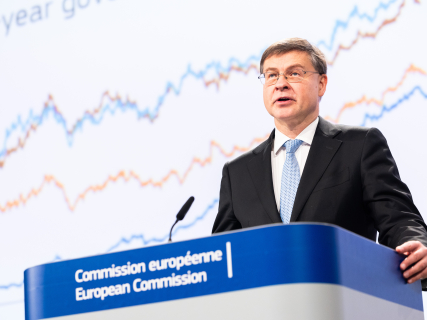

Despite the good performance of the Spanish economy, which Brussels has again confirmed by revising upward its forecasts for 2026, the European Commission has identified a top-tier risk to maintaining this trajectory. For the first time, the Community institutions explicitly warn of the direct impact that the housing crisis may have on the country’s economic growth. "Housing is Spain’s main economic risk", a European Commission official acknowledges openly.
The analysts of the Community executive warn that the lack of affordable housing can act as a "ceiling or limit" for the expansion of Spain’s GDP. The growth recorded by Spain in recent years has been supported especially by job creation and the hiring of new workers, more than by significant advances in productivity. In this context, the inability to find accommodation at prices that are affordable in the main centers of economic activity may end up blocking internal labor mobility and making it harder to attract labor, both national and foreign. "In a fast-growing economy like Spain, this is a real problem more than in any other country because it could really put a cap on economic growth," Community sources explain from the Berlaymont building, the headquarters of the European Commission.
Brussels’ diagnosis goes further than difficulties accessing housing for households. The institution warns that the increase in residential costs can also be passed on to the overall economy through wages and prices. The inaccessibility of housing raises the cost of living perceived by families and creates pressure to negotiate increases in nominal wages. When these increases occur in an environment of stagnant productivity, they end up raising unit labor costs and can affect companies’ competitiveness.
This mechanism takes on special relevance in a context in which services inflation continues to show high persistence. Residential costs can thus fuel second-round effects on final prices, making it difficult to converge inflation and adding new pressures to the evolution of business costs.
A structural supply deficit that limits growth
The central problem identified by the Community Executive lies in the structural inability of supply to respond to the volume of existing demand. A situation that, according to the sources consulted, is exacerbated by financial conditions and the increase in the costs of production. The reports submitted this Tuesday confirm that high interest rates and the tightening of access conditions to bank credit continue to weigh down residential construction in the eurozone. Although the housing deficit responds to structural factors, financing difficulties have added obstacles to the rollout of new real estate projects.
"Obviously there is a supply problem; there is a deficit in the supply of housing in relation to demand, but also in relation to household formation, the growing number of households in Spain, and the number of available housing units," explain the Community technical sources. The data handled by Brussels reflects the deterioration of construction activity across Europe. Housing deliveries have gone from four properties per thousand inhabitants four years ago to 3.1 in 2025, while building permits remain 16% below their previous levels. In Spain, moreover, the pace of creation of new households often exceeds the number of homes that are added to the market.

To financial difficulties is added the increased cost of construction materials, energy, and the shortage of skilled labor. These factors squeeze developers’ margins, raise the cost of projects, and slow down the execution of new developments. The result is limited capacity to respond to a demand that continues to grow. This is added to the reduced size of the public stock of social housing. In Spain, this segment represents around 2.5% of the total, a proportion that limits the ability of administrations to offer affordable housing alternatives to households with the greatest difficulties in accessing them.
The combination of an insufficient supply and growing demand causes the upturns in the latter to be transferred mainly to prices, rather than translating into an equivalent increase in the housing stock. In this way, the tensions in the residential market end up becoming an obstacle to economic activity and the capacity to absorb new workers.
The housing wealth effect loses capacity to boost consumption
The European Commission also detects a change in the traditional relationship between the price of housing and household consumption. Historically, the rise in the cost of property generated a positive wealth effect for its owners, who, perceiving an increase in the value of their assets, tended to increase their spending. However, recent studies by the Community executive point to the fact that the marginal propensity to consume derived from real estate wealth has fallen to levels close to zero. This means that increases in property prices no longer generate the same boost to consumption as in earlier stages.
The trend introduces an additional element of concern for Spain. Housing costs not only make it harder for those who are still not homeowners to access housing, but they also do not necessarily translate into a significant stimulus for the consumption of those who already have a property. The result is an uneven distribution of the effects of the revaluation of real estate, with an especially intense impact on young households and those who must enter the market.

Fotocasa warns of a crisis of accessibility and emancipation
The Community diagnosis aligns with the real estate sector’s warnings about the deterioration of housing access conditions in Spain. Purchase and rental prices are at historic highs, while the distance between household incomes and the cost of living continues to widen. "The consequences are already fully affecting our country's social model. The average age of emancipation exceeds 30 years, the second highest in Europe, fertility continues to be delayed, and more and more young people remain in their parents' home," says the director of Studies at Fotocasa, María Matos.
Just like the European Commission, the real estate portal places much of the origin of the problem in the shortfall of supply. Its data suggest that Spain builds around 100,000 homes per year, while the creation of new households exceeds 240,000. In terms of responsiveness, only about 40% of the housing needed to absorb the new demand is being built. To this gap, according to Matos, is added that Spain has one of the smallest social housing stocks in Europe, which limits alternatives for groups with the greatest economic difficulties.
For Fotocasa, the country should raise its construction pace to approximately 250,000 homes per year to align the entry of new households into the market. The difference with other European States also reflects the deficit in construction activity: while some countries build around four homes per thousand inhabitants, Spain builds approximately two. Among the priorities to reverse this situation, the sector points to the need to increase the availability of land, speed up administrative procedures, and improve the taxation of residential development. It also calls for strengthening public-private collaboration and promoting both the construction of affordable housing and the renovation of the existing housing stock.
Brussels’ assessment thus adds housing to the list of factors that can condition the continued growth of Spain. Beyond its social dimension, the lack of residential supply is beginning to be considered a macroeconomic risk: it can limit workers’ mobility, make it harder for companies to hire, fuel wage pressures, and shift new costs across the entire economy. Spain’s ability to sustain its expansion will also depend on whether it manages to resolve a housing deficit that threatens to become a structural limit on its growth.