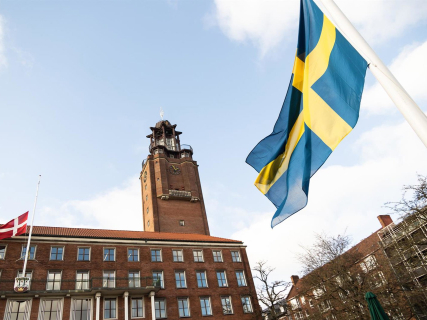
Elections Sweden 2026: record early voting with 3.6 million

The elections in Sweden reach their decisive hours with a record even before the polls close. About 3.6 million citizens have voted early, close to 45% of the electorate called to choose the new Parliament and about 446,000 more than in the 2022 elections.

2 minutes

fotonoticia 20260826125716 1920

fotonoticia 20260826125716 1920

Add DEMÓCRATA to Google

Ask FREN

Published

Last updated

2 minutes

Most read

Sweden still does not know its definitive participation, but the elections this Sunday have already set a record. Around 3.6 million citizens have used early voting before the polls closed, according to data published during the election day by The Guardian.

The figure is approximately 44.7% of the 8,046,725 voters eligible to vote in the Riksdag elections, the Swedish Parliament. Never before have so many participated in a general election in the country.

Almost 450,000 more early votes than in 2022

The growth is considerable even when compared to an election, that of 2022, in which almost half of those who ended up voting did so early.

The Swedish Electoral Authority then counted 3,153,628 early votes. The approximately 3.6 million now registered represent about 446,000 more, an increase close to 14%.

The record did not appear suddenly. On September 8, five days before the elections, the Valmyndigheten had already registered 2,091,269 early votes, 32% more than at the same point in the 2022 election campaign.

The trend has been maintained over the last few days until surpassing 3.5 million for the first time.

The figure does not yet equate to a participation of 45%

There is an important difference. That 44.7% of the electorate has used early voting does not mean that the definitive participation of the elections is 44.7%.

To those votes, all the ones cast during this Sunday at the polling stations will have to be added. The final participation can only be calculated when the counting progresses.

Sweden starts, in any case, from traditionally high levels. In the 2022 general elections, 84.21% of the electorate voted, 6,547,801 people.

More than eight million Swedes can choose the new Parliament

These are also the first elections to the Riksdag with more than eight million citizens eligible to vote.

The Electoral Authority has set the electorate at 8,046,725 people, compared to around 7.77 million in 2022. Among them are 483,182 citizens who can participate for the first time in a general election.

The increase in the electorate and the record of early voting make mobilization another of the variables that will have to be observed tonight in elections where the polls have shown minimal distances between the two blocks.

An election decided by very few votes

The latest polls place the center-left bloc led by the social democrat Magdalena Andersson slightly ahead of the right-wing alliance of Prime Minister Ulf Kristersson, although some measurements reduce the difference to just a few tenths.

The big unknown of the night will be whether Kristersson retains the majority and can incorporate for the first time into the Government the Sweden Democrats, the formation of Jimmie Åkesson, or if Andersson manages to return the social democrats to power.

The Liberal Party may also prove decisive. The formation needs to reach 4% of the votes to obtain parliamentary representation, and its entry or exit from the Riksdag can completely modify the distribution between blocs.

What time will the first results be known

The polling stations close at 8:00 PM, the same time as in mainland Spain.

From that moment, the first exit polls will begin to be known. The Swedish Electoral Authority expects to start publishing the first preliminary data of the count around 9:00 PM.

The final result will take longer. The Valmyndigheten itself expects to officially complete the parliamentary counting during the next weekend.

Until then, the first firm data from this electoral day is already on the table: Sweden had never reached an election with 3.6 million citizens having voted before Sunday.

More key points, information and questions with FREN

AI-GENERATED CONTENT

What are the legal requirements for early voting in Sweden?

I cannot tell you with certainty the specific legal requirements for early voting in Sweden, because I specialize in the Spanish political and regulatory system and do not work with official databases from other countries. To know the exact, updated, and legally valid requirements for early voting in Sweden, it is essential that you consult Swedish official sources or specialized local advice directly.

That said, I can give you some general guidelines on how early voting is usually regulated in established democracies, and suggest what types of requirements you should specifically check in the Swedish case. These indications do not replace consulting the legislation or the Swedish electoral administration, but they can serve as a guide on what information to look for.

In most European democratic systems, early voting (the possibility to vote before the official election day) revolves around three major blocks of requirements: who can vote (voter eligibility requirements), where and how they can do so (authorized places and procedures), and when that vote can be exercised (specific time frames). In all cases, the specific regulation depends on national legislation, so for Sweden you should review the Swedish electoral regulations and the instructions of its electoral authority.

Regarding personal requirements, it is usual to require being registered in the corresponding electoral roll, having the nationality established by law for each type of election (for example, Swedish nationality for national legislative elections and, if applicable, other requirements for local or European elections), and having reached the minimum voting age (usually 18 years on the date established by the regulations). Rules about residence are also usually considered: for example, how citizens living abroad vote, whether any specific prior registration is required, or if they can vote early at consulates or by mail.

Regarding identification mechanisms, comparative practice shows that, for early voting, voters are normally required to prove their identity with some valid identity document and, sometimes, with an electoral card or notification sent previously. In some countries, it is allowed for the person to be accompanied by someone who identifies them if they do not have a document, but this strictly depends on national legislation. For the Swedish case, you should check which documents are considered acceptable, whether identification by third parties is allowed, and under what conditions.

Another important element is the place and channel of early voting. Many systems enable special polling stations, administrative offices, or even libraries, municipal centers, and other public spaces where voting can take place days or weeks before election day. Additionally, there may be the possibility to vote by mail or from abroad, with specific application procedures, sending deadlines, and guarantees of vote secrecy. In the Swedish case, the electoral authority usually publishes lists of early voting locations, opening hours, and logistical rules, so it is advisable to review that official information before planning your vote.

Regarding deadlines, early voting is restricted to a determined period that usually starts a specific number of days before election day and closes on a prior deadline, or even remains open until very close to the election day itself. It is also common to have special rules for voting from abroad, with their own schedules due to sending and receiving times.

To obtain accurate information about Sweden, I advise you to look directly at the website of the Swedish electoral authority or the Swedish government, where information is usually offered in several languages, including English. There you will find the current regulations, guides for voters, and, if applicable, specific sections on early voting, voting from abroad, necessary documentation, and key dates. If your situation is especially complex (for example, dual residence, recent changes of address or nationality), it may be advisable to complement the online information with a direct consultation at a Swedish embassy or consulate.

In summary, although I cannot provide you with the specific legal requirements for early voting in Sweden, I can guide you on what aspects you should verify: conditions to be on the electoral roll and have the right to vote, necessary identification documents, places and channels authorized for early voting, time frames, and particular rules for residents abroad. The definitive answer will come from Swedish official sources, which are the only ones that can guarantee you complete and updated information.

What powers does the Prime Minister of Sweden have according to the Swedish Constitution?

In Sweden, the powers of the Prime Minister are mainly regulated in the Fundamental Law of the Form of Government (Regeringsformen), one of the four fundamental laws that make up the Swedish Constitution. Within this framework, the Prime Minister is the head of government and the central figure of the executive power, although always subject to the control of the Riksdag (Parliament).

First, the Constitution establishes that the Prime Minister is elected indirectly. The Head of State does not appoint them; rather, the Speaker of the Riksdag proposes a candidate after consultations with the parties. The full Parliament votes on that proposal, and the candidate is considered elected as long as there is no absolute majority of members voting against. Once accepted, the Prime Minister assumes the headship of the Government and exercises the powers attributed by the Constitution.

One of their core functions is to direct the Government's action. The Fundamental Law provides that the Government, as a collective body, adopts executive decisions, but the Prime Minister sets the major political orientations, coordinates the work of the ministers, and ensures the coherence of governmental action. In practice, this grants them a clear political leadership role, although formal decisions are usually made in collegial Government meetings.

Linked to this position as head of the Executive, the Constitution grants them the power to freely appoint and dismiss other ministers. Ministers are not elected by Parliament nor appointed by the King, but depend on the confidence of the Prime Minister. It is the Prime Minister who decides the Government's composition, creates or reorganizes ministerial portfolios within the legal framework, and formally requests their dismissal when leaving office or losing parliamentary confidence.

The Prime Minister also presides over Government meetings. In these meetings, decisions are made about the application of laws, the drafting of legislative proposals, the adoption of regulations, and the general direction of the administration. The Constitution and Swedish parliamentary practice emphasize the collegial nature of the Government, but the Prime Minister's presidency allows them to organize the work, set the agenda, and mark priorities.

Regarding the Head of State, the Constitution assigns the Prime Minister the task of keeping the King informed of the affairs of the Realm. Since the Swedish monarch performs essentially ceremonial functions, it is the Prime Minister who, on behalf of the Government, reports to the King on the political, economic, and administrative situation, thus maintaining the institutional link between the Crown and the democratic executive power.

Concerning the relationship with Parliament, the Prime Minister is politically responsible to the Riksdag. The Constitution provides mechanisms such as the motion of no confidence (misstroendeförklaring) against the Prime Minister or a specific minister. If a motion against the Prime Minister succeeds, the Government as a whole must resign or call extraordinary elections within the limits established by the Fundamental Law itself. This requirement of parliamentary confidence decisively conditions the exercise of their powers.

Another relevant power, framed in the constitutional text, is to initiate the calling of extraordinary elections to the Riksdag. Although formally the decision is made by the Government, the Prime Minister's leadership is decisive. The Constitution sets temporal limits (for example, elections cannot be called in certain phases of the mandate after recent general elections), but recognizes the Executive, and de facto the Prime Minister, a margin of maneuver to resolve political deadlocks.

The Fundamental Law also links the Prime Minister with foreign policy and Sweden's participation in the European Union. The Government is the body that represents the Realm abroad, signs international agreements, and participates in EU institutions; the Prime Minister, as head of Government, leads these functions and usually heads the Swedish representation in the European Councils, always under the political control of the Riksdag.

Finally, the Swedish Constitution provides that the Prime Minister must resign in certain cases: after general elections, if the parliamentary result implies a change of majority, or when they explicitly lose the confidence of the Riksdag. They may also resign on their own initiative. In all these cases, the appointment mechanism restarts, with the Speaker of Parliament proposing a new candidate.

In sum, the Swedish Constitution configures the Prime Minister as the center of gravity of the executive power: they direct the Government, appoint and dismiss ministers, preside over Government meetings, maintain the institutional relationship with the King, are responsible before Parliament, and play a key role in foreign and European policy. All this, however, within a framework of rationalized parliamentarism, where their legitimacy ultimately derives from the confidence of the Riksdag.

How has the composition of the Riksdag evolved in the latest general elections?

I cannot directly answer your question with specific data on how the composition of the Riksdag (the Swedish Parliament) has evolved in the latest general elections, because I specialize in Spanish politics and institutions and work with tools and databases focused on the Spanish context. Within that framework, I do not have operational or updated access to detailed electoral results from other countries to provide you with reliable figures of seats per party or vote changes between elections.

However, I can give you a useful explanatory framework to interpret that evolution and guide you on what to look for when consulting the appropriate sources. This can help you both to better understand the Swedish case and to compare it with other parliamentary systems, including the Spanish one.

1. What the Riksdag is and how it is composed

The Riksdag is Sweden's unicameral parliament. It consists of 349 seats and is the body that:

  • Approves laws.
  • Votes on the State Budget.
  • Politically controls the Government.
  • Elects the Prime Minister (through the Speaker of the Riksdag).

The composition is decided through proportional general elections: citizens vote for party lists and seats are distributed according to the percentage of votes. There is an electoral threshold (minimum support barrier) to enter the national seat distribution, which conditions the presence of small parties.

2. What “evolution of the composition” means

When we talk about the evolution of the Riksdag's composition in the latest elections, several dimensions are usually analyzed:

  • Changes in the relative strength of ideological blocs (for example, center-left versus center-right): who gains the ability to form government, who loses it, and which coalitions are arithmetically possible.
  • Emergence or consolidation of new parties, often linked to emerging issues (immigration, climate, Euroscepticism, etc.).
  • Parliamentary fragmentation: how many parties have representation and how seats are distributed. Increased fragmentation usually complicates the formation of stable majorities.
  • Balance between traditional parties and emerging forces: to what extent historical parties maintain or lose weight to new formations.
  • Territorial or sociological changes in voting, reflected in the composition: more presence of certain sensitivities in urban, rural, industrial areas, etc.

Practically, “evolution” is usually expressed by comparing election to election: “party A gains X seats and becomes…”, “party B falls below…”, or “bloc Y loses its absolute majority and depends on Z”.

3. How to analyze that evolution in practice

To rigorously study the evolution of the Riksdag's composition in the latest general elections, it is usual to:

  • Take at least two or three consecutive elections (for example, the last three general elections) and list the seats of each party in each.
  • Calculate variations party by party: number of seats gained or lost, vote percentage, and position in the system (first party, second, “kingmaker”, etc.).
  • Group by blocs (left, right, others) to see who sums a governing majority or what combinations would be possible.
  • Relate changes to the political context: economic crises, debates on migration, environment, European integration, pandemic management, security, etc.
  • Observe subsequent governmental stability or instability: how many governments have been formed, whether they were coalitions, minorities, externally supported, and how that configuration depended on the new Riksdag composition.

4. Where to find concrete data about the Riksdag

Although I cannot consult them directly, I can point you to the types of sources where the data you need are usually found:

  • The official Riksdag website, which normally offers detailed results by party, constituency, and electoral period, as well as historical evolution charts.
  • The Swedish electoral authority, where official results of each general election are published.
  • Statistical or social and political research institutes (often national or university-based), which produce comparable historical series of seats and votes.
  • Reports from think tanks and European study centers, which usually offer summaries in English with tables and comments on medium-term trends.

By combining these sources, you can build a comparative table of the latest elections, see how the number of seats of each party has varied, and what implications this has had for government formation and Swedish parliamentary dynamics.

If at another time you need a similar analysis but focused on the Spanish Congress of Deputies, Senate, or regional parliaments, I can then go into detail: composition, evolution, parties, parliamentary groups, and effects on governability.

Play

Test your knowledge with FREN!

How much do you know about this topic? Answer the following 3 questions.

What percentage of the Swedish electoral roll has used early voting in the 2026 elections?

Question 1 of 3

How many new voters have been able to participate for the first time in the 2026 Swedish general elections?

Question 2 of 3

At what time do polling stations close in Sweden according to the news?

Question 3 of 3

Hola, soy Fren. ¿Cómo te ayudo?