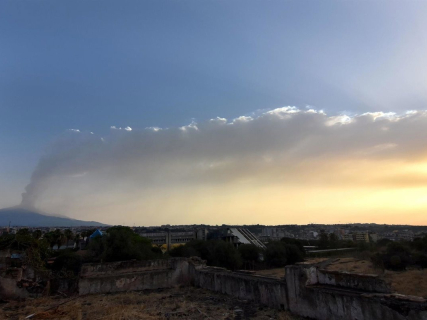
The ash from Etna paralyzes flights in Catania: suspension until 12:00 this Sunday

The restriction affects arrivals and departures. Passengers must confirm their flight with the airline and not interpret noon as a guaranteed reopening.

2 minutes

WhatsApp Image 2026 09 15 at 15.50.38

WhatsApp Image 2026 09 15 at 15.50.38

Add DEMÓCRATA to Google

Ask FREN

Published

Last updated

2 minutes

Most read

The Catania airport faces this Sunday, September 27, with flights suspended due to the ash from Etna and the weather conditions. The latest notice reported by the local press places the restriction until 12:00, the same time as in mainland Spain.

The suspension affects both arrivals and departures. La Sicilia reports that the managing company SAC closed sectors of the airspace due to the emission of ash and the direction of the winds.

12:00 does not guarantee that all flights will take off

The communicated deadline delineates the current suspension, but does not ensure an immediate recovery of the entire schedule. Travelers must check the specific status of their flight before traveling.

The disruptions have already caused diversions to other airports. La Sicilia reports operations moved to Palermo, Trapani, and Comiso, as well as a flight from New York that landed in Rome.

Aeroitalia also communicated changes in its connection between Rome and Catania to use Comiso while the interruption continues. These alternatives correspond to specific services: they should not be extrapolated to the entire set of airlines.

What rights a passenger retains if their flight is canceled

Volcanic ash can constitute an extraordinary circumstance that exempts from the economic compensation provided by European regulations. However, this does not eliminate all the rights of the passenger.

AESA explains that, in the event of a cancellation, there is a right to choose between a refund and alternative transportation, under the conditions provided by the regulations. Attention during the wait may also correspond, including food and accommodation when necessary.

The difference is important: that automatic compensation does not apply does not mean that the company can disregard those who have been left without a flight.

What to check before heading to the airport

The priority is to review the airline's communications: cancellation, delay, change of airport, or new departure time. It is advisable to keep the notices and receipts of necessary expenses for a potential claim.

The situation should be updated with the following communications from SAC. In the meantime, the useful information is the suspension announced until noon, not a promise of normalcy at that time.

More key points, information and questions with FREN

AI-GENERATED CONTENT

What procedures must the SAC manager follow to fully reopen the airport after a suspension due to weather conditions?

To fully reopen an airport after an operational suspension due to weather conditions (dense fog, storms, strong winds, snow, volcanic ash, etc.), the manager must follow a series of procedures and checks aimed at ensuring operational safety and coordination with all involved parties. Below is a practical and organized outline of the key steps that SAC should follow as the managing company.

1. Verification of weather conditions

  • Confirmation of the cessation of the adverse phenomenon: review aeronautical meteorological information (METAR, TAF, special reports) to ensure that conditions have returned within the airport's and nearby aerodromes' operational minima.
  • Stability of the improvement: a temporary improvement is not enough; it is advisable to confirm trends (for example, several consecutive updates showing visibility and cloud ceiling within minima).
  • Coordination with the meteorological service provider: cross-check short-term forecasts to avoid reopening followed by an immediate new closure.

2. Safety checks on infrastructure and systems

  • Inspection of runways and taxiways: check pavement condition, possible contamination (ice, residual snow, standing water, FOD), drainage system operation, and horizontal signage.
  • Visual aids and lighting: verify runway lights, approach lights, taxiway and apron lighting. Ensure no damage or electrical failures occurred during the weather event.
  • Navigation aids and associated systems: confirm with the air navigation service provider the proper functioning of ILS, VOR, NDB, radar and communication systems, as well as any temporary limitations that may affect operations.
  • Buildings and access: inspect terminals, jet bridges, parking lots, and road access, especially after snow, heavy rain, or strong wind episodes that may have caused damage or accumulation.

3. Coordination with the air navigation service provider (ATS)

  • Joint capacity assessment: agree with the control tower and/or control center the volume of movements the airport can handle upon reopening (for example, if a gradual reopening is necessary).
  • Definition of temporary procedures: establish, if applicable, specific procedures (greater separations, prioritization of certain operations, restrictions on runway or approach use).
  • Confirmation of controller staffing: ensure that staff and shifts are adjusted to manage the traffic peak resulting from flight rescheduling.

4. Formal communication and operational coordination

  • NOTAM update: process, through the aeronautical information provider, the cancellation or modification of NOTAMs announcing the suspension, indicating that the airport is available again and under what conditions (hours, usable runways, limitations, etc.).
  • Information to airlines and operators: notify in a structured manner (operational email, slot coordination systems, briefings) the expected reopening time, available capacity, and operational priorities.
  • Coordination with handling and fueling agents: ensure that ground assistance and fuel supply services are operational and staffed sufficiently to absorb the increased activity.
  • Information to emergency services: confirm with the Rescue and Firefighting Service (SSEI) and medical services that they maintain the required category level and are fully available.

5. Internal and personnel management

  • Shift reorganization: adapt shifts for operations, maintenance, security, cleaning, and passenger service staff to manage the accumulation of flights and passengers.
  • Operational briefing: hold a quick coordination meeting (in-person or virtual) with the heads of main areas to review the reopening plan, residual risks, and communication channels during the first hours.

6. Information to passengers and the public

  • Update of panels and information systems: reflect the new situation on flight screens, airport website, and mobile apps.
  • User service channels: reinforce information desks and service channels (phone, social media) to handle inquiries, incidents, and complaints.
  • Coordinated messages with airlines: align flight status and alternative messages with companies to avoid contradictions.

7. Follow-up and reporting

  • Monitoring of the first hours: continuous tracking of initial operations after reopening to detect bottlenecks or incidents.
  • Internal report: prepare a brief report on the weather event, suspension, and reopening (timeline, decisions, incidents, and lessons learned) to improve future procedures.

In summary, reopening is not just an administrative procedure but a coordinated process of safety verification, communication with aeronautical authorities and operators, internal reorganization, and passenger service. SAC should formalize these steps in its operations manual so that, in each severe weather episode, the return to normality is orderly, safe, and efficient.

Can you detail what specific inspections must be carried out on runways and taxiways after a heavy snowfall? What indicators can SAC use to decide whether the airport reopening should be gradual or immediate? How should SAC structure a written internal protocol to manage suspensions and reopenings due to weather conditions?

What are the competencies of the State Aviation Safety Agency (AESA) regarding passenger rights in cancellation situations?

The State Aviation Safety Agency (AESA) is the Spanish authority responsible for enforcing the rights of air passengers provided, among others, in Regulation (EC) 261/2004 in cases of cancellations, long delays, and denied boarding. It is not a court, but it plays a key role: it resolves claims, interprets European regulations, promotes compliance by airlines, and, since the recent legal reform, can sanction companies that ignore its rulings.

Basic legal framework
  • Regulation (EC) 261/2004 grants passengers, in cases of cancellation, significant delay, or denied boarding, rights to refund or alternative transport, assistance (meals, drinks, communications, accommodation), and, in many cases, a fixed financial compensation of 250, 400, or 600 euros depending on flight distance.
  • For flights originating in the EU or flights to the EU operated by community carriers, this regulation is the main reference, complemented by the jurisprudence of the Court of Justice of the EU.
  • Law 8/2025, amending the Air Navigation and Aviation Safety laws, strengthens AESA's role by establishing a sanctioning regime that allows fining airlines that do not comply with AESA's rulings on claims for canceled or delayed flights, without needing to go to court (news from the European Parliament Office in Spain).
What AESA can do in flight cancellations

1. Resolve individual claims within its competencies

  • If the passenger has first claimed with the airline and it does not respond or rejects the claim, they can turn to AESA. This is supported by both regional consumer guides and specialized explanations about traveler rights (Demócrata).
  • Since June 2, 2023, there is an alternative dispute resolution procedure before AESA for incidents covered by Regulation 261/2004:
    • Flight cancellations.
    • Delays of three hours or more upon arrival at the final destination.
    • Certain early flights.
    • Unjustified denied boarding.
    • Some specific rights of persons with reduced mobility.
    These claims are free for the passenger and AESA's rulings are binding on airlines, as highlighted by the Andalusian Government in its air transport information notes.

2. Interpret and apply European passenger regulations

  • In its rulings, AESA determines whether the cancellation entitles the passenger to refund, alternative transport, assistance, and/or compensation, applying the criteria of Regulation 261/2004: flight distance, timing of notice, alternatives offered, and existence or not of extraordinary circumstances (e.g., extreme weather or airspace closures).
  • Its criteria serve as a practical reference to standardize the interpretation of passenger rights in Spain.

3. Monitor compliance and sanction airlines

  • With Law 8/2025, AESA's management can impose administrative fines on airlines that ignore or delay compliance with AESA's rulings on passenger claims for canceled or delayed flights.
  • These sanctions are processed administratively and aim to ensure companies effectively comply with passenger rights without forcing them to initiate judicial proceedings.
What AESA cannot do
  • It does not replace courts. Although its decisions are binding on the airline, the passenger always retains the option to go to court if they want to claim additional damages (e.g., lost vacations, lost profits, moral damages). AESA focuses on regulatory transport rights (refund, assistance, fixed compensation).
  • It generally does not process baggage claims. A specialized analysis emphasizes that baggage incidents (loss, damage, or delay) are governed by the Montreal Convention and “are not part of the ordinary procedure” with which AESA handles conflicts arising from Regulation 261/2004; in those cases, the claim must be directed to the airline and, if no agreement is reached, the conflict is considered a private matter that may end up in courts.
  • It does not grant any type of compensation at its own discretion. AESA applies the fixed amounts of the Regulation (250, 400, or 600 euros) when applicable and does not recognize, on its own, extra concepts outside the legal regime, although the passenger may later try to claim them judicially.
  • It does not intervene before the airline or outside the deadline. The claim must first have been submitted to the company, and consumer guides set a general 5-year deadline from the flight date to claim in Spain; if not claimed in time or the airline has not been given a prior opportunity to respond, AESA may reject the request.

In summary, in flight cancellations AESA acts as a reference authority to enforce the rights recognized by European regulations: it examines the specific case, decides if compensation, refund, and assistance apply, and can force the airline to comply through administrative sanctions. What it does not assume is the role of a civil judge nor full reparation of all possible damages, which will continue to depend, if applicable, on judicial proceedings.

What specific steps do I have to follow to file a claim with AESA if my flight is canceled? In what cases can the airline claim extraordinary circumstances to avoid paying compensation and how does AESA assess this? How do AESA and the courts interact when a passenger decides to pursue judicial action after an Agency ruling?

What requirements does European regulation establish to consider an extraordinary circumstance in flight cancellations?

In European regulations on compensation and assistance to air passengers (Regulation (EC) 261/2004 and abundant jurisprudence from the Court of Justice of the EU), an “extraordinary circumstance” is key for the airline to be exempt from paying financial compensation in case of flight cancellation or long delay. But it is not enough that the event is "rare" or problematic: it must meet a series of very specific requirements.

1. Basic concept and double requirement

According to the CJEU interpretation, a circumstance is extraordinary only if two cumulative conditions are met:

  • It is not part, by its nature or origin, of the normal exercise of the air carrier's activity.
    That is, it is an event not intrinsically linked to the ordinary operation of flights (such as normal wear of parts, foreseeable technical incidents, tight rotations, etc.).
  • It is beyond the effective control of the air carrier.
    Even taking appropriate organizational and maintenance measures, the airline cannot prevent the triggering event.

Only when both requirements are met can one legally speak of an “extraordinary circumstance” that exempts from financial compensation, provided that the company has also done everything possible to avoid its effects (see point 4).

2. Typical examples of extraordinary circumstances

Regulations and jurisprudence usually consider there is an extraordinary circumstance when, among others, the following apply:

  • Extreme weather conditions that make the flight unsafe: severe storms, hurricanes, heavy snowfalls, or ice formation that prevent safe takeoff or landing, provided they are truly exceptional for the place and time.
  • Safety risks: bomb threats, acts of terrorism or sabotage, security incidents at the airport forcing runway or terminal closures.
  • Air traffic management or authority decisions: airspace closures, takeoff and landing restrictions, diversions imposed by controllers or airport authorities beyond the airline's control.
  • Bird strikes causing unforeseeable damage to the aircraft and requiring exceptional technical inspections beyond ordinary maintenance.
  • Certain strikes outside the airline's control: for example, air traffic controller or airport staff strikes not organized by the company and not reasonably manageable by it.

These examples are not exhaustive but illustrate the types of events the EU usually considers extraordinary when the two basic criteria are met: unrelated to normal activity and beyond the carrier's effective control.

3. What is normally not considered extraordinary

Equally clearly, regulations and jurisprudence DENY the extraordinary nature to many common operational problems:

  • Ordinary technical failures arising from normal fleet maintenance and operation (part failures, defects detected in routine inspections, etc.), unless due to a hidden factory defect communicated by the manufacturer or a sudden safety obligation imposed by authorities.
  • Internal organizational problems: poor rotation planning, crew shortages, failures in aircraft or personnel assignment systems.
  • Strikes by the airline's own staff over labor conditions, often considered part of normal business risk (though classification may vary case by case).

In these cases, the flight is canceled due to a risk that is part of normal business operation and that the company must foresee and manage. Therefore, in principle, they do not exempt it from paying compensation.

4. Obligation to prove the circumstance and minimize its effects

European regulations also establish evidentiary and diligence requirements:

  • Burden of proof: it is the airline's responsibility to demonstrate that a specific extraordinary circumstance existed and was the direct cause of the cancellation or long delay. It is not enough to generically invoke “technical reasons” or “operational causes.”
  • Reasonable measures: even if an extraordinary circumstance exists, the company is only exempt from compensation if it proves it took all reasonable measures to avoid the cancellation or limit its impact (e.g., rescheduling aircraft, rebooking passengers on alternative flights, organizing reserve crews when feasible, etc.).
  • Limited scope of exemption: the existence of an extraordinary circumstance mainly affects the right to financial compensation. Assistance rights (meals, accommodation, information, refund or alternative transport) may still be enforceable even if there is an extraordinary circumstance.

5. Case-by-case evaluation

In short, European regulations do not provide a closed list but a legal test based on:

  • The nature of the event (is it part of the normal risk of operating flights?).
  • The degree of control by the airline (could it have prevented or managed it within a diligent organization?).
  • The measures actually taken to minimize passenger harm.

Based on this, European and national courts assess whether the cancellation of a specific flight is due to a genuine “extraordinary circumstance” under EU law.

Can you explain in which cases there is a right to financial compensation and how the amounts are calculated according to European regulations? What assistance rights (meals, hotel, alternative transport) do I have if my flight is canceled due to an extraordinary circumstance? How can I claim with the airline or authorities if I disagree that extraordinary circumstances exist?

Play

Test your knowledge with FREN!

How much do you know about this topic? Answer the following 3 questions.

What is the main cause of flight suspensions at Catania airport this Sunday?

Question 1 of 3

Until what time is the flight suspension at Catania communicated?

Question 2 of 3

What rights does a passenger have if their flight is canceled due to volcanic ash, according to European regulations?

Question 3 of 3