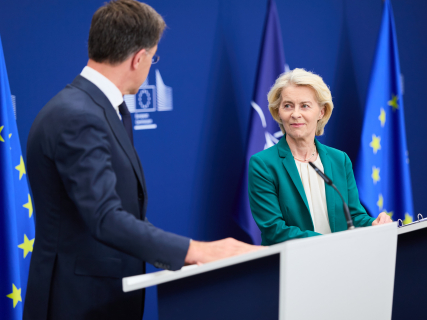

The President of the European Commission, Ursula von der Leyen, has confirmed this Monday the ban on issuing visas to those who have fought in the ranks of the Russian Armed Forces since the start of the large-scale invasion of Ukraine. The measure forms part of the latest EU sanctions offensive against Moscow and seeks to provide greater legal backing for a restriction that had already been raised previously, but whose implementation now requires new guidelines and tools for national authorities.
The initiative comes at a time when contacts and negotiations to reach a peace agreement appear to be intensifying. However, Europeans insist that any diplomatic progress must be accompanied by a sustained pressure policy on the Kremlin. Brussels’ argument is that sanctions are having an effect and that the EU-level response cannot be scaled back while the war of aggression against Ukraine continues.
In this context, the Commission has presented revised guidelines to support the implementation of the visa ban for Russian fighters, in line with the provisions set out in the twenty-first sanctions package and with the new proposal now on the table. The aim is for Member States to have common criteria and legal and administrative tools to identify applicants who may fall within this prohibition.
The change lies mainly in the update of the supporting documents that may be required from Russian citizens applying for a visa, as well as in the tightening of the access conditions for certain categories of travelers, including tourists and artists who intend to travel to EU territory.
EU sources place these decisions within the European determination to maintain constant political pressure on Russia and its accomplices. The position of the EU executive is that the relationship with Moscow cannot return to normal while a fair and lasting peace for Ukraine has not been reached.
The ban affects those who have served in the Russian Armed Forces since 2022
"We have proposed to activate the ban on entry into the EU for any person who is serving or has served in the Russian Armed Forces since the start of its war of aggression," Von der Leyen has stated. The president of the Commission has justified the initiative by the increase in hostile activities attributed to Russian agents in European territory and by the need to strengthen the Community instruments for protecting internal security.
The top official of the Community Executive has warned of the "increase in unconventional kinetic activities" in the Member States and has argued that the restriction on entry constitutes yet another part of the European response to these threats. "Entry into the European Union must be banned for those who pose a risk to Europe's security," she said.
The temporal scope of the measure dates back to February 24, 2022, the date on which Russia began the large-scale invasion of Ukraine. The enhanced checks will have to focus on the people who have provided or have provided service in the Russian Armed Forces or in associated armed groups since then.
The ban also does not, moreover, limit itself to Russian citizens. As the Commission explains, fighters of other nationalities who have also been part of the Russian Armed Forces will also be subject to this restriction, by considering that they represent an equivalent threat to the security of the European Union. In this way, the criterion for determining the application of the veto will not be exclusively the applicant's nationality, but also their link to the Russian military structures.
Brussels is thus seeking to prevent the ban from being circumvented through the use of passports from third countries or through other identification formulas. The determining element will be participation in the military forces or armed groups contemplated in the Community guidelines.
New documents to identify applicants
One of the main changes introduced by the Commission is the preparation of an updated list of supporting documents that will allow national authorities to have more elements to identify former fighters and check their military backgrounds.
A questionnaire specific to the applicant's military service is among the instruments envisaged, as is a sworn statement and the possibility of requiring supporting documentation, such as a military card. These mechanisms are intended to facilitate checks during the processing of visas and to reduce the margin of uncertainty for consular authorities when assessing each application.
The intention of the Community Executive is that Member States have more homogeneous references to detect possible links to the Russian Armed Forces. Until now, the application of the restrictions required that capitals have sufficient instruments to prove applicants' participation in military structures. With the new guidelines, Brussels is seeking to strengthen that identification capability and make it easier for the provisions on sanctions to be implemented in administrative practice.
The hardening also responds to a broader assessment of the risk that, in the Commission's view, is represented by certain movements of Russian citizens into Community territory. The Executive considers that Russian citizens continue to represent a high risk for European security, especially due to their possible links to hybrid threats, disinformation campaigns, acts of sabotage, espionage and other hostile activities.
At the same time, Brussels insists on the need to pay attention to the documentation used to access Community space. In this regard, Member States should no longer recognize non-biometric Russian passports, due to the high risk of fraud and the implications they may have for the security of border checks.
Individual assessments and enhanced checks in Schengen
The new Community guidance also includes a strengthening of verification procedures for Russian citizens who attempt to enter Schengen space. The checks must include exhaustive individual assessments, carried out by the competent security officers, with the aim of identifying possible risks before authorizing access to European territory.
These procedures may incorporate personal interviews and systematic fingerprint checks through the Schengen Information System. The intention is that national authorities can compare the information provided by applicants with available records and detect any possible criminal history or elements that justify refusal of entry.
The strengthening of these mechanisms is part of a broader strategy to toughen the European visa policy towards Russia. The Commission intends for the restrictions not to depend solely on the existence of a formal ban, but to be supported by administrative procedures capable of detecting possible non-compliance and preventing the entry of people considered a threat to the security of the Twenty-Seven.
The review of the guidelines also affects the conditions for granting tourist visas and the travel of certain profiles, including artists traveling to the European Union. Brussels seeks to limit access opportunities in a context in which it considers that there are no conditions to restore ordinary exchanges with Moscow.
The Twenty-Seven must decide on its application
The proposal, submitted by the High Representative of the European Union for Foreign Affairs and Security Policy, Kaja Kallas, must now go before the Council of the European Union. It will be the Twenty-Seven who have to decide on its application and determine when the prohibition will enter into force across the Union.
Kallas has defended the tightening of entry conditions as an extension of the pressure policy that Member States maintain on Moscow since the start of the invasion. "We are reinforcing our guidelines to restrict the entry of Russian citizens to the EU with tourist visas. Europe cannot normalize relations with a country that wages an illegal war on our continent," the former Estonian prime minister said.
Brussels’ move is therefore aimed at closing the gap between politically agreed restrictions and their effective implementation at national borders and consular offices. The Commission intends for capitals to have clearer criteria to identify former fighters, verify their backgrounds, and apply the entry limitations provided for in the framework of sanctions.
The decision is made while the EU maintains its commitment to a diplomatic exit from the conflict, but without modifying its position on the need to keep economic, political and security pressure on Russia. For the Community Executive, progress in the negotiations does not imply an automatic easing of restrictive measures. The normalization of relations will continue to be conditioned on Ukraine being able to achieve a just and lasting peace.