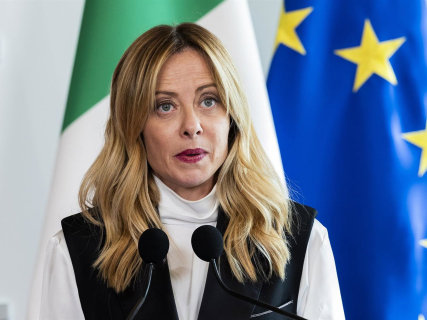

Giorgia Meloni has become one of the most influential figures of the European right. She became the president of the Council of Ministers of Italy in October 2022 after the electoral victory of Fratelli d'Italia, a party she leads and that went from holding a minority position to heading the Italian Government in just a few years.
Born in Rome in 1977, she began her political career very young and became Minister of Youth during one of Silvio Berlusconi's governments. In 2012, she participated in the founding of Fratelli d'Italia.
Her arrival at Palazzo Chigi made her the first woman to preside over an Italian Government.
Immigration, one of Meloni's political hallmarks
Immigration policy has occupied a central place on her agenda since before coming to power.
Her Government has advocated for a reduction in irregular arrivals across the Mediterranean, more intense agreements with countries of origin and transit, greater capacity to execute returns, and the possibility of managing part of the procedures outside the community territory.
The measure that best represents this strategy is the agreement between Italy and Albania.
Rome built facilities on Albanian territory intended to process procedures related to certain migrants intercepted by Italian authorities. The facilities remain under Italian jurisdiction and must operate in accordance with Italian and European law.
What is the so-called Albania model
The protocol allows Italy to use facilities in Shengjin and Gjadër for certain border and return procedures.
The system has encountered judicial obstacles and has ended up being analyzed by the Court of Justice of the European Union. A general lawyer of the court considered in April 2026 that the agreement may be compatible in principle with European law as long as the guarantees and rights of migrants are fully respected. The opinion does not equate by itself to a definitive ruling.
The Italian experiment has sparked interest in other European governments and has fueled the debate on so-called return centers in third countries.
This concept involves moving certain phases of migration management outside the EU, although the specific legal formula and the necessary guarantees remain subjects of European debate.
Tighter borders, but also legal immigration
The speech by Meloni focuses especially on combating irregular immigration. That does not mean that Italy has closed all entry points for foreign workers.
Her government has continued to use legal immigration mechanisms linked to the needs of the Italian labor market. The political difference that Meloni raises is to separate more clearly the regular entry channels from the irregular crossings.
This combination of more selected labor immigration pathways and a tightening of irregular control explains a good part of her model.
Why Meloni is gaining more weight in Europe
The Italian position is no longer just a national debate.
The tightening of immigration policies in different member states and the entry into force of the new European migration and asylum framework have brought some community discussions closer to proposals that just a few years ago were fundamentally associated with the more conservative governments.
The Albania model has thus become a political reference that other countries observe, although its application remains subject to judicial controls and to European and international obligations regarding asylum.