Fog Fire today: 66 evacuated, two roads cut off and the UME deployed

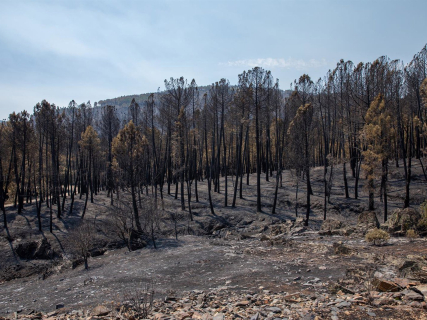
The forest fire declared in Niebla, in Huelva, remains active this Saturday, August 8, after a night marked by constant changes in the wind. The Junta maintains the emergency at operational level 2, there are 66 people evacuated, two roads remain closed, and the Military Emergency Unit has joined the operation.

2 minutes

fotonoticia 20260805134137 1920

fotonoticia 20260805134137 1920

Add DEMÓCRATA to Google

Ask FREN

Published

Last updated

2 minutes

Most read

The fire in Niebla enters this Saturday into a new day of extinguishing work after an evolution that the Junta de Andalucía has qualified as extremely complex due to the continuous changes in the direction of the wind.

The fire started in the area of Raboconejo and initially forced the preventive evacuation of residents from this nucleus and from Caballón. The number of evacuees later rose to 66 people, 40 of them from the La Florida area. Most have been able to move to other homes, although accommodation was provided for those who needed it.

The UME joins the fire in Niebla

The Junta raised the Infoca Plan to operational situation 2 due to the possibility that the fire could affect the population and non-forest assets and requested the intervention of the Military Emergency Unit.

The BIEM II, based in Morón de la Frontera, was deployed to Huelva to join the operation.

During Friday's workday, 24 aerial resources were operational, eleven helicopters and 13 planes, along with about 150 ground personnel and five bulldozers. For this Saturday, the incorporation of new brigades to the work on the ground is planned.

Which roads are closed

The two roads that remained closed due to the emergency are the HU-3106, between Niebla and Valverde del Camino, and the A-493.

Traffic and access may change depending on the evolution of the fire, so drivers who need to travel through the area should consult official information before starting their journey.

One of the points that most concerned the extinguishing teams was the northern flank. The changes in wind managed to radically alter the trajectory of the flames several times during Friday, complicating the creation of safe zones from which to attack the fire.

The provisional estimate released by the Junta placed the burned area at around 380 hectares. It is not yet a definitive balance and may vary when a complete measurement of the perimeter is possible.

What has caused the fire in Niebla?

The cause of the fire is still under investigation.

Although various hypotheses have circulated in recent hours, the authorities have not yet communicated a definitive cause. The information available this Saturday keeps the investigation open, preventing the fire from being attributed to negligence as a confirmed fact.

The other fire declared on Thursday in Villablanca was extinguished on Friday, which allows for more resources to be concentrated in Niebla.

More key points, information and questions with FREN

AI-GENERATED CONTENT

What procedures and phases does the activation of the Infoca Plan at operational situation 2 include, and what are the next steps until its deactivation?

In the Andalusian Forest Fire Emergency Plan (INFOCA Plan), the so-called “operational situation 2” corresponds to the level 2 potential severity of the fire. At this level, the fire requires the incorporation of extraordinary State resources or may escalate to a situation of national interest. Activation at level 2 involves a series of formal procedures (level declaration, request for state resources, activation of management and coordination bodies) and is maintained as long as the fire's evolution justifies it; once the situation improves, it can be downgraded to lower levels and, finally, the Plan Management declares the end of the emergency.

Basic regulatory framework

The INFOCA Plan is approved by Decree 371/2010, amended by Decree 160/2016 and, more recently, by Decree-law 2/2023, which updates the organization and competence to develop and approve the Plan. This framework is integrated into the state civil protection system defined by the Basic Guideline approved by Royal Decree 893/2013, partially repealed and adapted by the Basic Civil Protection Standard.

Additionally, the INFOCA Plan coordinates with the State Civil Protection Plan for Forest Fire Emergencies, approved by the Council of Ministers and published by resolution on October 31, 2014 (with errata corrected in the Resolution of January 23, 2015). More generally, laws such as the Law 5/2023, Andalusian Public Service, Decree-law 3/2024 on administrative simplification and previous sector reforms (Decree-law 11/2014, Law 21/2007, Law 7/2003), as well as instruments like the Master Plan of the National Parks Network or the previous regulations it repeals, also apply.

In the field of training and fire management in forest landscapes, there is also a master's degree regulated by the Resolution of June 6, 2022, which, although it does not regulate INFOCA, is part of the technical context.

What level 2 means in the INFOCA Plan

According to the Annex of Decree 371/2010, fires are classified into levels 0, 1, 2, and 3. Level 2 is defined as fires:

  • “For whose extinction it is necessary that, at the request of the Plan Management, extraordinary state resources be incorporated, or
  • That may involve emergency situations escalating to national interest.”

The regulation foresees that the severity level “may vary according to its evolution, changes in weather conditions, or other circumstances,” allowing both escalation to level 2 and return to lower levels.

Activation procedures at operational situation / level 2

According to the operational text of the INFOCA Plan approved by Decree 371/2010, activation at level 2 entails, in addition to all provisions for level 0:

  • Formal declaration of level 2:
    • In the affected provincial areas, the Plan Management in the province declares level 2 and decides the activation and convening of the Provincial Advisory Committee.
    • At the regional level, the Regional Operational Management of the Plan declares level 2 and decides the activation and convening of the Regional Advisory Committee and, if applicable, the CECOPI (Integrated Operational Coordination Center).
  • Request for extraordinary state resources:
    • Made by the Operational Management of the Plan.
    • If they are extinguishing resources, the request is made through the COR (Regional Operational Center).
    • For other state resources, the request is made through the Regional CECOP.
    • Information exchange is established between COR and CECOP regarding requests for extraordinary resources.
  • Coordination with the State Plan: when dealing with level 2 fires, the INFOCA Plan foresees coordination with the State Civil Protection Plan for Forest Fire Emergencies (State Plan), and if the situation escalates to national interest, level 3 could be declared according to state regulations.

Next phases: coordination, level downgrade, and end of emergency

At level 2, the political and operational management of the emergency intensifies: the Regional Management, to which Decree-law 2/2023 assigns reinforced functions, decides, after consulting the Regional Advisory Committee, the protection measures for the population, the request for extraordinary resources, and coordination with the General State Administration, following the criteria of the 2013 Basic Guideline ([link]).

As the fire stabilizes or reduces its severity, the Plan itself establishes that the severity level classification may vary. Although the available text does not detail step-by-step the “downgrade” (from 2 to 1 and to 0), the regulation implies that:

  • The same Plan Management that declared level 2 is competent to modify that level when the evolution and potential severity index improve.
  • When lowering the level, extraordinary state resources will be progressively demobilized and, if applicable, the CECOPI can be deactivated, maintaining only the necessary bodies for lower levels.

The INFOCA Plan expressly regulates the end of the emergency (section 5.1.2 of the Annex of Decree 371/2010):

  • The declaration of the end of the emergency corresponds to the Plan Management.
  • The end of the emergency must be communicated to all responsible parties of the mobilized action groups, thus formally closing the ongoing operational situation.

No further information is available in the consulted sources about a detailed procedure for the “return to normality phase” after that declaration; normatively, the key milestone is the formal decision by the Plan Management marking the deactivation of the emergency.

Which specific bodies make up the Regional Advisory Committee and the Provincial Advisory Committee of the INFOCA Plan, and what functions does each have? In which recent cases has level 2 of the INFOCA Plan been declared, and what types of state resources were mobilized? How does the INFOCA Plan coordinate with local forest fire emergency plans in Andalusian municipalities?

What are the competencies and functions of the Military Emergency Unit according to Spanish legislation?

The Military Emergency Unit (UME) is, legally, a permanent joint force of the Armed Forces whose main mission is to intervene in situations of serious risk, catastrophe, calamity, or other public needs, both in Spain and abroad. Its competencies focus on the protection of people, their property, the environment, and heritage, acting as a public emergency intervention and assistance service within the National Civil Protection System. In emergencies declared of national interest, the UME assumes Operational Management under the superior direction of the Minister of the Interior. Additionally, it participates in military operations as determined and in military contributions to State action.

Basic regulatory framework of the UME

The competencies and functions of the UME derive from a set of state norms, among which stand out:

  • UME creation agreement: Resolution of January 19, 2006, publishing the Council of Ministers Agreement of October 7, 2005, which creates the UME with its general mission of emergency intervention (UME creation).
  • Order DEF/160/2019, of February 21, on the organization and functioning of the UME, specifying its mission, dependency, operational actions, and structure (Order DEF/160/2019).
  • Royal Decree 1097/2011, of July 22, approving the UME Intervention Protocol and regulating its activation and coordination rules in emergencies (RD 1097/2011), replacing the repealed RD 399/2007.
  • Law 17/2015, of July 9, on the National Civil Protection System, which configures the UME as a public emergency intervention and assistance service and assigns it Operational Management in emergencies of national interest (Law 17/2015).
  • Order PRE/1776/2006, of June 7, publishing the Council of Ministers Agreement on the initial functioning of the UME (UME functioning 2006).

These norms are complemented by the Organic Law of National Defense (cited in several provisions) and the organizational development of the Ministry of Defense.

Mission and material scope of action

According to Order DEF/160/2019, the UME is a permanent joint force, organizationally dependent on the holder of the Ministry of Defense as Emergency Command, and its mission is:

  • To intervene anywhere in the national territory and abroad to contribute to the welfare and safety of citizens in cases of serious risk, catastrophe, calamity, or other public needs.
  • To participate in the fulfillment of military operations as determined, in accordance with the Organic Law of National Defense.
  • To adopt measures aimed at safeguarding the life and integrity of people, their property, the environment, natural spaces and their resources, as well as the historical-artistic heritage and other public needs.

Law 17/2015 configures the UME as the main collaboration structure of the Armed Forces with other Administrations in Civil Protection and orders that, in case of an emergency of national interest, it assumes Operational Management under the direction of the Minister of the Interior (Law 17/2015).

Operational and coordination functions

Regarding operations, Order DEF/160/2019 and RD 1097/2011 establish that:

  • UME's operational actions are governed by the Intervention Protocol and focus on direct intervention in emergencies, not on general prevention, except for actions necessary to face a declared emergency or alert/pre-emergency situations.
  • UME can intervene by decision of the Defense holder or, in situations of state of necessity or extreme severity, by decision of the UME Chief, with immediate communication to the Minister of Defense.
  • Its actions are considered military contribution operations to State action; those carried out outside national territory are considered operations abroad.
  • It can use personnel and resources of the Armed Forces, requesting them from the Chief of the Defense Staff and, if applicable, from the Chiefs of Staff of the Armies.
  • UME members, in the exercise of their functions, have the status of agents of authority.

The UME General Chief, as Emergency Command of the Armed Forces, is entrusted with planning, conducting, and monitoring emergency operations, both national and international, exercising command over units placed at his disposal and able to designate Military Emergency Coordinators.

Other related provisions

Besides the core regulatory framework, there are various provisions that, although not directly defining the UME's material competencies, relate to its framework, financing, or the military and civil protection legal framework. Among them are: the resolution on UME financing (UME financing), rules on UME personal data files (UME files), the UME contracting board (contracting board), or general references to civil protection and international cooperation (disaster cooperation, former Civil Protection Law and other resolutions).

Also cited in databases, though more indirectly linked to the UME, are norms on military jurisdiction and process (military jurisdiction, Military Penal Code, several Constitutional Court rulings such as STC 179/2004, unconstitutionality issue 3658-2004, STC 31/2000), as well as military organization provisions and other administrative resolutions (basic organization EMAD, basic organization Armed Forces, delegation in military education, Marine Infantry school, military mining service, among others).

Contextual references also include errata or various resolutions not directly linked to the UME but present in the same legislative search: international treaties, special dedication supplement, TC rulings 2001, EU provisional military body, Southern military region, unconstitutionality issue 4204-2003, Rome Statute ICC, Fleet contracting board, among others.

What legal and organizational requirements must an autonomous community meet to request UME intervention in its territory? How is the UME's Operational Management legally structured in a national interest emergency according to Law 17/2015? What differences does the regulation establish between UME interventions within national territory and its operations abroad?

What legal requirements must be met to proceed with the preventive evacuation of the population in cases of forest fires in Andalusia?

In Andalusia, preventive evacuation due to forest fires is supported by the basic state civil protection regulations and specific regional regulations (Emergency Management Law, INFOCA Plan, and local plans). Legally, these are civil protection decisions that may restrict rights, so they must be necessary, proportionate, and limited in time. Immediate competence lies with the management of the activated plan (local or regional) and is executed through Operational Groups (security, health, and logistical support), with intervention from Security Forces and emergency services. For the evacuation to be valid, it must be foreseen in emergency plans, respond to a real or foreseeable risk to the population, and be clearly communicated to those affected.

1. State civil protection framework

Law 17/2015 of the National Civil Protection System establishes that, in emergencies, competent authorities may adopt restrictive measures on rights, including evacuation of people in danger, with three basic limits:

  • Necessity and proportionality: measures must be “adequate to the magnitude” of the emergency and last only the strictly necessary time.
  • Respect for the inviolability of the home: when evacuation requires entering homes, the regime of the Organic Law on Citizen Security applies.
  • Duty of citizen cooperation: adults must comply with civil protection orders and instructions.

The Basic Guideline on forest fires approved by Royal Decree 893/2013 (partially modified later) and the State Civil Protection Plan for Forest Fires, published by Resolution in 2014 (State Plan), require that plans expressly include:

  • Measures for confinement, evacuation, and shelter, with provision of evacuation routes, meeting points, and safe places to house relocated population.
  • Mechanisms for warning and informing the population about what to do and when to evacuate.

2. Andalusian emergency and fire regulations

At the regional level, the core norm is the Law 2/2002 on Emergency Management in Andalusia, amended by Law 2/2023. This Law:

  • Configures the Andalusian Territorial Emergency Plan and special plans (including forest fires) as mandatory instruments.
  • Foresees that, in a situation of serious risk or emergency, the competent authority of the plan activates it and, if necessary, escalates to a higher-level plan.
  • Grants the Council of Government the power to declare emergencies of general interest in Andalusia and set applicable special measures.
  • Assigns the head of the department responsible for civil protection the coordination of civil protection policy and the management tasks foreseen in the Territorial Plan and special plans.

For forest fires, the central piece is the INFOCA Plan approved by Decree 371/2010 and amended by Decree 160/2016. This Plan:

  • Defines levels 0, 1, 2, and 3 of severity. Level 1 is activated when, although controllable with INFOCA resources, “special measures for the protection of people and goods threatened by fire” are foreseen.
  • Establishes a regional and provincial management structure (Regional/Provincial Plan Management, Advisory and Operations Committees).
  • Foresees the existence of Local Emergency Plans for Forest Fires in municipalities located in hazard zones.

Decree-law 2/2023 strengthens this scheme by assigning the civil protection and emergencies department the preparation of the Andalusian Forest Fire Emergency Plan and obliging municipalities in hazard zones to approve their local plan, all integrated within the general civil protection framework.

3. Competent authorities and decision chain

In practice, the preventive evacuation order fits into this command chain:

  • Local level: the mayor, through the Local Emergency Plan for Forest Fires, can order evacuations within the municipality, coordinated with 112 and INFOCA.
  • Provincial/regional level (INFOCA): the Provincial or Regional Plan Management, assisted by the Operations Committee and the Advanced Command Post (PMA), decides to evacuate when the fire is at level 1 or higher and there is risk to inhabited centers, infrastructures, or dispersed population.
  • INFOCA Operational Groups:
    • The Security Group (Security Forces and Provincial Traffic Headquarters) is responsible for controlling access, regulating traffic, and “assisting in evacuation tasks and protection measures for the population.”
    • The Health Group organizes assistance and evacuation of the injured to health centers.
    • The Logistical Support Group manages “accommodation, feeding, and shelter for the affected population” and transportation means for evacuation.

The INFOCA Plan also establishes that the PMA must “foresee meeting points for evacuations and centers for evacuation of injured and victims,” with permanent communication with the CECOP (Operational Coordination Center). The Communication Office of the Junta disseminates official orders and recommendations to the population.

4. Material and procedural requirements for preventive evacuation

From the cited regulations, the essential legal requirements for preventive evacuation in forest fires in Andalusia are:

  • Existence of a real or foreseeable risk to people or non-forest goods according to fire evolution.
  • Prior activation of the corresponding plan (local, INFOCA, territorial) and situation classification (at least level 1 in INFOCA when special measures on the population are foreseen).
  • Decision adopted by the plan management authority (mayor, Provincial/Regional INFOCA Plan Management, or Council of Government) within their civil protection competencies.
  • Measure foreseen in the plan itself: evacuation routes, meeting points, shelter zones, and minimum logistics.
  • Respect for the principles of necessity, proportionality, and temporality (Law 17/2015) and the duty of citizen cooperation.
  • Clear information to the population about the evacuation order, routes, destinations, and return conditions, channeled through 112, Communication Office, and Security Forces.

When the emergency reaches higher levels (level 2 or 3) or affects national interest, coordination with the State Forest Fire Plan and the General State Administration comes into play, but the legal logic of preventive evacuation (priority protection of life and safety through planned evacuation and shelter measures) remains unchanged.

What specific role does the mayor of an Andalusian municipality have in the decision and execution of evacuations due to forest fires? How do INFOCA, 112, and the Security Forces coordinate in practice when a preventive evacuation is ordered? What rights to compensation or indemnification does the population have if affected by an evacuation or damages caused by the fire?

Play

Test your knowledge with FREN!

How much do you know about this topic? Answer the following 3 questions.

Which military unit was incorporated into the Niebla fire operation?

Question 1 of 3

How many hectares are provisionally estimated to have been affected by the Niebla fire?

Question 2 of 3

Which two roads remain closed due to the fire according to Saturday's information?

Question 3 of 3

Hola, soy Fren. ¿Cómo te ayudo?