
The Ministry of Justice and Human Rights will increase its budget next year by 7.7%, to reach 397.7 million euros, with the aim of strengthening public services, improving care for victims, and consolidating policies for democratic memory.
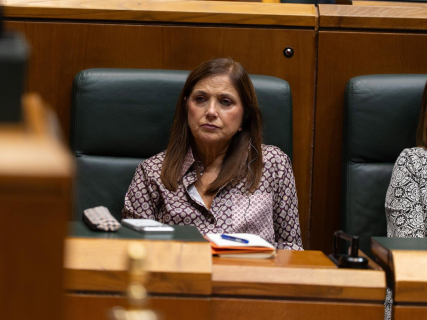
The Minister of Justice and Human Rights, María Jesús San José, defended in the Basque Parliament the accounts of her department for 2027, which represent a growth of nearly 28.5 million euros compared with the previous year.
As she emphasized, Justice and Human Rights are "two inseparable dimensions of the same public responsibility: guaranteeing people’s rights and strengthening our democracy". In her view, this approach is especially relevant "at a social and political moment in which we are witnessing with concern dynamics that call into question human rights and the rule of law, that trivialize or justify violence, and that feed the dehumanization of those who think differently or are different".
The chapter allocated to staff amounts to 222 million euros. In addition, 18 million euros are earmarked for the court-appointed duty and guard shift for the legal profession, and 1.13 million euros for the procurators, in order to ensure free legal assistance and prevent someone from being excluded for economic reasons.
Care for victims will continue to be "a priority", as San José has stressed. A sum of 1.2 million euros is maintained for the Victim Assistance Service, and funds directed toward legal assistance for victims of gender-based violence are strengthened through the law societies of the three historical territories.
The allocation for Juvenile Justice and Family Meeting Points is raised to almost 21 million euros, while the Penitentiary Management Service will have 9.1 million. These amounts will make it possible to sustain care for minors and families in complex situations, as well as consolidate socio-educational and reintegration programs.
In penitentiary matters, 3.66 million euros are reserved for the remuneration of more than 630 inmates who work in the workshops and services of the Basque Social Reintegration Agency Aukerak in prison centers, which represents 60% of the prison population in conditions to work.
In this way, the counselor has indicated, the Basque prison system "will continue to advance on the principles of security, dignity and reintegration, facilitating opportunities for social and employment integration after serving the sentences".
The Directorate for Digital Justice and Infrastructures will in 2027 move from 46.7 to 60.8 million euros, with an increase of more than 14 million that will make it possible to drive technological transformation and renew judicial infrastructures.
Among the main actions planned are the continuation of the works on the Telefónica building in Bilbao, the refurbishment of the last floor of the Palace of Justice of San Martín, in Donostia-San Sebastián, and the purchase of new premises in Vitoria-Gasteiz. Likewise, 575,000 euros are allocated for the adaptation of spaces to the new judicial office model, for improving care for minors, and for guaranteeing safe and separate routes for victims and persons investigated or accused.
The budget also sets aside 950,000 euros for the maintenance of judicial buildings. Technological modernization and infrastructures are intended to improve service to citizens and ensure a more accessible and efficient Justice.
Human Rights, memory and coexistence
The Human Rights, Memory and Coexistence area will have 12.4 million euros, adding the 7.15 million from the Directorate and the 5.25 million allocated to the Institute of Memory, Coexistence and Human Rights, Gogora, with care, recognition and reparation of victims as the central focus.
Lines of collaboration with associations and foundations such as AVT, COVITE, Fundación Víctimas del Terrorismo, Fundación Fernando Buesa and Fundación Egiari Zor are maintained, with contributions of between 55,000 and 64,000 euros, in addition to calls for competitive concurrence.
San José has emphasized that "we are not dealing with a mere policy of subsidies, but with a policy of institutional collaboration" because associations "provide experience, knowledge and an irreplaceable, key perspective for designing and developing public policies aimed at victims, and for that reason we want to keep strengthening that relationship".
In the field of human rights, it has insisted that they constitute “a permanent public responsibility,” and for that reason it has called for moving toward a society “increasingly aware of its rights, more committed to their defense, and more prepared to respond to any violation.”
The budget includes 675,000 euros to support social organizations that promote human rights promotion projects, 125,000 euros for local entities and 250,000 euros for the Bonos Elkarrekin. Thanks to this, programs such as Adi-Adian and the Community of Learning will be sustained, along with other awareness-raising and training initiatives in human rights developed with universities, educational centers and social entities.
Protective measures for human rights defenders and support for refugees and displaced persons will also be maintained.
Boost for Gogora and democratic memory
Gogora strengthens its work of research and recovery of testimonies, with an allocation that stands at 5.25 million euros. Among its main lines of work, research, the collection of testimonies and the dissemination of democratic memory will continue to stand out.
This institute will continue to cooperate with institutions in Navarra, Euskadi and the French department of Pyrénées-Atlantiques through the Consortium for Democratic Memories and Cross-Border Identities.
At the same time, it will expand the bank of testimonies of people persecuted for their sexual diversity during the Franco period and up to the 1990s, it will begin to collect testimonies related to violence of persecution and extortion, and it will launch research into people affected by polio during the dictatorship, “a historic demand by these victims included in the Law on Historical and Democratic Memory of Euskadi,” as San José has explained.
At the same time, studies will be promoted on early exhumations carried out in Euskadi between 1976 and 1980. With the aim of consolidating Gogora as a reference center for the analysis of violence motivated by political factors and in the construction of memories, management of the institute’s website will be improved, facilitating public and free access to digital documentation and making available to educational centers pedagogical materials tailored to the reality of each municipality.