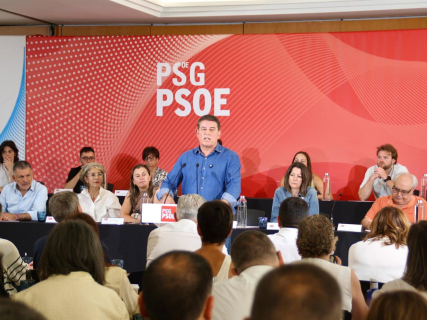

The general secretary of the PSdeG, José Ramón Gómez Besteiro, has called on the socialist bases to "take to the streets", with "decision and commitment", to "win" and achieve "more mayoralties than ever" in the municipal elections scheduled for 2027.
This message was conveyed this Saturday before the National Committee of the PSdeG, the highest governing body between congresses, where he contrasted the results of the central government's progressive policies with the "paralysis" that, in his opinion, the Xunta presided over by Alfonso Rueda shows.
In his speech, Besteiro took the opportunity to congratulate the already designated candidates --Pedro Blanco in Santiago, Natalia González in Ourense, Iván Puentes in Pontevedra, and Miguel Fernández in Lugo-- and to highlight the importance of the primaries in Ferrol, where former mayor Ángel Mato and former councilor Eva Martínez will compete.
In this regard, he defended that the Socialist Party promotes its internal processes to choose mayoral candidates, a "beautiful battle" that takes place "thinking about the people who are not part of the party" and with the aim of choosing the "best candidates" to "solve the problems" of the citizens.
He vindicated with "pride" the management of the socialist governments in Vigo, A Coruña, Vilagarcía, and Ferrol and committed to recovering the Mayor's Office of Lugo with Miguel Fernández, after the motion of no confidence in which the PP relied on a defector who entered "through the back door". "It is a symbol of what we are going to recover in ten months," he indicated.
The meeting, held a week after the Federal Committee that activated the primary calendar, brought together a good part of the organic and institutional leadership of the PSdeG in Santiago, including the three provincial secretaries --David Regades (Pontevedra), Bernardo Fernández (A Coruña), and Álvaro Vila (Ourense)--, in addition to the president of the Gestora of Lugo, Luis Lago Lage.
Some mayors, such as the mayor of Vigo, Abel Caballero, or the mayor of A Coruña, Inés Rey, did not attend the event. Other socialist officials did participate, such as the mayor of Vilagarcía, Alberto Varela; the president of the Provincial Council of Lugo, Valentín González; the mayor of Ames, Blas García; and the councilor for Economy and Strategic Planning of A Coruña, José Manuel Lage, along with several party representatives in the Parliament of Galicia and in the Cortes Generales.
Besteiro has highlighted the progress made in Galicia thanks to the progressive government, "a guarantee and glue" that, he said, unites socialists with the "social majority." At the same time, he accused the president of the Xunta of lacking a project, planning, and clear objectives. "Never have so many people been left without housing, without doctors, and without the money that belonged to Galicia," he stated.
"Governing by Bonus" versus "Government Bonus"
The leader of the PSdeG has reproached the regional Executive for "governing by bonus." "Care Bonus, Fish Bonus, Rural Bonus, Commerce Bonus, Culture Bonus. It is the best metaphor for a government that replaces rights with patches. The problem is turning rights into checks that buy wills," he criticized.
Faced with this model, he defended the socialist proposal presented in the debate on the state of autonomy, the "government bonus." "The Galician citizens have already done their part, they pay taxes. Now it is up to the Xunta to fulfill something as revolutionary for them as governing," he remarked.
The leader of the PSdeG has insisted on Rueda's "failure" in housing and healthcare, and has also denounced the "industrial paralysis" of the Galician Executive "while Pedro Sánchez brings SAIC to Galicia against competitors like Morocco, Catalonia, or Valencia."
Regarding forest fires, he recalled that the parliamentary agreement reached in 2018 with the PP remains unexecuted eight years later, with a Pladiga approved out of time and preventive measures that have not been carried out: "We learn nothing from everything that happened," he lamented.
In this regard, he has demanded that Rueda stop supporting Feijóo's positions in a "sterile confrontation" with the Government of Spain. "The interest of the president of the Xunta must be to defend the interest of Galicia," he stressed, reproaching the stance of the Galician PP in debates such as debt forgiveness.
Faced with that "opportunism," he has claimed the role of the PSdeG in the halting of the Altri project, which, he recalled, was stopped because "the socialists put their foot down"; and in the claim for the transfer of the AP-9: "On important issues, we are the ones who decide policy here in Galicia," he pointed out.
PSdeG Criticisms of the PP over the Grandchildren Law and the vote from abroad
In another part of his speech, Besteiro has lashed out at the PP's position regarding the Grandchildren Law and the suffrage of residents abroad. He has accused the popular party of "crossing a line in their Trumpist drift" by "openly despising" the children and grandchildren of those who had to emigrate because Galicia offered them no future.
"For years they called them ambassadors of Galicia, now, when they suspect they don't vote the way they want, they treat them like second-class Galicians. A lot of longing in their speeches and very little dignity when it comes to defending them," he has denounced.
He assured that he felt "ashamed" when Feijóo proposed to abolish the Grandchildren Law and also when Rueda "remained silent," and has criticized that the PP responds "amen" to Voz's proposal to eliminate the vote from abroad.
"Feijóo and Rueda failed the Galician emigration. We are not going to fail the Galician emigration. We are not going to fail them. For us there are no first-class and second-class Galicians. There are Galicians, wherever they are," he has concluded.