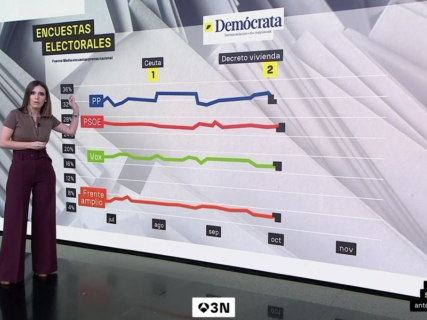

Demócrata has shown this Saturday on Antena 3 Noticias how the parties are arriving at the general elections of November 29 and what moves the polls pick up after the events that have marked the pre-campaign. The news program has incorporated the graphic from this outlet to go through three moments: the crisis in Ceuta, the rejection of the housing decrees, and the railway accident in Urda.
The final photograph places the PP in first position with 31% of estimated votes, followed by the PSOE, with 26.3%. Vox reaches 19.5% and Frente Amplio stands at 6.5%.
The gap between the conservatives and the socialists is 4.7 points. But the journey offers another key: Vox’s reinforcement after Urda is not accompanied, in the interpretation presented in the news program, by a penalty for the PSOE.
🔴 Demócrata ha llevado este sábado al telediario de Antena 3 (@A3Noticias) la evolución de las encuestas para las elecciones generales del #29N. El análisis muestra un PP en cabeza, un PSOE que resiste tras Urda y un Vox reforzado: los populares alcanzan el 31%, los socialistas… pic.twitter.com/Rw7RQpf6eC
— demócrata (@democrata_info) November 7, 2026
Demócrata takes the 29N electoral evolution to the news
The Demócrata chart makes it possible to follow the trajectory of the parties over the last few months and place their movements alongside the main political events. Its inclusion in the Antena 3 news segment brings that evolution closer to viewers as just over three weeks remain until the elections.
The comparison goes beyond the final percentage of each party. It shows how that position was reached and makes it possible to distinguish episodes in which the parties move forward or back from others in which they maintain their support.
Ceuta, vivienda and Urda are marked along the lines of the chart. The journey ends with the PP in the lead, the PSOE in second place, and a Vox that is moving toward 20%.
Urda strengthens Vox and the PSOE holds
The train accident in Toledo is the last of the three events examined. The reading of the chart presented on Antena 3 with data from Demócrata points to a boost for Vox without a penalty for the PSOE.
This behavior introduces a nuance into the debate about the electoral consequences of the tragedy. An improvement for one party does not necessarily imply an equivalent drop for another, nor does it allow an automatic identification of a transfer of voters.
The PSOE retains 26.3% in the final snapshot. Vox reaches 19.5%, half a point from 20%, although it remains 6.8 points behind the socialists.
This is the evolution captured in the average shown during the broadcast. The next studies will make it possible to see whether that trend continues and how events that take place after their fieldwork are incorporated.
The PP maintains almost five points of lead
The PP leads the vote estimate with 31%. The difference of 4.7 points with respect to the PSOE supports its first position in the chart released by Antena 3.
Demócrata’s analysis places one of the advances by the PP in the period of the Ceuta crisis. In that stretch, the analysis identifies an improvement for the PP and a retreat for the Socialists.
Comparison with Urda shows a different response. While Ceuta is associated with opposing moves between the first two parties, the rail tragedy coincides with a strengthening of Vox without punishing the PSOE in the interpretation offered during the broadcast.
Therefore, the PP keeps the lead in a snapshot in which the evolution of the third force also gains prominence.
Vivienda and Urda mark Vox’s path
The parliamentary rejection of the housing decrees occupies the second stop in the analysis. Vox appears as the beneficiary of that episode and strengthens itself again in the corresponding section of the Toledo accident.
Its final 19.5% places it 11.5 points behind the PP and 6.8 behind the PSOE. Abascal's party retains third position, with a distance of 13 points over Frente Amplio.
The chart makes it possible to see that progression, but not to attribute the origin of each support. To identify transfers between parties, specific polling data are needed, beyond the evolution of their aggregated percentages.
Frente Amplio stands at 6.5%
Frente Amplio closes the comparison with an estimate of 6.5%. The television graphic brings together four formations and does not represent the totality of the candidate lists that stand in the elections.
It also does not turn those percentages into a distribution of seats. The national estimate of votes and the allocation of seats are different measures, conditioned by the territorial distribution of support