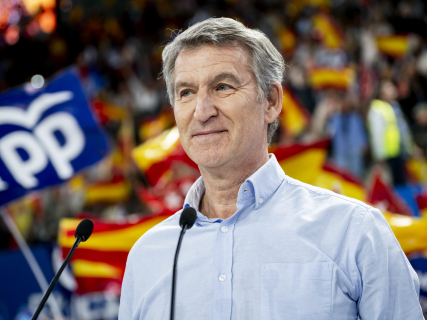
Feijóo brings together Ayuso and Almeida at the Caja Mágica in Madrid in the final stretch of the 29N campaign

The leader of the PP holds a rally in the capital four days before the general elections and on the eve of the last big televised debate with Sánchez, Abascal and Colau

EuropaPress 7943524 presidente partido popular alberto nunez feijoo interviene acto campana pp (1)

EuropaPress 7943524 presidente partido popular alberto nunez feijoo interviene acto campana pp (1)

Add DEMÓCRATA to Google

Ask FREN

Published

Last updated

1 minute

Most read

Hasta el día de las elecciones (29 de noviembre) se muestran los resultados de las elecciones generales anteriores, las del 23 de julio de 2023.

Resultados de las elecciones generales del 29N en directo

Elecciones generales del 23 de julio de 2023 · Congreso de los DiputadosSenado

Escrutado: 100,00 %Votantes: 24.952.447Participación: 66,59 %

Votos

PartidoEscañosVotosPorcentaje
PP1378.160.83733,06 %
PSOE1217.821.71831,68 %
Vox333.057.00012,38 %
Sumar313.044.99612,33 %
ERC7466.0201,89 %
Junts7395.4291,60 %
EH Bildu6335.1291,36 %
EAJ-PNV5277.2891,12 %
BNG1153.9950,62 %
CCa1116.3630,47 %
UPN152.1880,21 %
PACMA0169.2370,69 %
CUP-PR099.6440,40 %
FO046.2740,19 %
NC-bc045.5950,18 %
PDeCAT-E-CiU032.0160,13 %
RECORTES CERO023.4210,09 %
PUM+J023.2900,09 %
U.P.L.023.2010,09 %
EXISTE020.4400,08 %
PCTE013.3820,05 %
GBAI099380,04 %
SY096970,04 %
Adelante091910,04 %
JM+082930,03 %
ESCAÑOS EN BLANCO079860,03 %
XAV073620,03 %
BQEX058070,02 %
CJ056200,02 %
FE de las JONS046830,02 %
PAR041730,02 %
PCTC038750,02 %
ESPAÑA VACIADA031580,01 %
PH029020,01 %
ASTURIAS EXISTE EV023140,01 %
XH019310,01 %
VP019170,01 %
Zsi018430,01 %
VB017740,01 %
POR MI REGIÓN016980,01 %
AHORA CANARIAS-PCPC016740,01 %
PARTIDO AUTÓNOMOS014460,01 %
EVB014420,01 %
CpM012980,01 %
JxG012180,00 %
EV-PCAS-TC011840,00 %
PREPAL09640,00 %
Somos Cc09630,00 %
ALM08740,00 %
PCTG07020,00 %
F.I.A.05060,00 %
3e04840,00 %
Ud.Ca04630,00 %
ESCONS EN BLANC04620,00 %
GITV03660,00 %
PUEDE02690,00 %
EVC02650,00 %
LB02630,00 %
PCTE/ELAK02590,00 %
UNIDOS SI02530,00 %
+RDS+01650,00 %
CCD01530,00 %
FUERZA CÍVICA01150,00 %

Porcentajes sobre votos válidos. Resultados definitivos del 23J de 2023.

Escaños (350)

Mayoría: 176
PP: 137 escaños en 2023PSOE: 121 escaños en 2023Vox: 33 escaños en 2023Sumar: 31 escaños en 2023ERC: 7 escaños en 2023Junts: 7 escaños en 2023EH Bildu: 6 escaños en 2023EAJ-PNV: 5 escaños en 2023BNG: 1 escaño en 2023CCa: 1 escaño en 2023UPN: 1 escaño en 2023137121333120232023
  • PP 137
  • PSOE 121
  • Vox 33
  • Sumar 31
  • ERC 7
  • Junts 7
  • EH Bildu 6
  • EAJ-PNV 5
  • BNG 1
  • CCa 1
  • UPN 1

Pactómetro

Pulsa los partidos para sumar sus escaños.

Los escaños más ajustados

Quién tiene el último escaño, quién le sigue y los votos que le faltan
  1. GironaJxCAT - JUNTSyPP285 votos

    El último escaño de Girona (el 6.º) es para JxCAT - JUNTS. Le sigue el PP, que necesitaría 285 votos más para quitárselo. Ver Girona ›

  2. CantabriaVOXyPP403 votos

    El último escaño de Cantabria (el 5.º) es para VOX. Le sigue el PP, que necesitaría 403 votos más para quitárselo. Ver Cantabria ›

  3. TarragonaJxCAT - JUNTSyPSC1247 votos

    El último escaño de Tarragona (el 6.º) es para JxCAT - JUNTS. Le sigue el PSC, que necesitaría 1247 votos más para quitárselo. Ver Tarragona ›

  4. AlbacetePSOEyVOX1412 votos

    El último escaño de Albacete (el 4.º) es para el PSOE. Le sigue VOX, que necesitaría 1412 votos más para quitárselo. Ver Albacete ›

  5. SalamancaPPyPSOE1495 votos

    El último escaño de Salamanca (el 4.º) es para el PP. Le sigue el PSOE, que necesitaría 1495 votos más para quitárselo. Ver Salamanca ›

Provincias con al menos el 30 % escrutado donde el último escaño cambiaría de manos con menos votos. Pulsa una para ver el detalle.

Senado

100,00 % escrutado
PartidoSenadores
PP120
PSOEPSOE: 73 senadoresSe presenta con estos nombres:
  • PSOE48
  • PSC12
  • PSdeG-PSOE4
  • PSE-EE (PSOE)4
  • PSN-PSOE3
  • PSIB-PSOE1
  • PSOE-SUMAR-EUIB-ARA EIVISSA1
73
EH Bildu4
EAJ-PNV4
ERCERC: 3 senadoresSe presenta con estos nombres:
  • ERC-ESQUERRES PER LA INDEPENDÈNCIA2
  • ERC1
3
Junts1
UPN1
A.H.I.1
ASG1

Los partidos que se presentan con varios nombres van juntos: pasa por encima para ver el detalle. Baleares y Canarias eligen sus senadores por islas.

Senadores (208)

Elegidos en las urnas
PP: 120 senadores en 2023PSOE: 73 senadores en 2023 (PSOE: 48; PSC: 12; PSdeG-PSOE: 4; PSE-EE (PSOE): 4; PSN-PSOE: 3; PSIB-PSOE: 1; PSOE-SUMAR-EUIB-ARA EIVISSA: 1)EH Bildu: 4 senadores en 2023EAJ-PNV: 4 senadores en 2023ERC: 3 senadores en 2023 (ERC-ESQUERRES PER LA INDEPENDÈNCIA: 2; ERC: 1)Junts: 1 senador en 2023UPN: 1 senador en 2023A.H.I.: 1 senador en 2023ASG: 1 senador en 20231207320232023
  • PP 120
  • PSOE 73
  • EH Bildu 4
  • EAJ-PNV 4
  • ERC 3
  • Junts 1
  • UPN 1
  • A.H.I. 1
  • ASG 1

Los senadores designados por los parlamentos autonómicos no se eligen en las urnas.

Mapa

Ganador por provincia

    CanariasCeutaMelillaAraba/Álava: PSE-EE (PSOE) 27,7 %Albacete: PP 39,9 %Alicante/Alacant: PP 36,7 %Almería: PP 40,9 %Ávila: PP 43,3 %Badajoz: PSOE 39,2 %Illes Balears: PP 35,6 %Barcelona: PSC 35,7 %Burgos: PP 40,6 %Cáceres: PSOE 38,9 %Cádiz: PP 34,8 %Castellón/Castelló: PP 35,2 %Ciudad Real: PP 40,5 %Córdoba: PP 37,9 %A Coruña: PP 43,1 %Cuenca: PP 39,8 %Girona: PSC 28,9 %Granada: PP 37,0 %Guadalajara: PP 36,3 %Gipuzkoa: EH Bildu 31,2 %Huelva: PP 36,4 %Huesca: PP 38,2 %Jaén: PP 37,3 %León: PP 36,9 %Lleida: PSC 29,5 %La Rioja: PP 45,6 %Lugo: PP 50,2 %Madrid: PP 40,6 %Málaga: PP 38,3 %Murcia: PP 41,2 %Navarra: PSN-PSOE 27,4 %Ourense: PP 50,0 %Asturias: PP 35,7 %Palencia: PP 42,0 %Las Palmas: PSOE 33,2 %Pontevedra: PP 39,7 %Salamanca: PP 46,9 %Santa Cruz de Tenerife: PP 35,4 %Cantabria: PP 42,1 %Segovia: PP 45,0 %Sevilla: PSOE 36,6 %Soria: PP 37,2 %Tarragona: PSC 32,9 %Teruel: PP 35,0 %Toledo: PP 37,8 %Valencia/València: PP 33,6 %Valladolid: PP 40,8 %Bizkaia: EAJ-PNV 26,9 %Zamora: PP 44,7 %Zaragoza: PP 36,0 %Ceuta: PP 38,8 %Melilla: PP 49,2 %

    Pulsa una provincia para ver sus resultados y elegir municipio.

    Mapa

    Partido con más senadores por provincia

    CanariasCeutaMelillaAraba/Álava: PSOE, 3 de 4 senadoresAlbacete: PP, 3 de 4 senadoresAlicante/Alacant: PP, 3 de 4 senadoresAlmería: PP, 3 de 4 senadoresÁvila: PP, 3 de 4 senadoresBadajoz: PSOE, 2 de 4 senadoresIlles Balears: PP, 3 de 6 senadoresBarcelona: PSOE, 3 de 4 senadoresBurgos: PP, 3 de 4 senadoresCáceres: PP, 2 de 4 senadoresCádiz: PP, 3 de 4 senadoresCastellón/Castelló: PP, 3 de 4 senadoresCiudad Real: PP, 3 de 4 senadoresCórdoba: PP, 3 de 4 senadoresA Coruña: PP, 3 de 4 senadoresCuenca: PP, 3 de 4 senadoresGirona: PSOE, 3 de 4 senadoresGranada: PP, 3 de 4 senadoresGuadalajara: PP, 3 de 4 senadoresGipuzkoa: EH BILDU-INDEPENDENTZIA EZKERRETIK, 3 de 4 senadoresHuelva: PP, 2 de 4 senadoresHuesca: PP, 3 de 4 senadoresJaén: PP, 3 de 4 senadoresLeón: PP, 3 de 4 senadoresLleida: PSOE, 3 de 4 senadoresLa Rioja: PP, 3 de 4 senadoresLugo: PP, 3 de 4 senadoresMadrid: PP, 3 de 4 senadoresMálaga: PP, 3 de 4 senadoresMurcia: PP, 3 de 4 senadoresNavarra: PSOE, 3 de 4 senadoresOurense: PP, 3 de 4 senadoresAsturias: PP, 3 de 4 senadoresPalencia: PP, 3 de 4 senadoresLas Palmas: PSOE, 4 de 5 senadoresPontevedra: PP, 3 de 4 senadoresSalamanca: PP, 3 de 4 senadoresSanta Cruz de Tenerife: PSOE, 3 de 6 senadoresCantabria: PP, 3 de 4 senadoresSegovia: PP, 3 de 4 senadoresSevilla: PSOE, 3 de 4 senadoresSoria: PP, 3 de 4 senadoresTarragona: PSOE, 3 de 4 senadoresTeruel: PP, 3 de 4 senadoresToledo: PP, 3 de 4 senadoresValencia/València: PP, 2 de 4 senadoresValladolid: PP, 3 de 4 senadoresBizkaia: EAJ-PNV, 3 de 4 senadoresZamora: PP, 3 de 4 senadoresZaragoza: PP, 3 de 4 senadoresCeuta: PP, 2 de 2 senadoresMelilla: PP, 2 de 2 senadores

    Pulsa una provincia para ver sus senadores y candidatos.

    Resultados definitivos de las elecciones generales del 23 de julio de 2023 (Ministerio del Interior). Mapas: Instituto Geográfico Nacional (es-atlas, CC BY 4.0). Demócrata.

    Alberto Núñez Feijóo and Isabel Díaz Ayuso will headline this Wednesday’s central campaign event of the PP in Madrid at the Caja Mágica. The conservatives are hoping to gather around 11,000 people at one of their last major rallies before the general election on 29N, with which they want to demonstrate their ability to mobilize just four days before the date at the ballot boxes.

    The event, scheduled for 19.30 hours at the Manolo Santana stadium, will also feature remarks by the mayor of Madrid, José Luis Martínez-Almeida, and by the number two on the PP candidacy for Congress from Madrid, Cayetana Álvarez de Toledo. Feijóo and Ayuso will be in charge of closing the gathering.

    The popular candidate is once again sharing a platform with the president of Madrid after both took part in an event with young people in the Tetuán neighborhood on November 13, coinciding with the official start of the election campaign.

    The last big rally before the debate four

    The Caja Mágica appointment takes place on the eve of the final major televised debate of the campaign, in which Feijóo will face Pedro Sánchez, Santiago Abascal and Ada Colau this Thursday. It will be the last time that the four candidates will appear together in a studio before the general elections.

    Feijóo’s election-day schedule will also have a second setting: YouTube. The content creator YoSoyPlex will publish at 21.00 hours his interview with the president of the PP, one hour after posting the one he conducted with Pedro Sánchez. Both meetings were recorded last week.

    The PP will close the campaign in Seville

    After the Madrid rally and Thursday’s debate, Feijóo will face the final day of the campaign with events in Catalonia and Andalusia. The PP has chosen Seville to close the election campaign on Friday, November 27, where the candidate will be accompanied by the president of the Junta of Andalusia, Juanma Moreno.

    More key points, information and questions with FREN

    AI-GENERATED CONTENT

    What are the main competencies and functions of an autonomous community president in Spain?

    The president of an autonomous community is the highest political authority and the head of the autonomous executive power. Their competencies and functions derive from the Constitution, the Statute of Autonomy of each community, and the laws that develop it, but essentially they share a common framework throughout Spain.

    1. Headship of the autonomous executive

    • Leading the Autonomous Government: heads the Government Council (or autonomous government) and sets the major lines of political, economic, and administrative action within the scope of the community's competencies.
    • Setting priorities and coordinating ministries: decides the general orientation of the Government and coordinates the work of the ministers, resolving conflicts between departments and ensuring policies are coherent.
    • Promoting and planning public policies: leads the development of strategic plans in areas such as health, education, social services, housing, transport, or economic development within the autonomous competential framework.

    2. Institutional representation

    • Representation of the community: represents the autonomous community in its relations with the State, other autonomous communities, and, when appropriate, with international institutions and actors.
    • Ordinary representation of the State in the community: in many communities, the statutes also attribute the ordinary representation of the State in their territory (without replacing the Government delegate, who exercises specific state functions).
    • External projection: leads institutional trips, signs collaboration agreements with other regions or entities, and participates in national and international forums related to autonomous competencies.

    3. Relations with the autonomous parliament

    • Election and investiture: is elected by the autonomous parliament (legislative assembly) from among its members or as determined by the statute, usually after an investiture debate and a vote requiring a determined majority.
    • Political responsibility: is politically accountable before the parliament, which can demand their resignation through instruments such as a motion of censure or, in some cases, a vote of confidence.
    • Legislative initiative: on behalf of the autonomous Government, can present bills to the parliament and request urgent processing of certain initiatives when deemed necessary.
    • Information and control: is obliged to appear before the parliament to report on government action, answer questions, and attend interpellations from parliamentary groups.

    4. Appointments, dismissal, and organization of the Government

    • Appointing and dismissing ministers: freely appoints members of their Government (ministers or consellers) and can reorganize the Executive, create or suppress ministries, and reassign competencies.
    • Configuring the internal structure: proposes the basic structure of the autonomous Administration (ministries, general directorates, dependent bodies), within the legal framework.
    • Presiding over the Government Council: convenes and presides over its meetings, sets the agenda, and in case of a tie in internal votes, usually has the casting vote.

    5. Normative and executive functions

    • Promulgation and publication of autonomous laws: once approved by the parliament, the president sanctions, promulgates, and orders their publication in the official autonomous bulletin, an essential step for their entry into force.
    • Regulations and executive provisions: directs the drafting of regulations and other lower-ranking norms necessary to develop laws and manage autonomous competencies.
    • Direction of the autonomous Administration: ensures compliance with laws and the proper provision of autonomous public services (health, education, social services, etc., according to the competential distribution).

    6. Budgets, economy, and intergovernmental coordination

    • Promoting autonomous budgets: leads, through the Government, the preparation of the community's budget project and its defense before the parliament.
    • Autonomous economic and fiscal policy: sets the orientation of economic policy, aid and subsidies, and of own or transferred taxes whose management corresponds to the community.
    • Participation in cooperation bodies: participates, directly or by delegation, in the Conference of Presidents and other coordination bodies between the State and the communities, where issues of financing, competential distribution, and common policies are addressed.

    7. Other relevant functions

    • Power to dissolve the parliament (where the statute allows it): in some communities, can propose the early dissolution of the parliament and the calling of autonomous elections, within the limits set by their Statute and electoral legislation.
    • Crisis and emergency management: assumes the highest political coordination responsibility in emergency situations (natural disasters, health crises, serious public order disturbances) within the scope of autonomous competencies.
    • Incompatibilities and neutrality: is subject to strict incompatibility regimes and duties of impartiality and service to the general interest of the community.

    In summary, the autonomous president combines the role of territorial head of government, the highest responsible for managing autonomous competencies and coordinating public policies, with that of main political and institutional representative of the community before its parliament, the State, other communities, and abroad.

    How is an autonomous community president exactly elected and dismissed in a specific community (for example, in Catalonia or Madrid)? What differences exist between the competencies of an autonomous community president and those of the central Government president? In which areas do autonomous community presidents usually have more room for action (health, education, social services, etc.) and what legal limits do they face?

    What requirements must be met to hold massive electoral events in venues like the Caja Mágica?

    To hold a massive electoral event in a venue like the Caja Mágica, conditions regarding space use, capacity, security, evacuation, and electoral regulations must be met. Reserving the venue is not enough, but there is also no single "electoral license" that replaces all these requirements. It is essential to distinguish the political rally from complementary activities that may require specific permits.

    1. Right of assembly and electoral rules

    A rally is an exercise of the right of assembly: it is not subject to prior political authorization. The communication provided for meetings in public transit places should not automatically apply to an event inside a closed venue. If there are external gatherings, street occupation, or other additional actions, their obligations must be examined separately.

    During the campaign, the LOREG assigns competencies over public propaganda events to provincial electoral boards, while the governmental authority maintains its public order functions. Campaign prohibitions during the reflection day and voting must also be respected. References include the electoral regulations and the Ministry of Interior guidelines.

    2. Availability and conditions of the venue

    The organization needs an agreement with the owner or manager specifying spaces, dates, setup, dismantling, services, and responsibilities. The municipal reservation of free premises for the campaign does not automatically make the Caja Mágica a free space.

    It must also be verified that the intended use and layout are compatible with the authorized conditions of the building. It should not be assumed that a rally requires a public show license: that conclusion requires assessing the nature of the event and added activities. For setups or activities subject to administrative intervention, the corresponding permit must be processed. The City Council has a procedure for temporary activities.

    3. Capacity, setup, and evacuation

    The valid capacity is that of the specific configuration of the event, not a commercial figure of the venue. Stage, screens, press areas, seated or standing audience, and technical spaces can modify the available capacity.

    • Control entrances, exits, and occupancy of each sector.
    • Keep exits, evacuation routes, and emergency accesses free.
    • Have the required technical documentation for stages, stands, towers, and other temporary structures.
    • Guarantee accessible routes and adequate spaces for people with reduced mobility.
    4. Security and emergency response

    There must be an operational emergency organization adjusted to the venue and event, with identified responsible persons, evacuation procedures, and coordination with public services. It must be checked whether a specific self-protection plan or adaptation of the existing one is required.

    Surveillance and protection must be entrusted to authorized personnel when functions require it; they are not equivalent to merely checking invitations. Medical assistance is sized according to capacity and risk, without presuming a fixed number of ambulances. Civil liability coverage must also be verified.

    5. Noise, exteriors, and personal data

    Sound systems, sound checks, and schedules must respect applicable acoustic conditions. Queues, buses, traffic cuts, or exterior installations may require additional coordination and permits. If data is collected through registrations or accreditations, data protection obligations must be fulfilled.

    Before opening doors, it is advisable to close a joint documentary and technical check between organizer, manager, and security managers. These general requirements do not by themselves prove that a specific event has all necessary permits.

    What has been José Luis Martínez-Almeida's political career before becoming mayor of Madrid?

    José Luis Martínez-Almeida became Mayor of Madrid in June 2019 after a career that combined State Advocacy, positions in the Community of Madrid, and municipal opposition. His political path was linked to the People's Party and, especially in his first executive positions, to the governments of Esperanza Aguirre. Before leading the PP's municipal candidacy, he had been a councilor and spokesperson of his group in the City Council.

    The legal career preceding his political positions

    Martínez-Almeida joined the State Lawyers Corps in 2001. He first worked in Girona between 2001 and 2002, then was head of the State Advocacy in Toledo between 2002 and 2003. Later he worked in Madrid until 2007, before bodies such as the High Court of Justice and in matters of social and contentious-administrative jurisdictions.

    This stage was professional and legal, not a mandate obtained at the polls. It is important to distinguish it from his later political responsibilities: his first experience in the Administration was linked to the defense and legal advice of the State. The municipal transparency portal records the main milestones of his career.

    His responsibilities in the Community of Madrid

    In 2007 he took a step to a position of responsibility in the regional Executive as Director General of Historical Heritage of the Community of Madrid. He remained in that position until 2011, during Esperanza Aguirre's presidency, within the Culture area.

    Between 2011 and 2013 he was Secretary General of the Madrid Government Council. This position was related to the preparation and legal and administrative coordination of the regional Executive's activity. Therefore, these were two distinct responsibilities: first a general directorate in the cultural field and then a transversal support function to the autonomous Government. Both stages appear in his institutional biography at IFEMA.

    The passage through SEPIDES and AIReF

    After leaving the regional Government, between 2013 and 2014 he was secretary general and of the Board of SEPIDES, a state company dedicated to business development. Then, between 2014 and 2015, he directed the Legal-Institutional Division of the Independent Authority for Fiscal Responsibility (AIReF), the body responsible for supervising the sustainability of public finances.

    These positions maintained the legal and administrative component of his career before joining the City Council. His experience at AIReF also appears in the UN-Habitat biography.

    From councilor to opposition spokesperson

    In the 2015 municipal elections he ran on the PP list headed by Esperanza Aguirre and was elected councilor of Madrid. During Manuela Carmena's term, he served from the opposition and was also linked to the Moratalaz Municipal Board.

    The decisive change came in April 2017, when he replaced Aguirre as spokesperson of the Popular Municipal Group. That responsibility placed him at the head of the PP municipal opposition and gave greater visibility to his interventions in the Plenary. Telemadrid reviewed that path during the 2019 campaign.

    The candidacy for Mayor

    In 2018 he joined the PP National Executive Committee as Secretary of Participation. In January 2019, the party designated him as candidate for Mayor of Madrid.

    The path culminated on June 15, 2019: although Más Madrid had obtained more councilors, Martínez-Almeida was invested mayor through a government agreement between PP and Ciudadanos and the support of Vox. Thus ended his previous stage before the Mayorship, marked by the transition from legal and executive responsibilities to municipal representation and leadership.

    Play

    Test your knowledge with FREN!

    How much do you know about this topic? Answer the following 3 questions.

    Where did the PP of Madrid hold its main campaign event before the November 29 elections?

    Question 1 of 3

    How many people does the PP expect to gather at the Caja Mágica rally?

    Question 2 of 3

    Who will accompany Feijóo at the campaign closing in Seville?

    Question 3 of 3