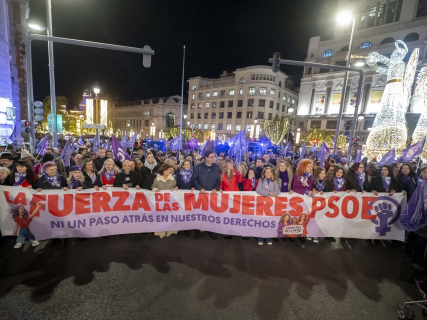
Feminism takes the streets of Spain on a 25N marked by sexist violence and the 29N campaign

Thousands of people take part in the demonstrations in Madrid, Barcelona, Seville and other cities, with slogans such as "Stop the barbarism" and "Against hate and denialism, more feminism." The protests coincide with the final stretch of the campaign for the 29N and there are still no official figures on attendance

EuropaPress 7943299 cabecera manifestacion motivo dia internacional eliminacion violencia

EuropaPress 7943299 cabecera manifestacion motivo dia internacional eliminacion violencia

Add DEMÓCRATA to Google

Ask FREN

Published

Last updated

6 minutes

Most read

Hasta el día de las elecciones (29 de noviembre) se muestran los resultados de las elecciones generales anteriores, las del 23 de julio de 2023.

Resultados de las elecciones generales del 29N en directo

Elecciones generales del 23 de julio de 2023 · Congreso de los DiputadosSenado

Escrutado: 100,00 %Votantes: 24.952.447Participación: 66,59 %

Votos

PartidoEscañosVotosPorcentaje
PP1378.160.83733,06 %
PSOE1217.821.71831,68 %
Vox333.057.00012,38 %
Sumar313.044.99612,33 %
ERC7466.0201,89 %
Junts7395.4291,60 %
EH Bildu6335.1291,36 %
EAJ-PNV5277.2891,12 %
BNG1153.9950,62 %
CCa1116.3630,47 %
UPN152.1880,21 %
PACMA0169.2370,69 %
CUP-PR099.6440,40 %
FO046.2740,19 %
NC-bc045.5950,18 %
PDeCAT-E-CiU032.0160,13 %
RECORTES CERO023.4210,09 %
PUM+J023.2900,09 %
U.P.L.023.2010,09 %
EXISTE020.4400,08 %
PCTE013.3820,05 %
GBAI099380,04 %
SY096970,04 %
Adelante091910,04 %
JM+082930,03 %
ESCAÑOS EN BLANCO079860,03 %
XAV073620,03 %
BQEX058070,02 %
CJ056200,02 %
FE de las JONS046830,02 %
PAR041730,02 %
PCTC038750,02 %
ESPAÑA VACIADA031580,01 %
PH029020,01 %
ASTURIAS EXISTE EV023140,01 %
XH019310,01 %
VP019170,01 %
Zsi018430,01 %
VB017740,01 %
POR MI REGIÓN016980,01 %
AHORA CANARIAS-PCPC016740,01 %
PARTIDO AUTÓNOMOS014460,01 %
EVB014420,01 %
CpM012980,01 %
JxG012180,00 %
EV-PCAS-TC011840,00 %
PREPAL09640,00 %
Somos Cc09630,00 %
ALM08740,00 %
PCTG07020,00 %
F.I.A.05060,00 %
3e04840,00 %
Ud.Ca04630,00 %
ESCONS EN BLANC04620,00 %
GITV03660,00 %
PUEDE02690,00 %
EVC02650,00 %
LB02630,00 %
PCTE/ELAK02590,00 %
UNIDOS SI02530,00 %
+RDS+01650,00 %
CCD01530,00 %
FUERZA CÍVICA01150,00 %

Porcentajes sobre votos válidos. Resultados definitivos del 23J de 2023.

Escaños (350)

Mayoría: 176
PP: 137 escaños en 2023PSOE: 121 escaños en 2023Vox: 33 escaños en 2023Sumar: 31 escaños en 2023ERC: 7 escaños en 2023Junts: 7 escaños en 2023EH Bildu: 6 escaños en 2023EAJ-PNV: 5 escaños en 2023BNG: 1 escaño en 2023CCa: 1 escaño en 2023UPN: 1 escaño en 2023137121333120232023
  • PP 137
  • PSOE 121
  • Vox 33
  • Sumar 31
  • ERC 7
  • Junts 7
  • EH Bildu 6
  • EAJ-PNV 5
  • BNG 1
  • CCa 1
  • UPN 1

Pactómetro

Pulsa los partidos para sumar sus escaños.

Los escaños más ajustados

Quién tiene el último escaño, quién le sigue y los votos que le faltan
  1. GironaJxCAT - JUNTSyPP285 votos

    El último escaño de Girona (el 6.º) es para JxCAT - JUNTS. Le sigue el PP, que necesitaría 285 votos más para quitárselo. Ver Girona ›

  2. CantabriaVOXyPP403 votos

    El último escaño de Cantabria (el 5.º) es para VOX. Le sigue el PP, que necesitaría 403 votos más para quitárselo. Ver Cantabria ›

  3. TarragonaJxCAT - JUNTSyPSC1247 votos

    El último escaño de Tarragona (el 6.º) es para JxCAT - JUNTS. Le sigue el PSC, que necesitaría 1247 votos más para quitárselo. Ver Tarragona ›

  4. AlbacetePSOEyVOX1412 votos

    El último escaño de Albacete (el 4.º) es para el PSOE. Le sigue VOX, que necesitaría 1412 votos más para quitárselo. Ver Albacete ›

  5. SalamancaPPyPSOE1495 votos

    El último escaño de Salamanca (el 4.º) es para el PP. Le sigue el PSOE, que necesitaría 1495 votos más para quitárselo. Ver Salamanca ›

Provincias con al menos el 30 % escrutado donde el último escaño cambiaría de manos con menos votos. Pulsa una para ver el detalle.

Senado

100,00 % escrutado
PartidoSenadores
PP120
PSOEPSOE: 73 senadoresSe presenta con estos nombres:
  • PSOE48
  • PSC12
  • PSdeG-PSOE4
  • PSE-EE (PSOE)4
  • PSN-PSOE3
  • PSIB-PSOE1
  • PSOE-SUMAR-EUIB-ARA EIVISSA1
73
EH Bildu4
EAJ-PNV4
ERCERC: 3 senadoresSe presenta con estos nombres:
  • ERC-ESQUERRES PER LA INDEPENDÈNCIA2
  • ERC1
3
Junts1
UPN1
A.H.I.1
ASG1

Los partidos que se presentan con varios nombres van juntos: pasa por encima para ver el detalle. Baleares y Canarias eligen sus senadores por islas.

Senadores (208)

Elegidos en las urnas
PP: 120 senadores en 2023PSOE: 73 senadores en 2023 (PSOE: 48; PSC: 12; PSdeG-PSOE: 4; PSE-EE (PSOE): 4; PSN-PSOE: 3; PSIB-PSOE: 1; PSOE-SUMAR-EUIB-ARA EIVISSA: 1)EH Bildu: 4 senadores en 2023EAJ-PNV: 4 senadores en 2023ERC: 3 senadores en 2023 (ERC-ESQUERRES PER LA INDEPENDÈNCIA: 2; ERC: 1)Junts: 1 senador en 2023UPN: 1 senador en 2023A.H.I.: 1 senador en 2023ASG: 1 senador en 20231207320232023
  • PP 120
  • PSOE 73
  • EH Bildu 4
  • EAJ-PNV 4
  • ERC 3
  • Junts 1
  • UPN 1
  • A.H.I. 1
  • ASG 1

Los senadores designados por los parlamentos autonómicos no se eligen en las urnas.

Mapa

Ganador por provincia

    CanariasCeutaMelillaAraba/Álava: PSE-EE (PSOE) 27,7 %Albacete: PP 39,9 %Alicante/Alacant: PP 36,7 %Almería: PP 40,9 %Ávila: PP 43,3 %Badajoz: PSOE 39,2 %Illes Balears: PP 35,6 %Barcelona: PSC 35,7 %Burgos: PP 40,6 %Cáceres: PSOE 38,9 %Cádiz: PP 34,8 %Castellón/Castelló: PP 35,2 %Ciudad Real: PP 40,5 %Córdoba: PP 37,9 %A Coruña: PP 43,1 %Cuenca: PP 39,8 %Girona: PSC 28,9 %Granada: PP 37,0 %Guadalajara: PP 36,3 %Gipuzkoa: EH Bildu 31,2 %Huelva: PP 36,4 %Huesca: PP 38,2 %Jaén: PP 37,3 %León: PP 36,9 %Lleida: PSC 29,5 %La Rioja: PP 45,6 %Lugo: PP 50,2 %Madrid: PP 40,6 %Málaga: PP 38,3 %Murcia: PP 41,2 %Navarra: PSN-PSOE 27,4 %Ourense: PP 50,0 %Asturias: PP 35,7 %Palencia: PP 42,0 %Las Palmas: PSOE 33,2 %Pontevedra: PP 39,7 %Salamanca: PP 46,9 %Santa Cruz de Tenerife: PP 35,4 %Cantabria: PP 42,1 %Segovia: PP 45,0 %Sevilla: PSOE 36,6 %Soria: PP 37,2 %Tarragona: PSC 32,9 %Teruel: PP 35,0 %Toledo: PP 37,8 %Valencia/València: PP 33,6 %Valladolid: PP 40,8 %Bizkaia: EAJ-PNV 26,9 %Zamora: PP 44,7 %Zaragoza: PP 36,0 %Ceuta: PP 38,8 %Melilla: PP 49,2 %

    Pulsa una provincia para ver sus resultados y elegir municipio.

    Mapa

    Partido con más senadores por provincia

    CanariasCeutaMelillaAraba/Álava: PSOE, 3 de 4 senadoresAlbacete: PP, 3 de 4 senadoresAlicante/Alacant: PP, 3 de 4 senadoresAlmería: PP, 3 de 4 senadoresÁvila: PP, 3 de 4 senadoresBadajoz: PSOE, 2 de 4 senadoresIlles Balears: PP, 3 de 6 senadoresBarcelona: PSOE, 3 de 4 senadoresBurgos: PP, 3 de 4 senadoresCáceres: PP, 2 de 4 senadoresCádiz: PP, 3 de 4 senadoresCastellón/Castelló: PP, 3 de 4 senadoresCiudad Real: PP, 3 de 4 senadoresCórdoba: PP, 3 de 4 senadoresA Coruña: PP, 3 de 4 senadoresCuenca: PP, 3 de 4 senadoresGirona: PSOE, 3 de 4 senadoresGranada: PP, 3 de 4 senadoresGuadalajara: PP, 3 de 4 senadoresGipuzkoa: EH BILDU-INDEPENDENTZIA EZKERRETIK, 3 de 4 senadoresHuelva: PP, 2 de 4 senadoresHuesca: PP, 3 de 4 senadoresJaén: PP, 3 de 4 senadoresLeón: PP, 3 de 4 senadoresLleida: PSOE, 3 de 4 senadoresLa Rioja: PP, 3 de 4 senadoresLugo: PP, 3 de 4 senadoresMadrid: PP, 3 de 4 senadoresMálaga: PP, 3 de 4 senadoresMurcia: PP, 3 de 4 senadoresNavarra: PSOE, 3 de 4 senadoresOurense: PP, 3 de 4 senadoresAsturias: PP, 3 de 4 senadoresPalencia: PP, 3 de 4 senadoresLas Palmas: PSOE, 4 de 5 senadoresPontevedra: PP, 3 de 4 senadoresSalamanca: PP, 3 de 4 senadoresSanta Cruz de Tenerife: PSOE, 3 de 6 senadoresCantabria: PP, 3 de 4 senadoresSegovia: PP, 3 de 4 senadoresSevilla: PSOE, 3 de 4 senadoresSoria: PP, 3 de 4 senadoresTarragona: PSOE, 3 de 4 senadoresTeruel: PP, 3 de 4 senadoresToledo: PP, 3 de 4 senadoresValencia/València: PP, 2 de 4 senadoresValladolid: PP, 3 de 4 senadoresBizkaia: EAJ-PNV, 3 de 4 senadoresZamora: PP, 3 de 4 senadoresZaragoza: PP, 3 de 4 senadoresCeuta: PP, 2 de 2 senadoresMelilla: PP, 2 de 2 senadores

    Pulsa una provincia para ver sus senadores y candidatos.

    Resultados definitivos de las elecciones generales del 23 de julio de 2023 (Ministerio del Interior). Mapas: Instituto Geográfico Nacional (es-atlas, CC BY 4.0). Demócrata.

    The demonstrations of 25N are already making their way through Spain’s main cities between purple placards, slogans against gender-based violence, and calls to stop denialist speeches. Thousands of people are mobilizing this Wednesday in Madrid, Barcelona, Seville, and Valencia on the occasion of the International Day for the Elimination of Violence against Women. The protests are taking place four days before the general elections on November 29, in a day marked by feminist demands and by the presence of political leaders in the marches.

    In Madrid, the feminist movement is appearing again separately. The first march set off at 18:30 from Alcalá with Gran Vía under the slogan "Let’s stop the barbarity", while the 8M Commission has called the participants in Neptuno at 19:00 to march through the center to Puerta del Sol. The cold has not prevented women from different neighborhoods and municipalities from gathering around the square before the start of this second mobilization.

    The first images from the afternoon also come from Barcelona, where the march of Novembre Feminista advances from Plaça de la Universitat to Sant Jaume under the placard "Feministes, antiracistes, antifeixistes, contra les violències masclistes". In Seville, the sound of the Oshun batucada accompanies the mobilization called from Alameda de Hércules, while Valencia has already begun its route with criticisms of denialism and demands for strengthening institutional protection.

    For the moment, no official counts of participants in the main marches have been released. Attendance figures, as well as possible incidents during the routes, are pending the summaries of the authorities and of the organizing organizations.

    In Madrid, two marches and political participation

    The capital is once again one of the main settings for feminist mobilization. The demonstration organized by the Foro de Madrid 25N and the Movimiento Feminista de Madrid moves through the center from the junction of Alcalá with Gran Vía to Plaza de España. Its main banner, "Let’s stop the barbarity", summarizes a call that demands more protection for victims, better prevention mechanisms, and measures against sexual exploitation.

    The organizers also call for reviewing risk assessment systems, improving institutional coordination, and ensuring specialized judicial attention for women who suffer violence. Their demands include the abolition of prostitution and surrogate wombs.

    Half an hour after the first call, the Commission 8M has brought together participants around Neptuno to begin its route from Cibeles to Puerta del Sol. The march is held under the slogan "Against machista violence: rights, housing and anti-fascist feminism".

    Along the route, interventions are planned by workers from the Red de Atención de Violencia de Género de Madrid network, representatives from the education sector, and groups linked to defending housing. The conveners denounce that high rental prices and economic precariousness make it difficult for some women to leave situations of violence.

    The demonstration also has political prominence. Ada Colau, candidate of Frente Amplio, and Irene Montero, candidate of Podemos, have confirmed their participation in the Commission 8M march, despite running separately in Sunday’s elections. The presence of both leaders coincides with a campaign in which equality policies have occupied much of the confrontations between parties.

    In Barcelona, a feminist and anti-fascist march goes through the city

    In Barcelona, the mobilization of Novembre Feminista has begun at 18:30 at the Plaça de la Universitat, heading to Plaça de Sant Jaume. The head banners advocate an anti-racist and anti-fascist feminism, with a banner that denounces machista violence and calls for a collective response to hate speech.

    The Catalan capital also holds two separate mobilizations. At 18:00, Feministes de Catalunya had called for another gathering at Plaça de Sant Jaume, reflecting the differences that the different organizations of the feminist movement maintain.

    During the morning, the Generalitat, the Barcelona City Hall, and the Diputación have taken part in an institutional event in memory of the victims. Rain has forced the reading of the manifesto to be moved indoors, where it was pointed out that there is a need to fight the silences surrounding violence against women.

    Seville, a batucada accompanies protests against hate and denialism

    The Alameda de Hércules has been the starting point of one of the demonstrations in Seville. Convened by the Asamblea Feminista Unitaria, the march runs towards the Setas under the banner "Against hatred and negationism, more feminism", accompanied by the sound of the Oshun batucada.

    The organizations call for a collective response to sexist violence and to speeches that question their existence. They also link the difficulties many victims face in leaving their aggressors with precarious working conditions and the lack of housing alternatives.

    The Andalusian capital holds another call at 19:30 hours, organized by the Movimiento Feminista de Sevilla from San Francisco Square. Its slogan, "Against violence against women, not one step back", accompanies a mobilization that is expected to conclude with the reading of a manifesto.

    Valencia demands renewal of the pact against gender violence

    The Valencian demonstration has already begun its route from Avenida de Navarro Reverter to Plaza del Ayuntamiento. Participants denounce the persistence of assaults and demand that administrations strengthen prevention, assistance, and victim protection services.

    From the head of the march, María Ángeles Bustamante, one of the spokespersons, has recalled that violence against women is not limited to murders. She also mentioned sexual assaults and economic, institutional, and judicial violence. "For us, November 25 is every day", she has asserted.

    Her colleague Elida Puig has warned of the advance of negationist discourses and has demanded the renewal of the Valencian pact against gender violence, which has expired since 2023. The conveners consider that protection policies must be strengthened in light of the risk of setbacks in equality.

    Mobilizations spread to the Basque Country, Navarre, and Galicia

    The Movimiento Feminista has also called for protests in Bilbao, San Sebastián, Vitoria, and Pamplona, with a call to strengthen the social response to sexist violence. Participants assert feminist self-defense and denounce discourses that question women’s rights.

    The marches are held after the institutional acts organized during the morning. The Basque Government and Emakunde have expressed their rejection of all forms of male-chauvinist violence and have called for greater social and institutional involvement in the prevention of and care for victims.

    In Galicia, the calls extend to Pontevedra, Vigo, A Coruña, Santiago de Compostela and other localities. The Asemblea Aberta de Pontevedra mobilizes under the slogan "Fronte ao fascismo, xustiza social e feminismo", while in Vigo the Rede de Mulleres Veciñais has called for a protest from the intersection of Vía Norte with Urzáiz.

    The main exception to the day is in Santander, where the Comisión 8 de Marzo and Percumozas have suspended the demonstration planned for this afternoon due to adverse weather conditions.

    On 25N with 47 women murdered

    The mobilizations come with 47 women murdered by their partners or ex-partners so far in 2026, according to the official tally released during the day by the Ministry of Equality. Since the statistics began in 2003, the number of fatal victims stands at 1,388.

    This Wednesday, new information has also been made known about a possible male-chauvinist crime in Chiclana de la Frontera, in addition to another case under investigation in Murcia. Its inclusion in the official statistics depends on the corresponding confirmation.

    Feminist organizations recall that murders are the most extreme manifestation of violence that also includes sexual assaults, threats, economic control, and different forms of psychological violence. For this reason, this year’s placards broaden the demands to housing, job insecurity, and the protection of migrant women.

    The campaign puts equality policies at the center

    The protests coincide with the final stretch of the general election campaign of Sunday. The parties maintain differences regarding the scope of equality policies, legislation against male-chauvinist violence, and the continuation of the Ministry of Equality.

    During the institutional event held this Wednesday, the minister Ana Redondo rejected any equidistance in the face of cases of violence against women. "There is no equidistance between victim and executioner", she said, while calling for the fight against male-chauvinist violence to remain an institutional priority.

    The President of the Government, Pedro Sánchez, has also denounced the trivialization of this violence, while the PP has questioned the management of the Executive and Vox maintains its criticisms of policies based on the concept of gender-based violence.

    Political differences arise while feminist organizations call for concrete measures: more care resources, strengthening judicial protection, prevention from the educational sphere, and economic and residential alternatives for victims.

    The day’s events will continue with the arrival of the demonstrations at their destinations, the reading of manifestos, and participation reports. Attendance estimates will make it possible to know the scope of a mobilization that is once again taking to the streets at one of the most politically relevant moments of the year.

    More key points, information and questions with FREN

    AI-GENERATED CONTENT

    What is the current parliamentary status of the organic abolitionist law proposal of the prostitution system in Spain?

    As of November 25, 2026, the proposal known as the Organic Abolitionist Law of the Prostitution System (LOASP) does not have active legislative processing in the Cortes Generales, according to consulted sources. It is important to distinguish this text, promoted by abolitionist organizations, from the socialist proposition against pimping: the latter did reach the Congress but was rejected and its procedure ended.

    The LOASP: a social proposal, not a pending law for approval

    The name LOASP identifies a proposal promoted by the State Platform of Women's Organizations for the Abolition of Prostitution, publicly presented in November 2020. The public presentation of a text, or its delivery to political representatives, should not be confused with its formal incorporation into the legislative procedure.

    Its promoters continue to demand a regulation that combines reparation for women, dismantling of pimping, and reduction of demand. These claims appear, for example, in the information from Demócrata about the Cortes of Aragón, dated November 19, 2025. However, this social and political impetus activity does not equate to having an organic law proposal in the amendment, committee, or Senate phase.

    The related parliamentary initiative: rejected in 2024

    The parliamentary precedent most easily confused with the LOASP is the Organic Law Proposal modifying Organic Law 10/1995, of November 23, of the Penal Code, to prohibit pimping in all its forms, file 122/000077, presented by the Socialist Parliamentary Group (Congress of Deputies).

    Its course was as follows:

    • March 19, 2024: presentation in Congress.
    • April 2, 2024: qualification of the initiative.
    • May 21, 2024: the Plenary rejected its consideration, that is, the vote deciding whether to start processing a parliamentary proposal.

    The rejection closed the procedure: it did not proceed to amendments, committee report, or Senate. Therefore, it is not correct to describe it as a law currently blocked awaiting a final vote. The debate is recorded in the Congress Session Diary, and Demócrata explained its rejection on May 22, 2024.

    What subsequent announcements mean

    Announcements about a future abolitionist law do not automatically reopen that file. Nor does a question to the Government initiate the approval of a law: the written question 184/030516, about a possible comprehensive abolitionist law, belongs to parliamentary control functions, not a legislative procedure (question in Congress).

    As context, in March 2026 the governmental submission of texts on trafficking and abolition of prostitution was still expected, according to the Equality agenda report published by Demócrata. That expectation alone does not prove its subsequent parliamentary registration.

    In conclusion: the LOASP remains a social proposal without an active legislative procedure located; the 2024 socialist proposition ended rejected. They are different texts and the procedures of one should not be attributed to the other. To advance in Parliament, a new formal initiative would be necessary, not simply continuing the closed file.

    What are the competencies and functions of the Third Vice President of the Government regarding equality and gender violence according to Spanish legislation?

    The Third Vice Presidency does not have, by mere fact of holding the position, general competencies over equality and gender violence. These correspond to the Ministry of Equality and its specialized bodies. To answer correctly, one must distinguish the functions of a vice presidency, those of the ministerial portfolio that its holder may accumulate, and the attributions of coordination bodies.

    1. Functions proper to the Vice Presidency

    Article 3 of Law 50/1997, of the Government, establishes that the holders of the vice presidencies exercise the functions entrusted to them by the president. Therefore, the denomination "third" does not determine a material competence over equality nor imply hierarchical direction of the Ministry of Equality. This is also reflected in the regulation of vice presidencies contained in Royal Decree 830/2023.

    The consequence is important: the preparation of plans against gender violence, the direction of victim support services, or specialized international representation should not be automatically attributed to that vice president. A coordination intervention must be supported by a concrete attribution, not only by her position within the Government. The general legal reference is the Government Law.

    2. General competencies of the Ministry of Equality

    Article 20 of Royal Decree 829/2023 assigns to Equality the proposal and execution of policies aimed at making effective equality between women and men and eradicating discrimination.

    Article 1 of Royal Decree 246/2024 specifies this mission: it includes "the prevention and eradication of any form of violence against women." It also includes developing and implementing rules and measures of equal treatment and opportunities, and promoting women's participation in political, cultural, economic, and social life. These functions are exercised in coordination with other ministries without displacing their competencies.

    3. Specialized functions against gender violence

    Within Equality, the State Secretariat for Equality and the Eradication of Violence against Women proposes and develops these policies under ministerial authority. Article 3 of Royal Decree 246/2024 assigns to the Government Delegation against Gender Violence, among others, these tasks:

    • Propose government policy and promote, coordinate, and advise measures against the different forms of violence against women.
    • Promote, monitor, and evaluate the measures of the State Pact and the Istanbul Convention, collaborating with competent administrations.
    • Promote strategies, plans and protocols, awareness campaigns, and professional training.
    • Prepare studies and statistics, coordinate actions against trafficking for sexual exploitation, and promote prevention of sexual violence.

    The Delegation also functionally coordinates specialized territorial units and its head chairs the State Observatory on Violence against Women. These are not attributions proper to the Third Vice Presidency.

    4. Cross-cutting coordination and territorial equality

    The Interministerial Equality Commission coordinates ministerial policies, gender impact reports, and monitoring of the Strategic Equality Plan. Its presidency corresponds to the holder of Equality, according to article 1.6 of Royal Decree 246/2024; its functions are developed in Royal Decree 1370/2007.

    On the other hand, Royal Decree 1/2024 contemplates, within coordination against demographic challenges, promoting women's participation and effective equality in areas at risk of depopulation. That sectoral connection does not equate to assuming general direction of equality or gender violence policies.

    What were the results of the last general elections in Madrid and how many seats did PSOE, PP, Podemos, and Frente Amplio obtain?

    The last general elections held were on July 23, 2023. In the Madrid constituency, the definitive result for the Congress was 16 seats for PP and 10 for PSOE; Sumar obtained six. Podemos participated within Sumar, not with a separate candidacy, and Frente Amplio was not the electoral name used in those elections.

    The definitive distribution in Madrid

    Madrid elected 37 deputies. The results correspond to the entire province and the Community of Madrid, not only the municipality of Madrid. The complete distribution among candidacies that obtained representation was as follows:

    • PP: 16 seats and 1,463,183 votes. It was the candidacy with the most votes and deputies in this constituency. (Results collected by Demócrata).
    • PSOE: 10 seats and 1,004,599 votes. It was the second candidacy by votes and representation. (Results collected by Demócrata).
    • Sumar: 6 seats and 557,780 votes. This is the 2023 candidacy that should be identified when interpreting your reference to Frente Amplio, although these are not interchangeable names to attribute historical results. (Results collected by Demócrata).
    • Vox: 5 seats and 506,164 votes. Its representatives complete the 37 deputies elected by Madrid. (Results collected by Demócrata).

    How to interpret Podemos' result

    The important precision is that there is no separate electoral result for Podemos in Madrid in those general elections: it ran integrated in the Sumar candidacy. Therefore, it would not be correct to present the six deputies of that list as six deputies belonging to Podemos, nor to add to those six an independent figure of seats obtained by a Podemos ballot. (Composition of the candidacy).

    It is also not advisable to simply summarize it as "Podemos obtained zero," without explaining that it did not compete separately. That expression could suggest that it presented its own list and did not obtain representation, when the electoral situation was different: it participated in a joint candidacy. The comparable data between lists is, therefore, the result of Sumar, not a sum of independent results of Sumar and Podemos. (Podemos' participation in Sumar).

    What happens with Frente Amplio

    Frente Amplio did not obtain seats under that name in the 2023 general elections, because the candidacy then was Sumar. To answer your question rigorously, the historical reference is the six seats of Sumar in Madrid; it is not appropriate to retrospectively attribute them to a candidacy with another name. (Distribution of July 23).

    The difference between the initial and definitive count

    It is still possible to find figures of 15 deputies for PP and 11 for PSOE. That distribution does not match the definitive one: to describe the final result, 16 for PP and 10 for PSOE should be used, maintaining six for Sumar and five for Vox. The page of RTVE results and the cited Demócrata breakdown record that distribution.

    In short, the answer to the four names you mention is: PSOE, 10; PP, 16; Podemos, no separate result; Frente Amplio, did not run under that name. The joint candidacy of reference, Sumar, obtained six deputies. These are results of elections already held, not forecasts about the next call. (Definitive results of Madrid).

    Play

    Test your knowledge with FREN!

    How much do you know about this topic? Answer the following 3 questions.

    What slogan headed the demonstration called by the Madrid Forum and the Madrid Feminist Movement?

    Question 1 of 3

    What is Begoña Gómez's relationship with Pedro Sánchez, according to the news?

    Question 2 of 3

    What specific housing demand did the 8M Commission make during the demonstration?

    Question 3 of 3