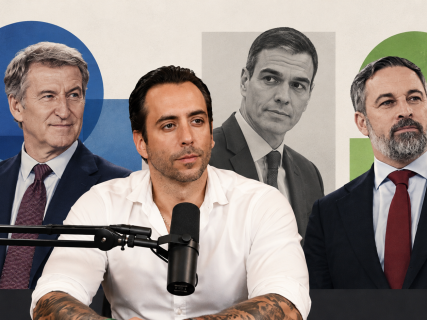

Jordi Wild premieres this Friday, coinciding with the start of the election campaign of 29N, his interviews with Pedro Sánchez, Alberto Núñez Feijóo and Ada Colau. The creator of 'The Wild Project' has prepared a different questionnaire for each candidate, with questions about the corruption cases that affect their parties, their economic proposals and some political decisions that still generate controversy. He has also not left out personal matters, such as Feijóo's relationship with Marcial Dorado, nor current affairs such as the train accidents in Adamuz and Urda.
The three conversations, recorded separately and without previously agreed questions, are published this November 13 on YouTube. Ada Colau has opened the series at 8:00 a.m., followed by Feijóo at 10:00 and Sánchez at 12:00. Wild also had two journalists tasked with checking the information during the recordings, which have an approximate duration of between one hour and an hour and a half.
The project arose with the intention of bringing the four presidential candidates for the government, but Santiago Abascal has been left out after Vox suspended its interview due to disagreements with Wild about the recording conditions and the use of the content. The decision was made after the controversy over the 40 minutes removed from the intervention of Vox leader in 'La Revuelta'.
Pedro Sánchez responds about Ábalos, Koldo, Cerdán and the train accidents
Pedro Sánchez has to explain to Jordi Wild why he wants to continue at the head of the Government, but he also has to respond for some of the crises that have accompanied the last months of his term. Among them, the train accidents in Adamuz and Urda, which led to Óscar Puente's resignation last November 3, after the then Minister of Transport appeared before the Permanent Commission of the Congress to give explanations about the disaster in Toledo, in which 69 people died.
Wild asks him about the political responsibilities of what happened before moving on to immigration, the Ceuta crisis and relations with Morocco. The integration of foreigners and Spain's demographic future complete that part of the interview, which then turns to one of the most delicate issues for the president: the judicial investigations that affect the PSOE.
José Luis Ábalos, Koldo García and Santos Cerdán are some of the names with which Sánchez must answer for his actions. The interviewer also asks him for explanations about Leire Díez and José Luis Rodríguez Zapatero, as well as about the investigations underway and their political consequences.
The amnesty, Bildu and Pablo Iglesias appear next among the questions about their parliamentary agreements and the changes of opinion he has carried out during his years in the Moncloa. There is also time to talk about housing, especially the price of rentals and the difficulties young people have in getting independent, and about political tension and insults.
Before wrapping up, Wild asks him to define Ada Colau, Alberto Núñez Feijóo and Santiago Abascal, a question he formulates analogously to the other interviewees. Sánchez closes the interview with a message addressed to voters.
Feijóo talks about Vox, pensions, taxes and his relationship with Marcial Dorado
Alberto Núñez Feijóo begins by talking about Vox and the possibility of governing in a coalition with Santiago Abascal. Wild asks him about political polarization and the agreements the PP could negotiate after 29N, before getting into the economic proposals with which the conservatives run for election.
Feijóo responds about the future of pensions, taxes on the self-employed, and the economic measures of his party. After that come questions about public debt, the deficit and defense spending, amid debate about Spain’s military commitments and the financing of the public accounts.
He also has to explain his positions on immigration. The situation in Ceuta and relations with Morocco lead to social assistance, the integration of foreigners and expulsions, matters in which differences between the PP and Vox have caused political disagreements.
Wild also brings up Feijóo’s old relationship with Marcial Dorado, after the photographs of the Galician leader alongside the drug trafficker have resurfaced in different stages of his career. The corruption investigations, including the Gürtel case and the procedures affecting the PSOE and the PP, will close the block about political controversies.
They also talk about Donald Trump, international politics, English and military service. Within his party, Feijóo responds about Isabel Díaz Ayuso and his relationship with the president of the Madrid region.
Ada Colau explains her return to politics and responds about housing, squatting and the division of the left
Ada Colau has returned to national politics as a candidate of Frente Amplio after her term at the head of the Barcelona City Council. Wild asks her about the reasons for her return and about the mistakes made during her years as mayor, especially in matters of security and cleanliness—two issues that sparked criticism of her municipal management.
Housing is of particular importance in her interview. Colau, who before arriving at the Mayoralty was the spokesperson for the Platform for People Affected by Mortgages, responds about rental prices, large landlords and real-estate speculation. The interview also includes housing squatting, non-payment and the problems faced by small landlords, matters on which she has defended different measures during her political career.
Wild also asks her about rail accidents and the management of the rail system, as well as immigration and relations with Morocco. In this latter area, the conversation turns to integration, cultural clash and coexistence, without leaving out the decline in birth rates and Spain’s demographic future.
The division of the left also forms part of the questions posed to Colau, who must explain the differences between Frente Amplio and Podemos, her relationships with Sumar and the PSOE, and the disagreements maintained by the different political formations. She also answers about corruption and political responsibilities.
The conversation ends with international and personal issues. Donald Trump, Israel and the flotilla are among the topics discussed, along with social networks and polarization.
Abascal, the fourth candidate who was left without an interview
Santiago Abascal had agreed to take part in 'The Wild Project', but Vox suspended the recording scheduled for Wednesday, November 11, after the party and Jordi Wild were unable to reach an agreement on the conditions for using the content.
This decision was preceded by the conflict with RTVE and El Terrat, whom Vox accused of failing to comply with what was agreed regarding Abascal’s interview on 'La Revuelta'. The group called for the publication of the 40 minutes removed from the broadcast and the delivery of the full recording, after denouncing that part of the leader’s responses had been left out of the program.
After that controversy, Vox demanded that it be able to have the complete recording of 'The Wild Project' and to use Abascal's responses with autonomy. Wild rejected those conditions, since it did not accept that the party had control over the subsequent use of his interview.
The content creator had initially obtained the commitment from the four candidates, but in the end he has only been able to record Sánchez, Feijóo and Colau. Abascal is therefore the only one of the invited leaders who does not participate in the electoral series.