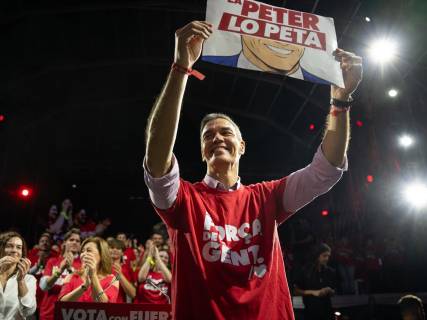

The President of the Government and PSOE candidate for re-election, Pedro Sánchez, this Saturday launched a new call for electoral mobilization ahead of the general elections on next 29 November, with a message on his social media in which he set out two figures as the keys to achieving a new progressive majority: 75% voter turnout and the 176 seats that mark the absolute majority in the Congress of Deputies. In this way, the socialist leader insists on the need to mobilize left-wing voters in an attempt to replicate a progressive Government for another four years.
"We must write down two figures: 75 and 176," Sánchez wrote on his X account, before explaining the objective his party pursues in the final stretch of the electoral campaign: "75% voter turnout to win 176 seats and a progressive absolute majority". The president accompanied this message with a direct appeal to his supporters to keep the mobilization going until the polls close: "Sweat the shirt until the very last minute, the last ballot paper in the last polling station."
The head of the Executive concluded his post with a statement of intent regarding the continuity of his Government: "Vote, to win, and to govern for four more years!". The message reflects the PSOE strategy of focusing its efforts on raising turnout and regaining progressive voters who are undecided or disillusioned, in an electoral scenario in which much of the polling published points to an advantage for the PP and to the possibility that the combined total of Popular and Vox could reach the parliamentary majority, while the latest CIS barometer places the socialists as the leading force.
Sánchez claims in Palma the "good politics" against Feijóo and Abascal
Sánchez’s message comes after his participation this Saturday in an electoral rally in Palma de Mallorca, held at the Son Fusteret venue, where he was accompanied by the general secretary of the PSIB-PSOE, President of the Congress and socialist candidate for the Balearic Islands, Francina Armengol. During the event, the President of the Government intensified his criticisms against the leader of the PP, Alberto Núñez Feijóo, and the President of Vox, Santiago Abascal, whom he has identified as representatives of a political alternative which, in his view, would entail a step back in the social advances of recent years.
In his intervention, Sánchez has assured that Feijóo and Abascal "offer no alternative, except cuts and the chainsaw", while he has defended the management of his Executive and has claimed the need to continue with social protection policies. The socialist candidate has insisted on contrasting what he calls "good policy" with the insults and confrontations that he attributes to the opposition, recovering one of the discursive pillars with which he is touring Spain during the campaign.
The president has also linked the leaders of the PP and Vox with international figures such as Donald Trump, Javier Milei, Giorgia Meloni and Viktor Orbán, considering that they share the same political orientation. In this context, he has again presented the elections of 29N as a choice between the continuity of his project and a change of Government led by the right, insisting on the importance of going to the polls to decide the political direction of the country.
The PSOE seeks to mobilize the left in decisive elections
The call for participation has become one of the main thrusts of the socialist campaign, especially in a context of fragmentation of the political space located to the left of the PSOE, where Frente Amplio and Podemos are running with differentiated candidacies. This division adds uncertainty to the distribution of seats in certain constituencies, in which the distribution of the vote may prove decisive for the composition of the next Congress.
Sánchez had already defended this same objective during events held on Friday in Arnedo (La Rioja) and Pamplona (Navarra), where he asked for 75% turnout in order to achieve an absolute majority of progressive MPs. The socialist leader believes that greater mobilization would make it possible to form an Executive with more parliamentary support and to move forward on measures related to housing, pensions, wages and public services, issues that his party intends to place at the center of the electoral debate.
However, a 75% share does not alone guarantee that the progressive bloc reaches 176 seats, since the composition of Congress will depend on the territorial allocation of votes and on the results obtained by each candidacy. The Spanish electoral system distributes the 350 seats by provincial constituencies, so the weight of each party in Parliament does not depend solely on its percentage of the vote at a national level.
The campaign for the general elections officially began on Friday, November 13, and now faces its first weekend, with the main candidates traveling through different autonomous communities. While Sánchez has chosen Palma to bolster Socialist mobilization, Feijóo has placed his election activity in Galicia and Abascal has scheduled events in Almería and Murcia. For her part, Frente Amplio candidate Ada Colau has moved her campaign to Seville, in a day marked by calls to vote and the confrontation between the different political projects.
With a little more than two weeks left until the election day, the PSOE is betting on turning mobilization into its main tool to contest the electoral outcome and regain support among progressive sectors. Sánchez insists that it is still possible to repeat the mobilization capacity that allowed him to keep his Government after the 2023 elections, although this time he raises his goal to an absolute majority of left-wing seats that would reduce his dependence on parliamentary agreements. On the next November 29, citizens will decide whether the Socialist president can continue in La Moncloa or whether a new political era opens in Spain.