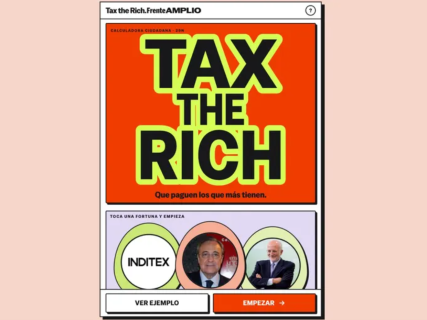

The 'Tax the Rich', an application that allows calculating how much money the State could raise with a wealth tax on the 50 richest Spaniards and deciding how to spend it. Users can choose an annual levy of 1%, 2% or 3% and distribute the resulting amount between healthcare, education, housing, and rail transport.
The initiative comes just 24 hours after Ada Colau presented her proposal for a tax on great fortunes at the Ritz hotel in Madrid, during an information breakfast organized by Nueva Economía Fórum. The Frente Amplio candidate for President of the Government argued that "there is no right to accumulate wealth, but there is to health, education and a dignified life," and denounced that "today the rich get richer at the expense of the effort of the working majority of society".
During her speech, Colau argued that Spanish tax pressure is between three and four points below the European average and defended that there is room to raise it. "What we want is for them to give back a bit of what society has given them", she said.
Presentamos la tasa TAX THE RICH desde el Ritz. pic.twitter.com/VeP6OH6ehr
— Ada Colau 💜🌈🔻 (@AdaColau) November 5, 2026
The announcement is part of a tax reform with which the coalition aims to raise an additional €10 billion per year through three measures targeting large fortunes, the banking sector, and large companies, and the accumulation of homes.
Now, the Broad Front transfers part of that proposal to a free digital tool, accessible from a mobile phone and without the need for registration or download.
A tax made-to-order and 20 tokens to distribute the money
The application uses as a reference the lists of Forbes España, which attribute to the 50 richest people in the country a combined wealth of about €250.55 billion. To prepare the calculation, the coalition has used the data for 2026 corresponding to the first ten fortunes and the data for 2025 for the remaining ones.
The user can apply the tax to the 50 people on the list, select groups, or choose individual fortunes. After that, they must set the tax rate percentage and how much money they consider would effectively reach the public coffers.
The tool offers three scenarios for effective collection: 50%, 75%, or 100% of the calculated amount. With this, the Broad Front allows results to be modified according to the degree of collection that one wants to consider.
Once the budget has been obtained, 20 tokens appear to distribute among trains, health care, education, and housing. Each one equals 5% of the estimated income.
The simulator then translates the amounts into examples of public investments, such as the purchase of Cercanías trains or the renewal of kilometers of track. It also allows the result to be viewed for one or four years and compared with Adif’s investment plan for 2022-2026, endowed with €24.1 billion. At the end, it generates an infographic that can be shared on WhatsApp and other social networks.
How much would the 50 richest Spaniards pay
According to the coalition’s calculations, a 2% tax on the wealth of the 50 largest fortunes, with effective collection of 75%, would make it possible to obtain about €3.758 billion per year.
If the same conditions were maintained for four fiscal years, the figure would exceed €15 billion. With the maximum rate of 3% and a 100% collection, the calculated revenue would amount to about €7.517 billion annually and exceed €30 billion in four years.
These figures, however, are simulations drawn up from wealth estimates and not official Treasury forecasts. They also do not correspond to the collection of an approved tax, since the tool allows choosing hypothetical collection percentages and does not necessarily reproduce all the deductions or conditions that a tax rule would have.
The initiative that Colau presented at the Ritz
At the information breakfast held on Thursday, Colau defended an annual tax of 2% on net assets over one million euros, which would rise to the 3% for those exceeding 50 million. The fee would be reduced based on what has already been paid through the Wealth tax and the tax on Large Fortunes.
According to the calculations of Frente Amplio, the measure would affect around 231,000 people, approximately 1% of those who file their income tax return. Among them would be the country’s 1,200 largest fortunes, with assets exceeding 50 million euros, to which the coalition attributes one third of the expected revenue.
The candidate justified the increase in taxation on large fortunes by the need to finance public services and recalled that, in her view, Spanish tax pressure allows increasing income without reaching the levels of other European countries.
The proposal presented at the Ritz is broader than the simulator launched this Friday. While the application is limited to the 50 largest fortunes and allows choosing different tax types, the tax in the electoral program would reach all assets that exceed one million euros, with the conditions and deductions set out by the coalition.
More taxes on banks and on those who accumulate homes
The tax on large fortunes is one of the three fiscal measures with which Frente Amplio calculates that it could collect an additional 10,000 million euros each year.
The second consists of increasing the effective taxation of large companies and banks through a review of tax breaks. Colau defended this measure by pointing out that, according to the figures used by her group, large groups pay between 7% and 9% of their profits, compared with the 19% or 20% that she attributes to small and medium-sized businesses.
The third proposal affects the accumulation of housing. The coalition proposes a 10% levy on the value of properties starting with the fourth home in the case of individuals, provided that the total exceeds 800,000 euros. For companies, the tax would apply from the first home, with exceptions when the properties are intended for affordable and stable rentals.
The left coalition calculates that the measure would affect more than 500,000 homes and aims to encourage their entry into the residential market at lower prices.
The Frente Amplio tax campaign reaches the networks
In addition to allowing users to compare different revenue-collection scenarios, the application includes a function linked to the Frente Amplio electoral campaign for November 29.
After distributing the 20 cards, the user can generate an image with their budget and share it on social media or send it via WhatsApp. The tool also invites people to join the campaign 'Que paguen los ricos', with which the coalition argues for higher taxation on large fortunes.
'Tax the Rich' is available at frenteamplio.info/taxtherich and allows the calculation to be repeated with different tax rates and budget distributions.