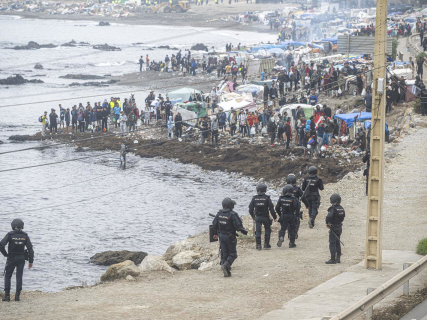

The National Police has identified 18 Moroccan civilian and police officials who were present in the vicinity of the border with Ceuta during the mass entry of migrants recorded on 30 and 31 July 2026. This is set out in a new report by the National Immigration and Borders Center (CENIF) sent to the National Court investigating judge María Tardón, into the circumstances of an unprecedented migration crisis and the possible criminal liabilities arising from those events.
The document places among those identified the governor of the Tanger-Tetouan-Al Hoceima region, Younes Tazi, and the Tetouan Police chief, Mohamed El Oualidi, as well as other command personnel from the security forces and representatives of the Moroccan Administration. The investigators consider that there are indications of a “planned and organized action”, upon detecting common behaviors among different police units and authorities that were deployed in the border area while tens of thousands of people were trying to access Spanish territory.
The report points to coordination between Morocco’s security forces
The investigation is based on testimonies from 81 migrants, the analysis of images captured during the days of greatest tension, and various minutes of photographic identification. Based on this material, the agents have reconstructed the presence and movements of Moroccan officials who were in Castillejos, a town near the Tarajal border crossing, during the hours when the main waves of entry occurred.
According to CENIF, in the same area there were members of the Auxiliary Forces, the Gendarmerie, the Moroccan Police and various civilian authorities, whose conduct would reflect the existence of a higher level of coordination. The document includes situations of inactivity, control of movements, and alleged indications to migrants to head toward the sea and cross by swimming to Ceuta.
One of the elements that draws researchers’ attention the most is that numerous statements coincide in pointing out that Moroccan agents guided people toward the water, instead of preventing their approach to the border. For the Spanish Police, this coincidence, along with the presence of officials from different organizations, reinforces the hypothesis that the events were not exclusively the result of an unplanned, spontaneous mobilization, but that they may have responded to shared instructions.
Who are the Moroccan senior officials identified by the Police
Among the most relevant figures appears Mohamed El Oualidi, Police prefect of Tetuán, whom several migrants have recognized in the images analyzed by the investigators. The report places him during the afternoon of July 30, between 18:00 and 20:00 hours, on the avenue that connects Castillejos with the border post, where he would have been giving instructions to other officers while one of the large waves of entry was taking place.
The police official also appears during the night of July 30 and the early hours of July 31; this time, dressed in civilian clothes and gathered with other authorities in the vicinity of the beach. In those same images, investigators have identified Younes Tazi, governor of Tánger-Tetuán-Alhucemas, the highest civil authority of Morocco’s Ministry of the Interior in the region and responsible for certain competencies related to maintaining public order.
The list of identified individuals also includes Abdel Fattah Sayed Al-Radi, security chief for M'Diq-Fnideq, and Muhammad Al-Sassi, commander of the Mobile Public Order Groups, units with functions similar to those of the Spanish riot police. They are joined by Youssef El Hajji, pacha of Castillejos, whom the investigators place giving instructions to police personnel in an area near the access points used by the migrants.
Also appearing are Rachid El Kaddouri, head of the security district of Tetuán; Yassine Jari, governor of the M'Diq-Fnideq prefecture, and other administrative, police, and Auxiliary Forces officials. However, the degree of identification and the available evidence differ in each case, since some have been recognized by witnesses, while the presence of others has been established through images and open sources.
The National High Court investigates whether an organized operation against Spain took place
The new document is added to the proceedings opened by the judge María Tardón on September 7 of last year, with the aim of determining whether the events recorded in Ceuta may constitute crimes related to the peace or independence of the State and against the rights of foreign citizens.
The judicial investigation seeks to clarify whether behind the mass arrival of migrants there was an operation intended to overwhelm the Spanish border-control devices and whether certain officials from the Moroccan authorities played any role in its organization, execution, or facilitation. Previous police reports had already warned about the presence of uniformed and plainclothes agents in attitudes compatible with guiding and controlling the movement toward Spanish territory.
However, the identification of these 18 persons does not imply that all of them committed a crime, nor does it by itself establish criminal liability. The report provides indications about their presence, their functions, and certain behaviors observed during the crisis, but it will be the judicial investigation that must determine the scope of those events and decide whether there is sufficient evidence to attribute specific responsibilities.
The mass entry of July and the warnings prior to the crisis
The events of July 30 and 31, 2026 triggered one of the largest border crises recorded in Ceuta. Tens of thousands of people crossed from Morocco to the autonomous city, mainly in the area of the Tarajal breakwater, while Spanish security forces attempted to contain a situation that ended up overwhelming the usual monitoring and control devices.
The scale of the arrivals made it necessary to reinforce the presence of agents and mobilize the Army, in a series of days marked by chaos at the border access points and the death of numerous migrants during attempts to cross by sea. The crisis also opened a debate about the warnings from intelligence services and the information available to the Spanish authorities before the first waves occurred.
The new report represents an advance in the reconstruction of what happened by incorporating specific identities and placing different Moroccan authorities at strategic points during the most critical hours. The National Court continues now with the steps to determine who could have organized or facilitated the mass mobilization and to what extent any possible coordination took place among those responsible present at the border, an issue that may have important judicial and diplomatic implications for relations between Spain and Morocco.