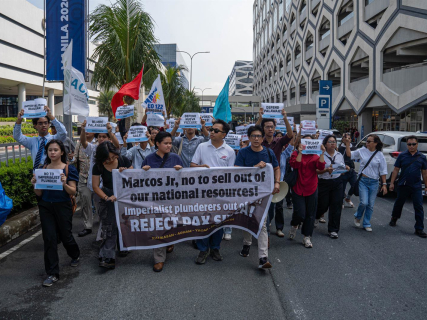

After people have been arrested and 16 Police officers have been injured following the action of the security forces to contain the march by protesters who were trying to move forward to the headquarters of the 49th ASEAN Summit of the Association of Southeast Asian Nations (ASEAN), which takes place in Pasay, on the outskirts of Manila.
A police spokesperson, Philip Ines, has confirmed the eleven arrests in the vicinity of the International Convention Center of the Philippines, the venue of the meeting, for "causing disturbances and protesting in front of one of the "free parks", the protected areas linked to the summit, according to the Filipino newspaper 'SunStar'.
The march had set out from Liwasang Bonifacio, in the heart of Manila, heading to Pasay, under a heavy security deployment, to protest against the President of the United States, Donald Trump, who will arrive in the country on Tuesday, and his Pax Silica proposal to guarantee the supply chain of critical raw materials.
The head of the Kilusang Mayo Uno (KMU) union, Jerome Adonis, indicated that the officers blocked their advance citing the lack of authorization for the protest. After nearly an hour trying to approach the headquarters of the meeting, the participants chose to return to the Liwasang Bonifacio plaza.
Eyewitnesses have denounced pushes, slaps, and punches by police officers against protesters, according to the Filipino portal Rappler. "The incident started with the Police, not with us. We were only defending our group," Adonis emphasized.
The head of the Manila Police, Christopher Abrahano, warned the protesters that they had to respect the "free parks" or assume "all the weight of the law".
The Pax Silica is implemented in the Philippines in an industrial area of more than 1,600 hectares with U.S. capital, among other countries, which entails the displacement of indigenous and farming communities in New Clark, in the province of Tarlac. The agreement was scheduled to be signed during Trump's visit, but it would have been postponed and could be concluded before the year ends.
The Philippines as host country
"The Philippines, as host of the 49th ASEAN Summit, has the responsibility to demonstrate whether it has the capacity, stability, and hospitality for heads of state, foreign delegates, and international visitors invited for the visit," another police spokesperson, Felino Nabato, argued.
At the same time, Abrahano has stressed that "the protection of public order can never be at the expense of the constitutional rights of the population," and therefore has demanded of the personnel "maximum tolerance, professionalism, restraint and respect for human rights" in the face of the protests.
Regarding the content of the summit, the Philippines aimed to take advantage of its term presidency of ASEAN during the last year to move forward a Code of Conduct for the South China Sea with which to address the tensions in this disputed area between several States.
However, the Philippine foreign affairs minister, María Theresa Lázaro, has admitted this Sunday that the text is only agreed on by 80% and that, therefore, it will be Singapore that must complete the negotiations. "We leave it to Singapore," who assumes the rotating presidency in January, Lázaro explained to the media.