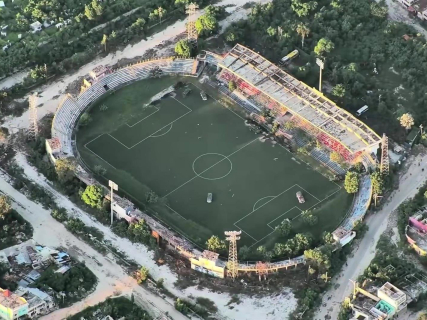

The president of El Salvador, Nayib Bukele, said this Friday that units of Salvadoran special forces, in collaboration with the Haitian Police and the Haitian Army, have taken control of the Sylvio Cator stadium in Port-au-Prince. Inside the sports venue, several human skulls were found, and the place will be used as an operational base to launch new offensives against the armed gangs that dominate the area.
"Under a bilateral agreement between the governments of Haiti and El Salvador, a joint operation in which the Haitian National Police, the Armed Forces of Haiti, the working group and the Salvadoran Special Forces participated has taken control and successfully secured the Sylvio Cator stadium. During the operation, we discovered several human skulls inside it," Bukele detailed through a message on social media.
The Salvadoran leader said that the allied forces now have "tactical advantage on the ground" and stressed that the stadium will function as a starting point to "continue moving toward the interior of the territory controlled by the gangs." According to his assessment, the installation will become a key enclave for the upcoming operations.
In the face of the offensive that is being prepared, Bukele issued a new warning to members of criminal organizations: "I strongly urge all members of the gangs to leave the area before the offensive begins. Those who decide to stay and confront our forces will assume the consequences," warned the Salvadoran head of state, reiterating that there will be no concessions for those who remain in the area.
The deployment in Port-au-Prince is part of the contingent of more than 2,000 personnel that San Salvador maintains in Haiti, with the priority of locating and rescuing four Salvadoran military personnel — technical air assistants — who have been missing since an ambush by armed gangs in the Haitian capital. This search and rescue mission conditions much of the operations on the ground.
In recent days, Salvadoran forces had already increased their military activity in the Caribbean country, with air strikes with which Bukele claims to have destroyed the headquarters of the 400 Mawozo gang, in addition to providing air support to Chadian personnel of the Gang Suppression Force (GSF), a structure backed by the United Nations to combat criminal groups.
On the other hand, the Salvadoran vice president, Félix Ulloa, defended on Thursday at the XXX Ibero-American Summit held in Madrid the legitimacy of the operation, relying on a “bilateral arrangement” with the Executive of the Haitian prime minister, Alix Didier Fils-Aimé. His statements responded to the reservations raised by the United States about a possible risk of lack of coordination between the Salvadoran forces and the rest of the international troops deployed on the island.