
On April 26, 1986, a huge radioactive plume rose over the Soviet city of Pripyat, in present-day Ukraine. It came from reactor number 4 of the Chernobyl nuclear power plant, located a few kilometers away, and would end up spreading over a large part of Europe. Four decades later, that accident remains the biggest civil nuclear catastrophe recorded to date.
Today, the plant remains out of service as an energy facility, but continues to be active in containment, surveillance, and decontamination tasks. Furthermore, the war between Russia and Ukraine has brought Chernobyl back to the center of international debate on nuclear risks in wartime contexts. In February 2025, a Russian drone impacted the protective structure of the damaged reactor, without causing radioactive leaks, but reopening alarms about the vulnerability of these infrastructures.
The night that changed Europe
The accident began during a safety test on reactor 4. Operators were simulating a power outage to check if the auxiliary systems could maintain cooling until the emergency generators kicked in. However, a combination of human errors, technical deficiencies, and design flaws led to an uncontrolled overheating.
The explosion lifted the reactor lid and released large quantities of radioactive material into the atmosphere. The cloud contained particles of radioactive iodine, strontium, plutonium, and graphite, among other highly contaminating elements.
Various estimates maintain that the radiation released was hundreds of times greater than that recorded in Hiroshima after the atomic bomb of 1945.
A questioned design
The Chernobyl reactors belonged to the RBMK model, a system widely used in the former Soviet Union. Numerous experts have pointed out over the years that this design presented serious safety deficiencies and would hardly have been authorized in many Western countries.
The tragedy also exposed Soviet secrecy. During the first hours and days, authorities downplayed the accident, delayed evacuations, and withheld key information from both the population and the international community.
The evacuation and the "liquidators"
After the explosion, the Soviet Union evacuated about 130,000 people, including the nearly 50,000 inhabitants of Pripyat, which has since become a ghost town. At the same time, a 30-kilometer exclusion zone was established around the plant.
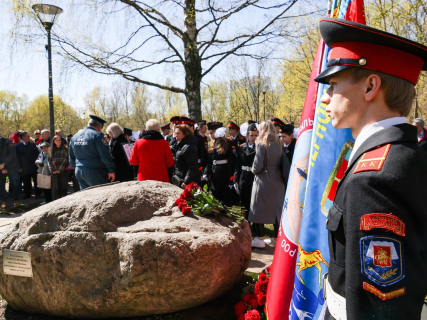
To contain the disaster, hundreds of thousands of people were mobilized, later known as the liquidators: military personnel, firefighters, miners, engineers, and civilian workers tasked with extinguishing fires, removing radioactive debris, and erecting the first protective structures.
It is estimated that around 600,000 people participated in those tasks.
The new sarcophagus and the threat of war
In 2016, a gigantic metal structure was installed over the destroyed reactor, known as the New Safe Confinement, also called “The Arch”. Designed to isolate the radioactive remains for approximately one century, it was considered one of the largest nuclear engineering projects in the world.
However, six years later, the start of the full-scale Russian invasion altered the future of the plant again. Russian troops occupied Chernobyl in February 2022, in an operation that placed the facility at the center of the conflict. In addition to its symbolic value, the plant is located just 90 kilometers from Kyiv, which gives it strategic importance.
The occupation was brief and ended in late March of that year, when control returned to Ukrainian hands. But during those days, power outages occurred that compromised essential systems for spent fuel and hindered the rotation of technical personnel. The international community followed the situation with concern given the risk of an additional incident.
Radiation, drones and new alerts
The fighting in the area also caused a temporary increase in radiation levels. Experts and anti-nuclear organizations explained that the passage of heavy vehicles and military movements stirred up contaminated dust accumulated on the ground since 1986.
The alarm reactivated in February 2025, when a drone impacted the reactor's protective cover. Although no leaks were recorded, the episode reinforced the idea that such a facility remains exposed in a war scenario.
Several specialists recall, however, that deliberately destroying a nuclear power plant would have unpredictable consequences even for the attacker, as radioactive dispersion depends on meteorological factors and can spread without borders.
Zaporizhzhia, the other great risk
Despite the symbolism of Chernobyl, numerous analysts consider that the greatest nuclear threat of the conflict is at the Zaporizhzhia plant, occupied by Russia since 2022. It is the largest nuclear power plant in Europe, with six reactors in operation before the war.
The International Atomic Energy Agency maintains inspectors on the ground to supervise the security conditions and try to avoid an escalation with major consequences.
A wound that does not close
Forty years later, Chernobyl is simultaneously a memorial, a laboratory, and a warning. It symbolizes the risks of political opacity, the limits of technology without sufficient controls, and the persistence of radioactive effects long after the initial disaster.
The plant stopped producing electricity years ago, but its history remains fully alive.