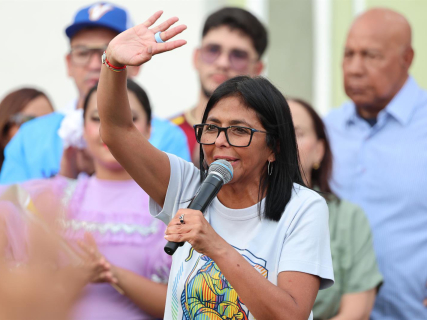

The acting president of Venezuela, Delcy Rodríguez, has emphasized that the upcoming electoral processes in the country must have as their main objective "to solve problems" and not become an additional factor of conflict, calling for the responsibility of all political actors in the context of the dialogue table between the Government and the opposition.
At an event held in the state of Carabobo, Rodríguez has advocated for peaceful coexistence and respect for institutional guarantees, stressing that political consensus must translate into concrete advances for the population. Thus, she has positioned the third cycle of conversations with the opposition within the strategy to promote economic recovery, strengthen public services, and demand the restitution of assets abroad, including the return of the gold held at the Bank of England, in order to allocate it "to the salaries of workers, the electrical system, and hospitals."
Regarding the upcoming electoral dates in the South American country, Rodríguez has lashed out at those groups that, in her opinion, foster confrontation or prioritize their partisan interests. "I know that there are those who are hungry for power, who juggle and put on all kinds of 'shows' for power. We are not here for power; we are here to serve the people," she has stated.
The Venezuelan leader has once again expressed her support for the recently approved amnesty law, which she considers a key tool for "radical sectors to abandon violence forever," and has urged all parties to focus their efforts on institutional work and discard any path that involves altering public order.
Her words come just a few days after the main opposition leader, María Corina Machado, announced her return to Venezuela after ten months outside the country, a return that was accompanied by massive caravans and demonstrations of citizen support in various regions.
However, the Nobel Peace Prize winner has stayed on the sidelines of the third round of conversations between the interim Executive and the representatives of the opposition —led by Dinorah Figuera and the president of the National Assembly, Jorge Rodríguez— a process aimed at establishing the foundations for electoral guarantees and which has the explicit support of the United States to reinforce democratic stability in Venezuela.