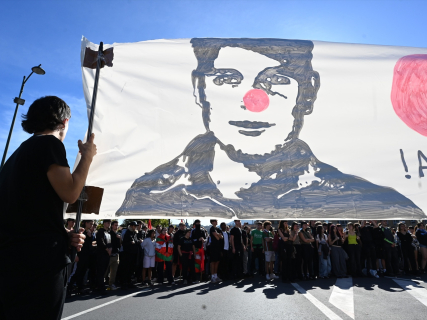
Riots in Bilbao after the event of Vito Quiles was canceled: nine arrested and several cars set on fire

The Ertzaintza has charged against groups of protesters in Deusto after the communicator suspended his visit for security reasons. The disturbances began when the police device had already withdrawn from the area.

EuropaPress 7870720 manifestantes movilizaciones presencia vito quiles plaza eliptica 26

EuropaPress 7870720 manifestantes movilizaciones presencia vito quiles plaza eliptica 26

Add DEMÓCRATA to Google

Ask FREN

Published

Last updated

3 minutes

Most read

Elecciones 29N · Encuestas

La media de las encuestas

Media a 26 de octubre de 2026 · 15 institutos

  • PP31,0 %
  • PSOE27,3 %
  • Vox18,9 %
  • Sumar6,3 %
  • Podemos2,9 %
  • ERC2,3 %
010203040ene 2024jul 2024ene 2025jul 2025ene 2026jul 2026

Media del último estudio de cada instituto en 30 días y su evolución semanal desde el 23J. Partidos con al menos un 2 %.

Todas las encuestas

Elecciones generales del 29 de noviembre · Demócrata

At least nine people have been arrested this Monday in Bilbao during the riots recorded after the cancellation of an event by Vito Quiles in the vicinity of the University of Deusto. The incidents have left several vehicles burned, containers used as barricades, and confrontations with the Ertzaintza, which has had to redeploy its riot units to intervene in the area.

The altercations began late in the afternoon on the avenue of lehendakari Aguirre, in the neighborhood of Deusto, and then spread to the vicinity of the Iberdrola tower. Several hooded individuals have crossed containers, launched flares, and set fire to parked cars and a motorcycle of the Bilbao Municipal Police. Firefighters have arrived to extinguish the fires while the Ertzaintza advanced through the streets to disperse the participants.

The Department of Security of the Basque Government has reported that a group of people concentrated against Quiles' visit headed towards the Deusto police station with stones. It has also pointed to a possible premeditated action, as the incidents occurred when the event had been canceled for hours.

Vito Quiles suspends the event for security reasons

The communicator was scheduled to hold a meeting at 7:00 PM in Bilbao, but announced its cancellation after contacting the Ertzaintza and learning about the risk of incidents.

According to the Department of Security, Quiles called the Basque Police at 2:00 PM to inquire if he could move the event to another location, a possibility that was ruled out. At 4:06 PM he communicated in writing that he was renouncing to hold it.

On his social media, Quiles has assured that he had received a warning about a "very high" risk of incidents and has held the participants in the protests responsible for the suspension. "Freedom of expression is sacred but not more important than protecting the integrity of all the good young people who attend these events", he stated.

He has also linked the controversy to the general elections on November 29, warning that he will return to Bilbao and call for a response at the polls.

Controversy over the withdrawal of the Ertzaintza's device

One of the most controversial points of the day has been the police action. Although the Ertzaintza had deployed a wide security device from the early hours, some of the agents have withdrawn after the cancellation of the event was announced.

The fires began when the police presence had been reduced and the riot units returned around 7:40 PM, after the disturbances had been ongoing for several minutes.

The police union Erne has criticized the decision to dismantle the operation and has asked for explanations from the security officials. According to the organization, the cancellation of an event does not automatically eliminate the risk of incidents, especially when concentrations continue and there is tension in the streets.

The University of Deusto has suspended classes

The day had begun with two mobilizations against the visit of Quiles. The first, called by the student organization Ikasle Antolakunde Sozialista (IAS), took place in the morning, while another demonstration by antifascist groups occurred in the afternoon.

In anticipation of protests, the University of Deusto has suspended its activities from 2:00 PM and has closed the Bilbao campus starting at 3:00 PM. The institution has clarified that the event announced by Quiles was unrelated to the university and has rejected messages and behaviors that may harm coexistence.

The visit has also provoked a crossfire of political statements. The youth organizations of the PSE-EE and the PNV have criticized the presence of the communicator, while the Basque PP has defended its right to express its opinions and has questioned the closure of the campus.

More key points, information and questions with FREN

AI-GENERATED CONTENT

What is the usual procedure for a university to suspend its activity due to external protests?

The usual procedure is for the university to assess the risk, make a decision through the competent body, and communicate which activities are suspended, for how long, and how the measure will be reviewed. An external protest does not automatically imply closing the campus: the determining factor is whether it compromises safety, blocks access, or makes it unfeasible to maintain activity. There is no identical procedure for all universities; the specific competence must be determined according to their statutes, internal regulations, and emergency plans.

1. Assess the situation and risk

The first step is usually to gather security information, building managers, and management teams. It is advisable to distinguish between a peaceful gathering near the campus, a blockade of access points, and a situation involving threats or violence. The assessment should consider observable facts, not only the content or orientation of the protest.

  • Possibility of safely entering and exiting buildings.
  • Risks to students, staff, visitors, and especially vulnerable persons.
  • Impact on evacuation routes and emergency service access.
  • Expected duration and possibility of maintaining activities in other spaces.
2. Identify who can decide

It must be verified which authority has the power to suspend activities and what delegations exist. The rectorate usually intervenes in general decisions, while center or building managers may have specific functions. It is not advisable to equate these functions: managing a local incident does not necessarily mean being able to suspend all university activity.

It is also necessary to separate urgent protective action from the closure decision. In the face of immediate danger, evacuating or temporarily restricting access may be necessary before formalizing a broader suspension.

3. Choose a proportionate measure

Complete suspension should be considered against less restrictive alternatives: changing access points, relocating classes, postponing certain events, limiting the use of a building, or temporarily adapting teaching when feasible. The measure must respond to the specific risk and have a justified scope.

It is essential to specify what "suspending activity" means: canceling in-person classes does not equate to closing buildings, suspending exams, interrupting research, or stopping administrative services. Some facilities may require continuous attention even if general access is limited.

4. Document and communicate the decision

An orderly decision should record the reasons, the authority adopting it, the affected spaces, the start of the suspension, and the review time. If urgency requires acting first, it is advisable to document afterward what happened and the instructions given.

Communication should be disseminated through institutional channels and provide clear operational instructions:

  • Who must leave the campus or avoid traveling.
  • Which activities continue and which are postponed.
  • How exams, practicals, and other affected obligations will be handled.
  • Where updates will be published and whom to contact for incidents.
5. Coordinate the response and review the suspension

When there are security or access problems from outside, it is appropriate to coordinate with emergency services and competent authorities. This coordination should not be confused with the academic or organizational decision to suspend activities.

Finally, the university should periodically review whether the circumstances that justified the measure persist and communicate the reopening. The key is a motivated, limited, and reviewable decision, accompanied by solutions to reduce academic harm. To determine the required procedure in a specific case, it is necessary to identify the university and examine its applicable rules.

What powers does the Ertzaintza have regarding public order according to Basque legislation?

The Ertzaintza is tasked with protecting rights and freedoms, ensuring citizen security, and preserving peaceful coexistence in the Basque Country. Regarding public order, its actions must protect people and their property, prevent disturbances, and respond to them within its competencies. It is not an unlimited power: it is subject to the law, the direction of competent authorities, and respect for fundamental rights.

Applicable legal framework

The two main regional references are Legislative Decree 1/2020, of July 22, which approves the consolidated text of the Basque Police Law, and Law 15/2012, of June 28, on the Organization of the Public Security System of the Basque Country. The former replaced the articulated text of Law 4/1992 and its amendments. Both laws refer to Article 17 of the Statute of Autonomy to delimit police competencies.

What functions does it include?
  • Security and coexistence. The Police Law expressly establishes the mission to guarantee citizen security, ensure peaceful coexistence, and protect people and their property. Public order must be understood as serving the exercise of rights, not as an end detached from them.
  • Prevention and protection. Articles 2 and 3 of Law 15/2012 orient the system towards risk and threat prevention and protection against acts that disturb security. They require planning the response, acting with proximity, and evaluating results.
  • Operational response. The consolidated text foresees that the Ertzaintza's structure covers areas of citizen security, administrative police, criminal investigation, and operational resources. This framework allows organizing the necessary services to carry out its functions but does not by itself authorize any restrictive measure.
  • Crime investigation. Its agents must assist in investigating crimes and identifying and securing those responsible, within the statutory scope and Security Board agreements. As judicial police, they act under the direction of judges and prosecutors; their specialized units functionally depend on them in assigned actions.
Demonstrations and large gatherings

The protection of rights and security constitutes the framework for deployments during demonstrations and gatherings. It is important to distinguish an explicit attribution: the consolidated text provides that local police collaborate in protecting demonstrations and maintaining order in large human gatherings when requested. This collaboration does not mean they depend organically or functionally on the Ertzaintza: they remain dependent on their municipalities.

Direction and coordination

The leadership and supreme direction correspond to the Basque Government department competent in security, under the supreme command of the Government, exercised through the lehendakari. The department directs, coordinates, inspects services, and plans their actions.

Coordination with State Security Forces and Corps is carried out through the Security Board, according to Article 17.4 of the Statute. Basque legislation preserves state competencies: it does not grant the Ertzaintza exclusive competence over all police activity carried out in the Basque Country. Coordination commissions exist with local police to articulate interventions respecting each body's functions.

Limits and control

Article 3.2 of Law 15/2012 requires that any restriction of rights have legal authorization, be necessary, motivated, and proportionate, and that the least restrictive measure be chosen without discrimination. Additionally, agents are personally liable for actions contrary to regulations. The Control and Transparency Commission must study ex officio police interventions causing deaths or serious injuries.

What results did the PNV obtain in the last Basque regional elections?

The PNV obtained 372,456 votes, 35.17%, and 27 seats in the last Basque Parliament elections, held on April 21, 2024. It was the most voted candidacy across the Basque Country, although it tied in the number of parliamentarians with EH Bildu. The result allowed its candidate, Imanol Pradales, to be subsequently elected lehendakari with the support of the PSE-EE.

PNV's results

The three main figures describe different aspects of the result: votes express the support received; the percentage shows its electoral weight; and the seats determine its representation in the Basque Parliament.

  • 372,456 votes: was the total support reached by EAJ-PNV. The party confirmed this figure when its representatives presented their credentials after the elections (parliamentarians' accreditation).
  • 35.17% of the votes: this percentage placed the PNV ahead of other candidacies across the Basque Country (results and electoral context).
  • 27 seats: this was its representation in a chamber of 75 members. The PNV thus held 36% of the seats but did not have an absolute majority on its own (Basque Parliament constitution).
First in votes, tied in seats

The important distinction is that winning in votes did not mean obtaining more seats than EH Bildu. Both candidacies secured 27 representatives. Therefore, the precise balance for the PNV is a first position in electoral support and a tie in parliamentary representation, not its own majority (chamber distribution).

The Parliament resulting from those elections was composed as follows (Demócrata, May 14, 2024):

  • PNV: 27 seats.
  • EH Bildu: 27 seats.
  • PSE-EE: 12 seats.
  • PP: 7 seats.
  • Sumar: 1 seat.
  • Vox: 1 seat.

This distribution helps interpret the result without confusing electoral position with governing capacity. The 27 PNV representatives placed it eleven seats short of the 38 that constitute an absolute majority in a chamber of 75 members. The support of the twelve PSE-EE parliamentarians allowed surpassing that threshold.

What consequence did it have for the Basque Government?

The electoral result led to the election of Imanol Pradales as lehendakari on June 20, 2024. He received 39 votes: the 27 from the PNV and the 12 from the PSE-EE. This is recorded in the official Basque Government communication about that investiture session (Pradales' election).

Therefore, it is advisable to separate two moments. On April 21, the Parliament representatives were elected; on June 20, that chamber elected the lehendakari. The 39 investiture votes were not seats obtained by the PNV at the polls but the sum of its representatives and those of the PSE-EE.

In summary, the PNV ended the last Basque regional elections as the most voted force, with 27 seats and without its own majority. It tied with EH Bildu in parliamentarians and managed to maintain the Basque Government leadership through an agreement with the PSE-EE.

Play

Test your knowledge with FREN!

How much do you know about this topic? Answer the following 3 questions.

How many people have been arrested during the riots following the cancellation of Vito Quiles' event in Bilbao?

Question 1 of 3

What measure did the University of Deusto take in anticipation of protests due to Vito Quiles' visit?

Question 2 of 3

What criticism did the police union Erne make regarding the Ertzaintza's actions?

Question 3 of 3