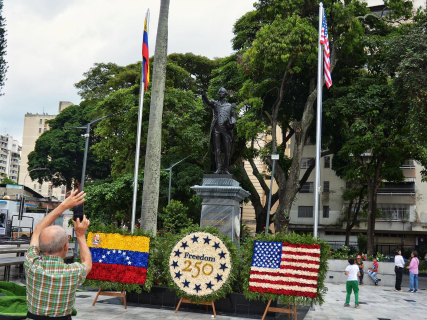

The acting president of Venezuela, Delcy Rodríguez, and the chargé d'affaires of the United States, John Barrett, have presided this Friday over the reopening of Washington Square in the heart of downtown Caracas, on the occasion of the 250 years of U.S. independence. The event is part of the recent phase of rapprochement between Caracas and Washington following the capture of the former Venezuelan president, Nicolás Maduro.
The Venezuelan leader has emphasized that the reopening of Washington Square seeks to honor the historical figure of the American independence leader and his decisive role in his country’s independence, establishing a parallel between his legacy and the emancipatory feat of Simón Bolívar in Latin America.
Delcy has also insisted on the importance of reclaiming one’s own historical memory, while paying tribute to the heroes of other nations, reaffirming the country’s support ahead of the imminent celebration of the anniversary of U.S. independence.
"This reopening is a tribute to a leader of independence and to a president of the United States; it is a heartfelt tribute to the historical legacy he left, just as Bolívar opened the way for the peoples of America. It is important to know the history of their countries and to recognize the heroes of other nations. We join in the jubilation for the 250 years of independence of the United States," the acting president has celebrated, who has laid a floral offering before the statue located in the parish of El Paraíso.
Rodríguez has been accompanied by a sizable delegation from her Executive branch, which included the heads of the portfolios of Economy and Finance, Public Works and Services, and Foreign Affairs, in addition to the mayor of Caracas.
In representation of the United States, the chargé d'affaires, John Barrett, the Under Secretary of the Department of State for South America, and several senior officials from the Treasury and Energy departments have attended.
This gesture of easing tensions takes place in a context marked by Washington’s demand to replace the "electoral infrastructure" inherited from the previous regime, with the aim of ensuring a political transition with defined timelines and new democratic guarantees.