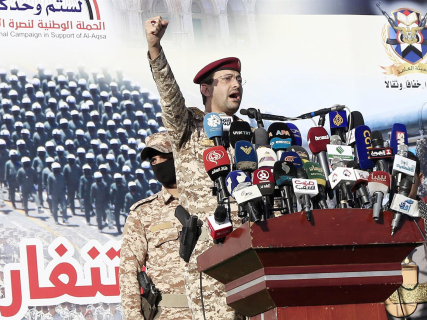

The Houthi rebels of Yemen announced this Thursday a series of rocket and drone attacks against facilities and camps of the government forces in the governorates of Marib and Hadramut, located in the east and north of the country.
The military spokesman of the movement, Yahya Sari, stated on social media that "Our Armed Forces have carried out a qualitative and large-scale military operation against concentrations of the Saudi enemy in the areas of Al Ruaik, Al Abr, Al Zaniyh, and other camps belonging to the so-called First and Third Emergency Divisions."
According to Sari himself, "hundreds of Saudi mercenaries" would have lost their lives and the Houthi forces would have managed to "destroy and burn a large number of camps, warehouses, and enemy weaponry," although for now no official casualty balance has been provided.
The media center of the First Division of the Emergency Forces of Yemen confirmed on social media that "the Houthi militias have attacked government camps," confirming the existence of "material and human losses" as a consequence of these bombings.
As the fighting intensifies, the Ministry of Defense of the government recognized by the international community has announced the start of a broad security campaign that will extend across several governorates, with special emphasis on Hadramut and Al Mahra.
Condemnation from the United States and escalation of the internal conflict
The United States Embassy in Yemen conveyed its "deepest condolences to the families of the brave Yemeni soldiers who died today in Hadramut and Marib" and described the attacks as "cowardly." In its message, it emphasized that "The cowardly attacks by the Houthis, backed by Iran, represent yet another example of their terrorism against the Yemeni people," and expressed its wish for "a speedy recovery for the wounded."
These events occur following the death of Osama al Radfani, a high commander of the Homeland Shield Forces — a formation linked to the Yemeni government and funded by Saudi Arabia — in an ambush recorded over the weekend in the province of Hadramut.
The Minister of Information of Yemen, Muamar Al Eryani, held the Houthi insurgency responsible for this attack, which he described as part of a continued offensive against military commanders, security officials, and key figures in the efforts to restore state authority.
In a message disseminated on social networks, Al Eryani stated that "This cowardly crime reveals once again the terrorist nature of this militia, which only believes in the logic of terrorism, murder, and attack, and which uses chaos and violence as means to implement the agenda of the Iranian regime in Yemen and the region."
In this context, the Southern Transitional Council (CTS) formally accepted in January to withdraw its forces from the bases and strategic enclaves of Hadramut and Al Mahra, transferring its control to the Homeland Shield Forces, brigades created by the Yemeni Presidential Leadership Council and that operate under the direction of the coalition led by Saudi Arabia.
The CTS separatists supported the Government during the most intense phases of the war in exchange for their aspirations for independence to be addressed, in a country that was divided into North Yemen and South Yemen until 1990.
Tension flared again at the beginning of December last year, when the CTS launched an offensive on the eastern provinces of Al Mahra and Hadramut, included in its territorial claims. This operation was responded to by Riyadh, an ally of the Yemeni Executive, with bombings on the areas seized by the separatists.