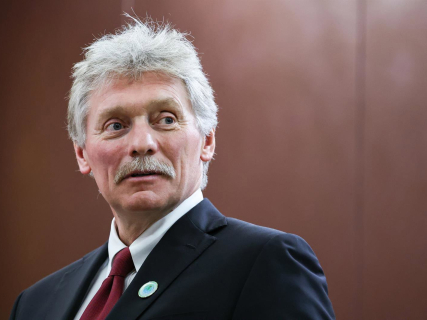

Russian authorities have indicated this Monday that the latest statements by the European Union (EU) regarding negotiations concerning Ukraine “suggest reluctance to contribute to the peace process,” although they have emphasized that Moscow continues to hope “to understand from the mouths of the Europeans how its position can help” in those efforts.
“We have heard statements both from (the President of the European Commission, Ursula) Von der Leyen and from her colleagues in Brussels saying that unconditional support for Ukraine will be maintained,” Kremlin spokesperson Dimitri Peskov has said, who has stressed that the bloc has already indicated that it “will maintain the line of increasing pressure on Russia to force it to take part in the peace process.”
“These proposals suggest reluctance to contribute to the peace process,” he added, before insisting that Russia “has said on repeated occasions that it would be good to understand from the mouths of the Europeans how its position can help the peace process.” “So far, the negotiations have been coordinated in trilateral format,” he indicated, referring to contacts between Moscow, Washington and Kyiv.
In this vein, the spokesperson for Russian President Vladimir Putin has pointed out that “perhaps it will be possible to clarify the position of the Europeans and draw some conclusions about the advisability of their participation in the negotiation process at this stage,” according to statements collected by the Russian news agency TASS.
Peskov has stressed that Russia “does not want a temporary ceasefire, but a peace that will last for many years and centuries.” “That is why the special military operation continues --the name with which Moscow refers to the invasion of Ukraine, launched in February 2022 by order of Putin--, being the path of negotiations that should take us towards peace,” he said.
At the same time, he has reiterated that Moscow will not allow Ukraine “to take any step that allows it to heal its wounds” through a simple ceasefire, while he has stressed that the peace process “requires time, is complex and has an enormous number of details,” and therefore he has asked not to expect immediate progress. “The importance of each one (of these details) is difficult to overstate. The work continues,” he concluded.
Peskov’s statements come after Von der Leyen reiterated on Sunday that Europe will participate “actively” in the peace talks between Ukraine and Russia through the format “E5 + EU” —composed of representatives of the Community institutions together with Germany, France, the United Kingdom, Italy and Poland—, ensuring that in the meantime they will maintain the “maximum support” for Kiev and “maximum pressure” on Moscow.
The Heads of State and Government of the Twenty-Seven endorsed on Friday at the Dublin summit the launch of this European negotiating team, given the impossibility of reaching consensus on a single envoy, thereby extending the previous “E3” format (Germany, France and the United Kingdom) with the entry of Italy and Poland, as well as representatives of the Commission and of the European Council.
On the other hand, the special envoys of the United States, Jared Kushner and Steve Witkoff, said after their latest meetings in Moscow and Dublin that Washington is working to integrate the European partners directly into the next round of trilateral talks, although the Russian Ministry of Foreign Affairs has questioned whether the Kremlin has given its approval to such involvement.
In this regard, Yuri Ushakov, adviser to President Vladimir Putin, has warned that, despite the fact that in recent days the idea of expanding the talks format has been raised, no agreement with Moscow has been reached. He has also warned that, for the presence of a European delegation in a new round of contacts to be finally approved, “we will have to do much more,” and that “probably another round will be necessary, and perhaps more than one of the trilateral negotiations that have taken place in Abu Dhabi, as he has declared to Interfax.
“When we receive clear signals from the Europeans about what they really want and about the constructive and meaningful things they can offer to ensure a successful solution in Ukraine, then the question of their participation will probably arise,” the close collaborator of Putin has indicated.
Talks for a new exchange of prisoners
Meanwhile, the Russian Commissioner for Human Rights, Yana Lantatova, confirmed this same Monday that talks continue with her Ukrainian counterpart, Dimitri Lubinets, with a view to a “major” exchange of prisoners of war and to organizing a humanitarian mission in Konstantínovka.
"We are in regular contact with Dimitri (Lubinets) and we are preparing a major exchange, which has been announced. All details will be available when the agreements have been finalized," he explained, according to the Interfax agency. "They are very sensitive matters that affect the fate of the people," he emphasized.
The Kremlin asked last week the United States and European countries to pressure Ukraine to back a humanitarian truce in Kostantínovka, in the Donetsk region, as proposed by Putin, taking as a reference the model applied recently in Oleshki, in Kharkiv, which made it possible to send aid and evacuate civilians.
"We are calling on the Americans and the Europeans, who, if the statements that they seek peace are true, should also use their influence to influence the Ukrainians and encourage them to carry out this humanitarian operation in Kostantínovka," Peskov said about this locality, located on one of the main fronts of the conflict.
Kiev and Moscow agreed on a three-day ceasefire to make possible, on October 30, a humanitarian mission in Oleshki --occupied by Russia since 2022-- through which several tens of tons of aid were distributed and the departure was organized, both to Ukraine and to Russia, of those who requested it.