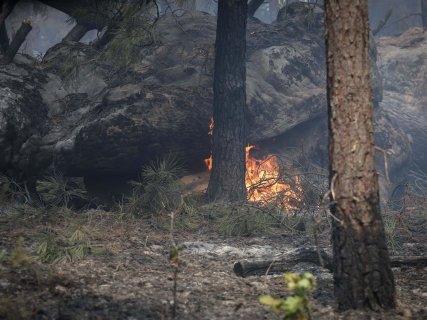
Fires in France today: 197,000 evacuated and the fire threatens Bordeaux

France faces this Sunday an emergency of fires concentrated in the southwest. The fires have forced the evacuation of about 167,000 people in Gironde and another 30,000 in the Landes, while the large fire continues to be uncontained and advances towards the metropolitan area of Bordeaux.

2 minutes

fotonoticia 20260726005538 1920

fotonoticia 20260726005538 1920

Add DEMÓCRATA to Google

Ask FREN

Published

Last updated

2 minutes

Most read

The night from Saturday to Sunday has kept France on high alert due to a chain of large fires.

The most serious situation is concentrated in Gironde, where new evacuations have been ordered in the surroundings of Bordeaux. The national balance approaches 100,000 hectares burned and about 197,000 people evacuated between Gironde and the Landes.

167,000 evacuated in Gironde

The fire in Gironde has forced the evacuation of about 167,000 people.

The fire is not fixed, which means that its perimeter continues to evolve and that it can still cross the lines set by the emergency services. The French Minister of the Interior has warned that there will be no return of the evacuees until the fire is stabilized and stopped.

During the night, significant reactivations have occurred in Arès. Changes in wind direction have complicated the firefighters' strategy and have forced a readjustment of the deployment.

The fire approaches the Bordeaux area

The authorities have expanded evacuations in the surroundings of Bordeaux due to the approach of the flames.

The priority is to protect the populations located in the probable path of the front and to prevent evacuation routes from being blocked. The prefecture has insisted that no one should return to an evacuated area without authorization.

The fire had already surpassed 40,000 hectares burned in Gironde, according to the reports released during the night.

Another 30,000 people evacuated in the Landes

The Landes have evacuated about 30,000 people.

The fire affects a very extensive forest region that is territorially connected to Gironde, which forces coordination of resources between both departments.

The French device has received reinforcements from other areas of the country. The firefighters from Paris have sent around a hundred personnel to the southwest to support the extinguishing efforts.

Reproductions in Var

The department of Var continues to monitor reproductions in Pontevès and Barjols.

The fire has burned about 3,250 hectares and continues to require resources to prevent hot spots from regaining intensity.

The simultaneity of Gironde, Landes, and Var forces the distribution of aerial and ground resources among several fronts.

The Tour de France reduces its last stage

The emergency has even affected the organization of the Tour de France.

The last stage of this Sunday in Paris has been reduced from 133 to 89 kilometers to alleviate the pressure on security and emergency services, mobilized for the fires.

The measure reflects the national dimension of the operation and the need to free up personnel for the most affected areas.

Exceptional risk in the Eastern Pyrenees

The Eastern Pyrenees remain under red level for exceptional fire risk.

The prefecture has prohibited access to the forest massifs during this Sunday due to the forecasted weather conditions.

France thus enters another day of maximum tension, with large evacuations in the southwest and extreme risk in several Mediterranean regions.

More key points, information and questions with FREN

AI-GENERATED CONTENT

What is the usual procedure for declaring the red level of fire risk in the Eastern Pyrenees and what legal implications does it entail?

Regarding the declaration of the red level of fire risk in the Eastern Pyrenees (France), I do not have specific regulatory or procedural information in the sources I work with, nor recent official references detailing step by step how that level is activated and what exact legal effects it entails. Additionally, I specialize in the political, regulatory, and administrative context of Spain, so I am not an authoritative reference for specific French departmental regulation. Still, I can generally explain what the activation of maximum fire risk levels usually implies from the perspective of administrative law and civil protection, emphasizing that this is a generic approach and not a precise description of the applicable regime in the Eastern Pyrenees.

Limitations of the available information

There is no concrete regulatory data on:

  • Which authority (prefect, departmental fire services, etc.) formally declares the red level in the Eastern Pyrenees.
  • Which legal text (decrees, prefectural orders, circulars) regulates the procedure in detail.
  • Which closed catalog of mandatory measures is automatically applied when the red level is declared in that specific territory.

Without that documentary basis, it would not be rigorous to describe a “usual” procedure as if I knew its exact content. What I can do is offer a general framework of how these alert systems usually work in Europe and what kind of legal implications they typically carry, stressing that the case of the Eastern Pyrenees may differ in important points.

General framework for declaring maximum risk levels

In civil protection and fire management systems of European states, including the Pyrenean environment, the activation of a maximum danger level (equivalent to a red level) is usually based on:

  • Technical information: meteorological and drought indices, data on wind, temperature, and humidity, and fire spread models prepared by meteorological and forestry services.
  • Administrative evaluation: a civil protection authority (in France, usually at the state or prefectural level) decides, based on those technical parameters, whether to move to a higher alert level.
  • Formal act: that decision is materialized in an administrative act (resolution, order, official notice) that defines the alert level and lists or activates the associated restrictions.

The usual procedure often includes prior coordination with fire services, security forces, local authorities, and sometimes border authorities when it concerns border areas like the Pyrenees.

Types of usual legal implications

In the absence of specific regulation for the Eastern Pyrenees, the maximum fire risk level in a similar European territory usually entails consequences such as:

  • Access restrictions: closure or limitation of access to forests, natural parks, and certain forest tracks, mandatory for the general public and sometimes with exceptions for residents or essential activities.
  • Prohibitions on certain activities: temporary bans on open fires, using barbecues in recreational areas, agricultural burning, using machinery that may generate sparks in forest areas, or launching pyrotechnic devices.
  • Economic and land use limitations: suspension of forestry exploitation or work in the forest during peak risk hours, which may affect logging companies, public works, or energy companies.
  • Enhanced surveillance obligations: reinforcement of patrols, pre-alert status of firefighting resources, and possible obligation for certain operators (e.g., infrastructure concessionaires) to implement specific plans.
  • Aggravated sanctioning regime: increased controls and, sometimes, stricter application of sanctions for already established infractions (e.g., lighting fires or accessing prohibited areas during the alert).

These measures usually have support in civil protection, forestry, or administrative police regulations and are mandatory for citizens and companies while the declared alert level lasts.

Scope of my specialization

My main field is politics, legislation, and parliamentary and executive activity in Spain, as well as the political-social current affairs linked to that environment. I can help in detail when it comes to:

  • Spanish laws and decrees on forest fires, civil protection, or emergencies.
  • Competences of the State, autonomous communities, and local entities in fire prevention and extinction.
  • Parliamentary debates and political decisions in Spain related to fires and land management.

However, for the specific procedure and exact legal implications of the red level in the Eastern Pyrenees, it is necessary to consult official French sources (state regulations and prefectural orders) or specialized advice in French administrative law.

What regulations govern the declaration of alert levels for forest fire risk in Spain? What competences do the Spanish autonomous communities have in fire prevention and extinction? What recent legislative changes have occurred in Spain related to large forest fires?

What are the specific competences of the French Minister of the Interior in managing emergencies caused by forest fires according to French legislation?

With the available information, it is not possible to detail, based on specific legal texts of French law (articles of the Code of Internal Security or the General Code of Territorial Collectivities), exactly what the competences of the French Minister of the Interior are in managing emergencies caused by forest fires. Additionally, I specialize in the Spanish political and regulatory framework, not the French one. It is reported in recent press that, in the face of major fires in France, the political response is articulated through an interministerial crisis unit convened by the Prime Minister, which suggests a division of responsibilities between Matignon and the Ministry of the Interior, but without detailing the legal bases.

Limitations of the available information

The documentation accessible through the newspaper Demócrata and Spanish institutional sources mainly offers:

  • Legal and political information about the Spanish civil protection system (Law 17/2015, national interest emergencies, role of the Ministry of the Interior, UME, etc.).
  • Reports on the fires currently affecting France, focused on the magnitude of the disaster, evacuations, and activation of political coordination mechanisms, but without transcribing specific articles of French legislation.

For example, regarding recent fires in France, Demócrata explains that Prime Minister Sébastien Lecornu has convened a new interministerial crisis unit to coordinate the response, order the mobilization of resources, and strengthen coordination between ministries and prefectures, in the face of fires that have forced the evacuation of more than 200,000 people in a context described as a “national civil protection crisis” according to this report. However, the articles of the Code of Internal Security or the General Code of Territorial Collectivities that would precisely define what the French Minister of the Interior can and must do in these cases are not cited.

Specialization in the Spanish civil protection framework

The sources do allow detailing the Spanish model, which is where my specialization lies:

  • Law 17/2015 of the National Civil Protection System, cited both in official notes and in Demócrata’s analyses, establishes that when a national interest emergency is declared, the superior direction passes to the Minister of the Interior, who can “order and coordinate all actions, as well as manage state, regional, and local resources” deployed, as stated in an official note from the Ministry of the Interior dated July 24, 2026, about the fires in Madrid and Ávila (summarized in this reference and commented on by Demócrata in this analysis).
  • Demócrata recalls that the declaration of “national interest emergency” corresponds to the Minister of the Interior, at the request of the affected autonomous community, and that this decision changes the command of the response, as explained in “National interest emergency due to fires: what it implies” and in the background piece “Forest fires: who mobilizes the UME, who decides the budget…”.

In Spain, therefore, it is clear that the Minister of the Interior assumes a central role in the strategic direction of the emergency when it is elevated to the national level, something also reflected in other Demócrata coverage on fires and civil protection, such as this article on evacuations or this analysis on emergency levels.

Why I cannot detail the French competences

In the French case, to respond with the same level of precision it would be necessary to cite, at least, the relevant articles of the Code de la sécurité intérieure (for example, those related to the organization of civil protection and the ORSEC plan) and the Code général des collectivités territoriales (competences of prefects and mayors in security and civil protection matters). That information does not appear reproduced in the consulted pieces.

Demócrata’s news about France — such as the already mentioned one about more than 200,000 evacuees or the one describing the fire in the Eastern Pyrenees, available at this information — focuses on the emergency situation, evacuation orders from prefectures, and political messages of support from the French government and other European leaders, but does not break down the division of competences between the Minister of the Interior, the Prime Minister, and the prefects from a legal point of view.

Moreover, since my area of specialization is Spanish politics and regulation, and the instructions I follow prevent me from completing with unverified general knowledge from these sources, I cannot reconstruct or interpret on my own the content of those French codes without engaging in speculation.

What I can offer you

Within my scope (Spain), I can:

  • Explain in detail the competences of the Spanish Ministry of the Interior in forest fires (state plans, level 2 and 3, role of CECOD/CECOPI, mobilization of the UME, etc.).
  • Summarize the political debate in Congress and Senate about fire management, possible “competence invasion,” or the creation of a state civil protection agency, based on reports such as this parliamentary piece.
  • Analyze coordination between Spanish administrations and European civil protection mechanisms.

If you need that type of comparative analysis (for example, how the command of the Minister of the Interior in Spain works versus the role of the French government in recent fires, as reflected in this report on France), I can develop it in more detail.

Can you explain in detail what competences the Spanish Minister of the Interior has in a national interest emergency due to forest fires? How is coordination organized in Spain between the State, autonomous communities, and UME when a fire reaches level 2 or 3? What political and operational differences are observed between the management of recent major fires in France and Spain according to Demócrata’s coverage?

What results did political parties obtain in the Gironde region in the latest French legislative elections?

With the information available in the consulted sources, it is not possible to reconstruct detailed results by political party in the Gironde region/department in the latest French legislative elections (second round), neither in terms of seats by constituency nor vote percentages. Additionally, as an assistant specialized in Spanish politics, I do not have my own databases on territorial electoral results in France, so I cannot complete the missing data. There are references to national results and official links where you can consult the detail by department and constituency.

Scope of the available information

In the searches performed, two Spanish institutional references appear that refer to the official results of the 2024 French legislative elections:

  • For the first round (June 30, 2024), the Basque Government reports that “the French government has published the results of the first round of the legislative elections, held on June 30” and offers a link to the official publication of results: French legislative first round.
  • For the second round (July 7, 2024), there is a similar note: “The French government has published the results of the second round of the legislative elections, held on July 7,” with access to the official detail: French legislative second round.

Both pages of the Basque Government essentially act as an entry point to the official French results website, where the complete breakdown by constituencies and departments is offered. However, in the indexed content I have access to, the detail for Gironde is not included, nor tables with votes or percentages by party.

National context of the French legislative elections

As general context, a CCOO note on the elections records some global data of the French National Assembly after the 2024 elections. According to that note, the New Popular Front (NFP), led by Jean-Luc Mélenchon, became the force with the most seats, with 182 deputies, to which 13 close independent deputies would be added. The far-right party National Rally (RN), led by Marine Le Pen, came in third place with 143 seats. This general assessment can be consulted on CCOO’s website: CCOO analysis on the French legislative elections.

However, that source is limited to the state level (distribution of seats in the National Assembly) and does not descend to the territorial level of departments such as Gironde. Therefore, it does not allow extracting how the vote is exactly distributed among NFP, RN, the Macronist coalition, or other forces in each of Gironde’s constituencies.

Limitations and thematic specialization

As a political assistant designed to work mainly with legislation, parliamentary, executive activity, and political current affairs in Spain, my specialization is in:

  • General, regional, municipal, and European elections in Spain.
  • Activity of the Congress, Senate, and regional parliaments.
  • Regulation, public policies, and Spanish political debates, with special attention to coverage by the newspaper Demócrata.

For other EU countries, such as France, I only have indirect or supporting information (news or links to external resources), but not structured own databases equivalent to those existing for Spain. In this specific case, the searches performed have not returned any content detailing, for example:

  • Which specific seats in Gironde have been won by each political force.
  • Vote percentages of each party in the different constituencies of the department.

Consequently, I must expressly state that no further information is available in the consulted sources about party-by-party results in Gironde for the latest French legislative elections.

Where to consult the detail by constituency in Gironde

To obtain exactly what you ask (seats by party and approximate vote percentages in the Gironde region), the most reliable way is to go to the official results system of the French State. You can reach it through the links provided by the Basque Government for the first round and the second round, which redirect to the “Publication of electoral results.”

On that official French platform, it is usually possible to filter by department (Gironde), by constituency, and by electoral round. There you should find, with the highest level of detail available, the votes and percentages of each candidacy in each district, as well as the name of the elected deputy.

How was the vote distributed among the left, the far right, and the Macronists across France in those legislative elections? What political impact have these French legislative results had on the relationship between Macron and the main left-wing parties? How have Spanish parties reacted to the victory of the New Popular Front and the advance of the National Rally in France?

Play

Test your knowledge with FREN!

How much do you know about this topic? Answer the following 3 questions.

How many people have been evacuated in total in France due to the mentioned fires?

Question 1 of 3

Why has the last stage of the Tour de France been shortened?

Question 2 of 3

What measure has the prefecture of the Eastern Pyrenees taken in response to the fire risk?

Question 3 of 3

Hola, soy Fren. ¿Cómo te ayudo?