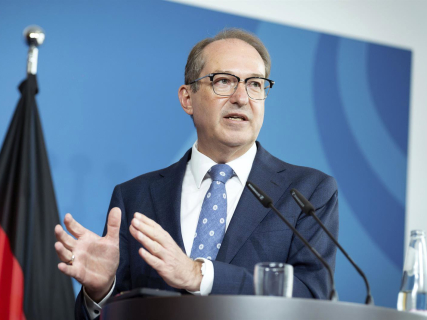

The German Interior Minister Alexander Dobrindt has argued that the country must be in a position to "counterattack" when it suffers cyberattacks and has said that the Government is already working to define the legal framework that would make it possible to carry out this type of retaliation, considering that a new level of intensity has been reached in these attacks in several European countries.
During a security conference held this Wednesday and organized by the Federal Criminal Police Office (BKA), Dobrindt stressed that the latest recorded cyberattacks in France and in other European States represent a qualitative escalation. In a veiled reference, he pointed to the hacking of last Monday against the refrigeration and freezing systems of several supermarket chains in France, which caused damage valued in the millions of euros and which Paris attributed to Iran's Islamic Revolutionary Guard Corps.
Against this backdrop, the French Foreign Minister Jean-Noël Barrot described the incident as one "without precedent" in terms of its scope and aggressiveness, although Iranian authorities categorically rejected that attribution.
Dobrindt, who has warned that "the same actor could be willing not only to destroy food, but also to attack blood banks," has defined what happened as "a hybrid attack of a higher level" and has insisted that the response must also be "of a higher level," using the term in English.
In his view, it is necessary to increase "the consequences, the risks and the cost" for those who carry out this type of hybrid operations against other States.
Along these lines, the Interior minister has detailed that Germany is designing the legislative scaffolding in order to be able to "counterattack in cyberspace," and has assured that it is prepared to activate these tools when circumstances require it.
Regarding those responsible, he pointed directly to Russia as the most relevant actor in the field of hybrid threats, without failing to mention that he also perceives risks coming from Iran and North Korea, among others. This type of hybrid attack combines military, economic, intelligence and propaganda tools with the aim of destabilizing other countries.
The head of the BKA calls for urgent improvement of coordination
In the same statement, the President of the Federal Criminal Police Office (BKA), the federal agency of the German criminal police, Holger Münch, has warned that coordination between the federal police, the law-enforcement bodies of the federal states, the Intelligence services and the Armed Forces must be urgently strengthened and improved in terms of speed and effectiveness to meet the new criminal challenges.
Münch has reiterated that Germany has to be prepared to neutralize the use of intelligence-based agents capable of detecting vulnerabilities and selecting targets for criminals, as well as to address the increasing blurring of borders between organized crime and state actors.
"This is a serious matter, and we take it very seriously," he said, calling for exploring new solutions and warning that "we are running out of time". As he explained, advances in artificial intelligence have given criminals "unprecedented industrialization and professionalization".
The police official highlighted the increase in crimes committed from abroad against targets in Germany, which rose by around 24% year-on-year during the first half of this year. The clearance rate for these cases, he added, remains well below 5%.
In addition, Münch warned that, if perpetrators and victims continue to be located in different countries and the line between criminals and state actors continues to blur, this will affect both cooperation within the German federal system and the principle according to which, in Germany, the police services and the Intelligence services act separately.