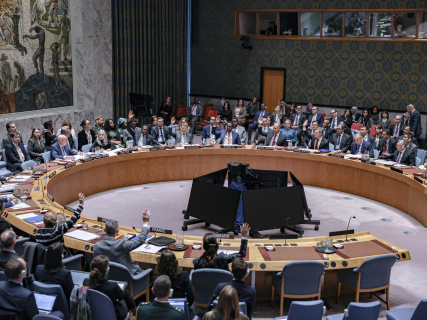

The international human rights defense organization Human Rights Watch (HRW) has informed the UN Security Council that the autonomy proposal put forward by Morocco for Western Sahara does not guarantee the exercise of the Sahrawi people's right to self-determination. This warning comes after the recent resolution approved by the body, which encourages the parties involved to begin negotiations taking as a reference the offer presented by Rabat.
The United Nations' principal decision-making body approved resolution 2797 on October 31, driven by the United States and adopted thanks to the abstention of Russia and China. The text was enthusiastically received by Morocco, which interprets this support as an endorsement of its claim of sovereignty over the territory that was a Spanish colony until 1976.
In this resolution, the Security Council urges the parties to "engage in discussions without preconditions, taking as a basis Morocco's autonomy proposal," presented in 2007 and which has garnered the support of numerous states, including Spain. Likewise, they are encouraged to propose "ideas to contribute to a definitive solution that is acceptable to all of them."
The document specifies that the purpose of this negotiation process must be "to achieve a definitive and mutually acceptable political solution that contemplates the self-determination of the people of Western Sahara" and that recognizes that "genuine autonomy could be the most feasible outcome."
However, HRW considers that the resolution does not offer sufficient guarantees that this new framework for dialogue—which has already allowed for several rounds of talks sponsored by the United States with the participation of Morocco, the Polisario Front, Algeria, and Mauritania—will effectively respect the Sahrawi people's right to self-determination or fully comply with International Law.
Along these lines, the organization emphasizes that any settlement formula should ensure the Sahrawi people's right to receive reparations for the damages suffered since Morocco assumed control of most of the territory. This would include compensation and the recognition of the right of return for people displaced to the refugee camps in Tindouf (Algeria) and for their descendants who have maintained sufficient ties with the region.
UNFULFILLED PROMISE OF REFERENDUM
The associate director for the Middle East and North Africa at HRW, Hanan Salah, has recalled that "35 years after the UN Security Council agreed to a referendum to resolve the situation in Western Sahara, political expediency risks overlooking the Sahrawi right to self-determination."
"To fulfill these rights, the Security Council and all countries should guarantee the Sahrawi people's right to freely determine their political status," Salah pointed out. "After 50 years of (Moroccan) occupation, it should articulate how it intends to enforce all Sahrawi human rights, including self-determination," she insisted.
In line with this position, HRW maintains that the Security Council must protect the right to self-determination and ensure that any agreement reflects the authentic will of the Sahrawi population. It also recalls that the Moroccan autonomy plan does not contemplate the possibility of independence in any scenario, the option historically defended by the Polisario Front.
The organization also emphasizes that any update to the autonomy plan —Morocco would have developed a more extensive text from the initial three-page proposal— must explicitly incorporate the right to reparations for the occupation and the right of return for the displaced population.
Finally, HRW insists that Western Sahara, a former Spanish colony, has been on the UN's list of non-self-governing territories since 1963 and that this status remains unchanged, despite several countries recognizing Moroccan sovereignty over the area.