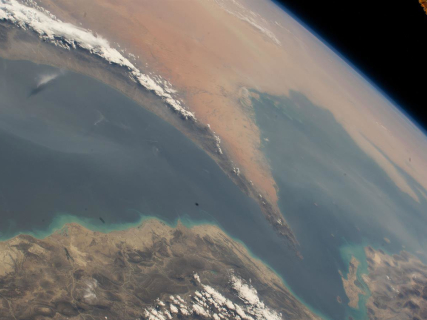

The Revolutionary Guard of Iran has reported this Friday that a vessel carrying liquefied natural gas caught fire after colliding with a naval mine while attempting to navigate through "an unauthorized route" in the Strait of Hormuz, also noting that there was "a massive explosion" in the area.
"A vessel carrying liquefied gas in the eastern part of the Strait of Hormuz, ignoring the repeated warnings, tried to travel along the southern route, unauthorized and dangerous, causing a massive explosion when it collided with a naval mine," it said in a statement, as reported by the Iranian public television network IRIB.
In its note, the Iranian elite force emphasized that "this vessel did not learn from the experience of the previous tanker ships that exploded and opted to travel with the support of American fighter jets," referring to the protection offered by the United States Army to ships that use the southern maritime route in this strategic corridor.
"Unaware that naval mines never coordinate with the smuggler and aggressor United States Army to hunt down their prey, it suffered a very serious explosion," it scoffed, before insisting that the Strait of Hormuz "is managed with complete determination and seriousness" and warning that any vessel attempting to cross through that area "will meet the same fate as the previous vessels."
Tehran has declared the Strait of Hormuz closed — a key passage for the transport of crude oil from the Persian Gulf to numerous countries — as a consequence of the offensive launched in February by the United States and Israel against the country, and has warned that only transit along the routes authorized by its Armed Forces is considered safe.
Washington, meanwhile, argues that there is no such blockade of Hormuz because it maintains military control of the strait, a presence that, it claims, is limited to the outer part of the passage, from where it escorts vessels to ensure that the export of oil from the Near East continues.