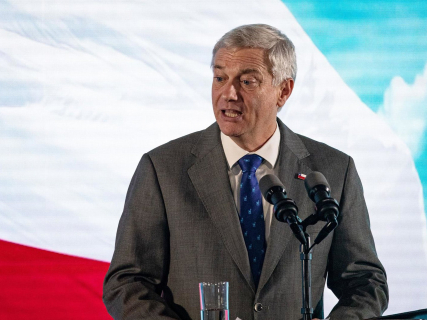

The president of Chile, José Antonio Kast, has communicated this Wednesday that he will promote a reform of the Constitution to address citizen security from a "much broader framework of action" and to equip himself with more "effective" instruments against criminal advances within the national territory.
"We are going to send to the National Congress a constitutional reform that unequivocally enshrines that protecting the security of people is a duty of the State and that will allow us to have a much broader framework of action and more effective tools to combat crime," the head of State emphasized in a message directed to the entire country.
According to his defense, with this change citizens "will regain their freedom," while "criminals and drug traffickers will lose it forever," highlighting that "for the first time, the State will decide in its own Constitution that protecting its people is not just another option but an obligation."
In this line, the ultra-conservative leader explained that he has given instructions to the Minister of Security, Martín Arrau, so that "together with Congress" they can push forward "as soon as possible" a package of initiatives that he has called the Agenda against Organized Crime and Terrorism (ACOT).
"I hope that before Christmas we approve all the tools that allow us to regain our freedom from the hands of criminals," the president pointed out, specifying that this agenda will include more than 30 projects, several of them already in parliamentary processing.
Kast has estimated ten transnational organized crime organizations currently operating in Chile and has detailed that one of the lines of action will be the "permanent" police presence in the 50 "most critical" neighborhoods of the country, "with saturation, patrolling, and technology in each of them."
Likewise, he has announced that the flagrancy period will be extended from 12 to 24 hours, with the aim that the police forces "have the time they need to apprehend those responsible" for the crimes, along with measures such as "illegal migratory detention and the capacity for effective expulsion of those who have no right to be in Chile."
"We are going to identify and pursue fugitives from Justice who have been outside the law for a long time and we will continue to reinforce the control of our borders with trenches, drones, and permanent technological monitoring so that no one enters Chile where they should not," he stated.
On the other hand, the president has guaranteed that no carabiner, police officer, gendarme, or member of the Armed Forces "who acts in legitimate defense defending their life or that of a third party" will be considered by the legislation "as if they were a criminal."
Regarding sanctionable conduct, he has made it clear that "a barricade, a vehicle crossed in a street, or an obstacle trying to block the street illegally, may be a crime. And whoever recruits a child to shoot, to transport drugs, or to watch on a corner, will face the full weight of the law aggravated and without mitigating factors," he concluded.