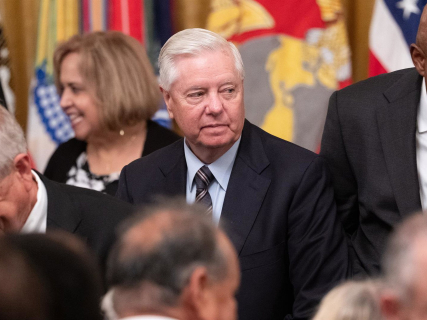
US Senator Lindsey Graham has died at the age of 71 after suffering a brief and sudden illness, as confirmed by his office early Sunday morning.
The Republican passed away during the night of Saturday, July 11. His team has not explained what illness he suffered from, where he died, or when his health problems began. The family has thanked those who have offered support and has requested privacy during this time.
The news has caused a great shock in Washington due to the unexpectedness of his death. Graham had turned 71 on Thursday, July 9, and had maintained public political activity until practically the last moment.
Just one day before his death, he appeared before the media in Kyiv after meeting with Ukrainian President Volodymyr Zelensky. From there, along with other senators, he announced an agreement with the Trump Administration to unblock new sanctions legislation against countries that buy Russian oil and gas.
What is known about the cause of Lindsey Graham's death
The senator's office has limited itself to reporting that Graham died after a "brief and sudden" illness.
No diagnosis has been released, nor has it been confirmed that he was hospitalized. There is also no official data on the nature of the ailment, so any attribution of a specific cause would be speculative.
The statement was released in the early hours of Sunday by the communications director of his office. The family expressly requested respect for their privacy and thanked them for their prayers.
He had appeared in Kyiv the day before his death
Graham's last known public activity occurred on Friday, July 10, in Ukraine.
The senator traveled to Kyiv and appeared before the press after a meeting with Zelensky. Graham had been promoting for months, along with Democrat Richard Blumenthal, a broad sanctions law against Russia and against countries that continue to buy its energy products.
On Friday, he stated that a bipartisan group had reached an agreement with the Donald Trump Administration to move forward with the initiative. Senators Jeanne Shaheen and Roger Wicker also participated in the announcement.
The appearance in Kyiv underscores the speed with which his death occurred. No prior illness or temporary withdrawal from his schedule had been publicly reported.
Who was Lindsey Graham
Lindsey Olin Graham was born on July 9, 1955, in Central, a small town in South Carolina.
He studied Psychology and later Law at the University of South Carolina. Before entering politics, he developed a long career linked to the U.S. Armed Forces and worked as a military lawyer.
He was elected senator in 2002 and took office in January 2003. Since then, he was re-elected in 2008, 2014, and 2020, becoming one of the longest-serving and most influential Republicans in the Upper Chamber.
At the time of his death, he chaired the Senate Budget Committee. He was also a member of the Appropriations, Judiciary, and Environment and Public Works committees.
From Candidate Against Trump to One of His Biggest Allies
The relationship between Lindsey Graham and Donald Trump underwent one of the most striking political transformations in recent Republican Party history.
Graham ran in the 2016 Republican presidential primaries. During that campaign, he was one of Trump's harshest critics, considering him dangerous for the party and unprepared to lead U.S. foreign policy.
His candidacy never managed to take off, and he dropped out of the race before voting began.
After Trump's victory, the two grew closer. Graham went from fighting him in the primaries to becoming one of his most recognizable allies in the Senate, although they had occasional clashes over abortion and certain international decisions.
The senator supported the president's agenda, defended his judicial appointments, and acted as an intermediary on issues of national security, Ukraine, the Middle East, and Iran.
Trump backed Graham in his 2026 re-election campaign and helped him win a crowded Republican primary held just a month before his death.
The Most Belligerent Republican Senator on Foreign Policy
Graham built much of his national profile around an interventionist foreign policy.
For decades, he advocated for high military spending, U.S. presence abroad, and a particularly tough stance against Iran. He supported the Iraq War, operations in Afghanistan, and the maintenance of strong military alliances with Israel and European partners.
In recent years, he also became one of the main Republican defenders of Ukraine against the Russian invasion. His trips to Kyiv and his legislative initiatives placed him among the most constant voices in favor of increasing economic pressure on Moscow.
His last major legislative battle consisted precisely in approving sanctions against countries that indirectly finance the war by purchasing Russian energy.
His position on Iran
Graham maintained an especially aggressive stance against the Iranian regime throughout his career.
Already during his time in the House of Representatives, he defended policies to isolate Tehran and limit its nuclear and missile programs. He later called on numerous occasions for the United States to be willing to use force to prevent Iran from developing nuclear weapons.
His influence grew again during the US offensive against Iranian targets in 2026. Graham supported Trump's actions and argued that military pressure could transform the political balance in the Middle East.
A military career of more than three decades
Before and during his political career, Graham maintained a close relationship with the US Air Force.
He entered the military legal corps and spent more than six years on active duty. Between 1984 and 1988, he was stationed at Rhein-Main Air Base in Germany, where he served as a lawyer and military prosecutor.
He then joined the South Carolina Air National Guard and later the Air Force Reserve. He reached the rank of colonel and retired in 2015 after approximately 33 years of service.
His military experience fueled his constant defense of the Pentagon, veterans, and the increase of US defense capabilities.
From Congress to the impeachment trial of Bill Clinton
Graham began his political career in the South Carolina House of Representatives.
In 1994, he was elected a member of the US House of Representatives for his state's third district. He was the first Republican to represent that constituency since the 19th century.
He gained national prominence during the impeachment proceedings against Democratic President Bill Clinton. As a member of the House Judiciary Committee, he actively participated in the investigation and served as one of those responsible for presenting the prosecution's arguments to the Senate.
That process also marked the beginning of his friendship with John McCain, who would later have an enormous influence on his career.
Friendship with John McCain
For years, Graham was politically linked to Senator John McCain.
Both shared an internationalist vision of the United States' role, frequently traveled to conflict zones, and advocated for a foreign policy based on military strength and traditional alliances.
Graham actively participated in McCain's presidential campaigns and was one of his closest collaborators. Together with independent Joe Lieberman, they formed the informal group known in Washington as the “three amigos.”
McCain's death in 2018 left Graham as one of the leading representatives in the Senate of that Republican faction. However, his rapprochement with Trump, who was publicly at odds with McCain, raised doubts and criticisms about the evolution of his political position.
His role in Trump's judicial appointments
Graham also had considerable influence over the American judiciary.
He chaired the Senate Judiciary Committee between 2019 and 2021, a position from which he intervened in the confirmation of federal judges and in the appointments made by Trump to the Supreme Court.
He supported the conservative majority that subsequently overturned federal constitutional protection for abortion established in the Roe v. Wade case. Graham continued to advocate for a federal ban on abortion after a certain number of weeks of gestation, an issue on which he publicly disagreed with Trump.
Lindsey Graham was seeking a fifth term
The senator was in the midst of an election campaign when he died.
On June 9, he won the Republican primaries in South Carolina with approximately 57% of the vote, defeating five internal rivals without the need for a runoff.
Graham was scheduled to face Democratic candidate Annie Andrews, a pediatrician and former congressional candidate, on November 3. He was seeking a fifth six-year term that would have kept him in the Senate until early 2033.
His death now forces the South Carolina Republican Party to choose another candidate.
What happens now with his candidacy
South Carolina's electoral law stipulates that when a candidate elected in the primaries dies, the vacancy in the candidacy must be filled through a new special primary.
The enrollment period must begin on the second Tuesday after the death and remain open for one week. Subsequently, a special election will be held and, if no candidate obtains the necessary support, a second round may be called two weeks later.
The law also allows candidates defeated in the first primary to re-enter when the initially elected candidate dies or ceases to be the nominee.
The winner of that process will replace Graham as the Republican candidate against Annie Andrews in the November elections.
Who will temporarily occupy his seat
The governor of South Carolina, Republican Henry McMaster, has the legal capacity to appoint a provisional senator to occupy the vacant seat.
State legislation allows the governor to make this appointment until January 3rd following the next general election. The designated person will be able to participate immediately in Senate votes while the electoral process is resolved.
Until the appointment is made, Republicans temporarily lose a member of their majority in the Upper House. The party controlled 53 out of 100 seats before Graham's death, compared to 47 Democratic senators and independents linked to their caucus.
The vacancy does not wrest control of the Senate from the Republicans, but it can complicate close votes until McMaster announces a replacement.