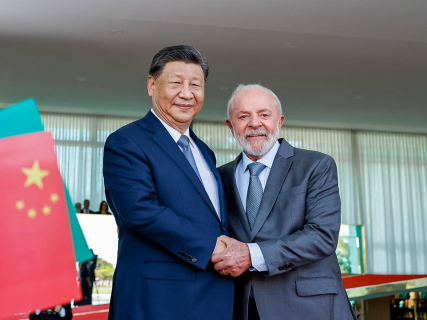

The leaders of Brazil, Luiz Inácio Lula da Silva, and China, Xi Jinping, have maintained a phone call in recent hours in which they emphasized the relevance of further tightening the ties between both countries, a few days after the United States confirmed tariffs of 25% on Brazilian sales.
During the conversation, Lula reiterated to Xi Brazil's commitment to "diversifying markets and trade partners," in line with recent statements in which he downplayed the rates imposed by Washington. "We are not going to cry over what we could not sell them because we are going to look for other buyers," he stated.
In the subsequent statement, the Brazilian president highlighted the "good results" derived from the trade exchange between Brazil and China and from the exemption of short-term visas, measures that, he emphasized, "will expand the flow of tourists and business opportunities." He also stressed the importance of deepening cooperation in other areas and continuing to advance in an agreement with Mercosur.
"We have reiterated the shared purpose of expanding cooperation in strategic and high-tech areas, such as artificial intelligence, satellites, processing of critical minerals, and trade in fertilizers," the Brazilian president communicated in a message on his social networks.
On the international front, both governments defended multilateralism as a way to face and try to resolve the "proliferation of conflicts around the world," in a context where the "inability" of the United Nations Security Council to respond to these crises is becoming, they emphasize, increasingly evident.
This increase in military tensions particularly impacts food and energy security on a global scale and also causes "severe human and material losses," as stated in the official note, which describes the scenario that the next UN Secretary-General will have to manage as "particularly challenging."
Furthermore, the two leaders defended free navigation in the Strait of Hormuz and Bab al Mandeb, in the context of the war in the Middle East that pits the United States against Iran; and drew attention to the critical humanitarian situation in the Gaza Strip, as Israeli bombings continue.