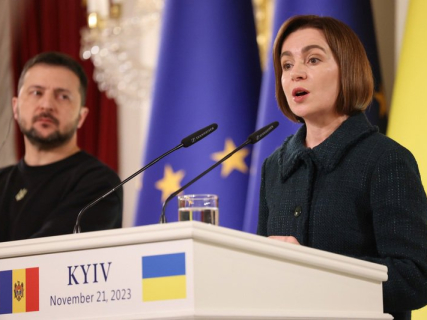

The European Commission has published this Wednesday several roadmaps to give a boost to accession negotiations for the four countries that are in the most advanced stage to enter the European Union. The schedule designed by Brussels provides for Moldova to progress at a faster pace than Ukraine throughout 2027, despite the fact that until now both had maintained a practically parallel advance on their path toward the community bloc.
This is reflected in the annual enlargement package presented by the Community Executive, which proposes the provisional closure of up to 25 negotiating chapters with Moldova over the next year, compared with the seven that are being considered for Ukraine, according to the indicative timetables drawn up by the Commission itself, in which Montenegro and Albania are also listed.
This divergence in pace responds to the different levels of compliance with the reforms demanded by Brussels, above all in the area of the rule of law. In the Moldovan case, the Commission highlights the “very significant” progress made in meeting the requirements necessary to move forward in the talks, as well as efforts to adapt its domestic legislation to the acquis communautaire.
By contrast, although the Commission recognizes the progress made by Ukraine despite the Russian invasion, it insists that the country must accelerate reforms linked to the rule of law, the functioning of democratic institutions and the modernization of the public administration, in addition to strengthening the protection of national minorities.
As a result, although both states have opened the same 24 negotiating chapters so far, their accession timetables begin to diverge. According to the Community forecast, Moldova aims to conclude the negotiations “at the beginning of 2028,” a goal that Brussels considers “ambitious but achievable,” while for Ukraine it sets as a horizon “at the end” of that same year, limiting itself to stating that it “supports this ambitious objective”.
Both Chisinau and Kyiv achieved candidate country status in June 2022 and formally began the accession talks in June 2026, after Hungary lifted a veto that it had maintained for two years. From that moment on, the process had advanced practically in parallel.
During an appearance before the European Parliament to break down the enlargement packages, Marta Kos, Commissioner for Enlargement, has explained this discrepancy by noting that "Ukraine is required to meet the same standards as any other candidate country, no matter that it is at war," dismissing any "discount" on the accession requirements.
MONTENEGRO AND ALBANIA, AT THE HEAD OF THE PROCESS
Alongside the eastern bloc, the European Commission places Montenegro as the most advanced applicant in the current enlargement package, after having provisionally closed 21 of the 33 negotiation chapters. Brussels’ plan envisages that Podgorica can complete the pending chapters before this year ends and move toward full accession in 2028.
Albania, for its part, has opened all 33 negotiating chapters and has provisionally closed four of them. According to the roadmap of the Community executive, it is "achievable" that Tirana concludes the accession talks by the end of 2027, just a year after Montenegro.
The Commissioner for Enlargement highlighted Albania as an example during her speech in the Eurochamber, stressing that it has fulfilled its reform commitments and that this year it has surpassed "an important milestone" by closing chapters related to fundamental values, an area that has stalled in other States.
The most striking case is Serbia, which has 22 chapters open out of 35 and only two provisionally closed, in addition to a low level of alignment with the EU’s Common Foreign and Security Policy.
"In Serbia, we had found that there had been a kind of disillusionment and that fundamental values had lost importance. But after the elections, there may be new hopes (...). The new government of the country has the opportunity to turn the page and put the country back on the path to accession," Kos said about Belgrade.
In the intermediate group of the Western Balkans, progress continues to be uneven. In the case of North Macedonia, the Commission acknowledges advances in the implementation of reforms, but recalls that the opening of the first group of negotiating chapters remains contingent upon the approval of the constitutional reforms committed by Skopie.
Meanwhile, Bosnia and Herzegovina remains blocked by the difficulties in pushing through reforms and the lack of internal political consensus, while Kosovo continues as a potential candidate, with a process conditioned by the absence of recognition as a State by countries such as Spain and by the evolution of the normalization dialogue with Serbia.
GEORGIA AND TURKEY, AT THE BACK OF THE PROCESS
At the opposite end are Georgia and Turkey, whose rapprochement processes with the EU continue to stall due to the deterioration of fundamental rights and the rule of law. In the Georgian case, the Commission denounces that the ruling party continues to undermine the country’s European aspirations through restrictions on civil society and measures directed against the opposition.
As for Turkey, whose accession negotiations remain frozen since 2018, the Community Executive notes a new setback in democratic values and in the rule of law, although it maintains cooperation with Ankara in areas of shared interest such as trade, migration, and the fight against climate change.
GRADUAL INTEGRATION BEFORE ACCESSION
Beyond the negotiating timelines, the European Commission has detailed how it intends to bring about the gradual integration of candidate countries into EU policies and programs before their formal entry, an idea it already raised with the Twenty-Seven last October.
Specifically, the Community Executive has identified new avenues so that aspirants can participate progressively in European programs, agencies, and policies, linking each of these options to the corresponding negotiation chapters, so that they can access them as they make progress on the reforms required by Brussels.
Thus, if a candidate country adapts its legislation to European transport standards, it could begin to gradually intervene in Community programs to finance infrastructure and improve connections with the EU, without needing to wait to become a Member State.
The same approach would apply to sectors such as energy, where access would be facilitated to integration mechanisms of the European energy market, or the single market, with initiatives to simplify bank transfers, e-commerce, or the recognition of professional qualifications.
To implement this scheme, the Commission plans to hold annual dialogues with the candidate countries in which their progress will be assessed and the outstanding conditions, the responsible authorities, and the technical or financial support necessary to facilitate their participation in new European programs will be set.
In any case, this proposal for phased integration will have to have the unanimous support of the Member States, which will continue to have the final say on each phase of the accession process of the countries that aspire to join the Community bloc.