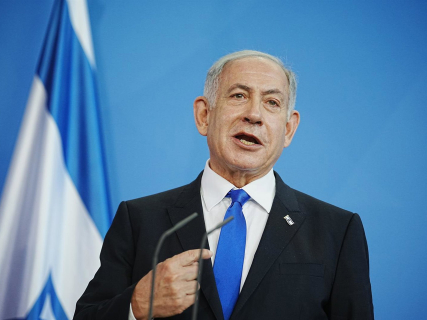
Netanyahu intervenes before a nearly empty UN assembly: "They are moral cowards"

Numerous representatives leave the hemicycle before the intervention of the Israeli prime minister, who responds from the podium and claims the attacks against Iran's nuclear facilities.

2 minutes

fotonoticia 20260917144451 1920

fotonoticia 20260917144451 1920

Add DEMÓCRATA to Google

Ask FREN

Published

Last updated

2 minutes

The intervention of Benjamin Netanyahu before the United Nations General Assembly began this Thursday with numerous representatives leaving the chamber in protest. In response to the departure of delegations, the Israeli Prime Minister responded from the podium, labeling those who decided to absent themselves as "moral cowards".

"If there are other moral cowards who have not yet left the room, please leave now", Netanyahu exclaimed at the beginning of a speech marked by the growing international backlash against his government's actions. The departure of representatives had been anticipated in recent days, with calls for a boycott of his speech and protests organized during his brief stay in New York.

Netanyahu claims attacks against Iran

Following the walkout by some delegations, Netanyahu placed Iran and its nuclear program among the main issues of his speech. The Prime Minister defended Israeli military operations against Iranian nuclear facilities and presented the decision as a matter of survival for his country.

"I committed to preventing the murderous dictatorship of Iran from acquiring the atomic bomb," he stated, before assuring that such weapons would have posed a threat not only to Israel but to the entire international community.

Netanyahu personally claimed the decision to attack the Iranian facilities. "Destroying Iran's nuclear facilities was difficult, a very difficult objective, but for me it was one of the easiest decisions I had to make as Prime Minister", he maintained.

The Israeli leader took his argument even further by stating that, had he not acted, "we would all be dead".

"We are going to win, we have no alternative"

Netanyahu also referred back to October 7, 2023 to justify the military offensive subsequently launched by Israel in Gaza. "We are going to win, we have no alternative," he proclaimed from the United Nations podium.

"October 7, 2023 is the darkest day in Israel's history. On this horrendous day, thousands of Palestinian terrorists entered Israel from Gaza. Hamas terrorists committed the largest massacre of Jews since the Holocaust," the Prime Minister stated.

Netanyahu has used the attack by Hamas, in which around 1,200 people died in Israel, as an argument to defend the subsequent Israeli military response. "On that gloomy day, our enemies expected us to crumble, but that was not the case, and what we did was stand up and fight like lions," he has stated.

More key points, information and questions with FREN

AI-GENERATED CONTENT

What is the official procedure for a delegation to leave a session of the UN General Assembly as a form of protest?

I do not have a specific framework of internal instructions or detailed regulations on the official UN procedure for a delegation to leave a General Assembly session as a form of protest. I specialize in the functioning of Spanish political institutions and their regulatory and parliamentary environment, not in the internal protocol of the United Nations. For that reason, I cannot provide you with a reliable and documented answer about the specific procedure governing this type of action in the General Assembly.

My field of work is focused on:

  • The Congress of Deputies and the Senate of Spain: legislative procedures, initiatives, votes, composition of parliamentary groups, functioning of committees, etc.
  • The normative activity of the Government of Spain and the autonomous communities: royal decree-laws, draft and proposed laws, ministerial orders, agreements of regional governments and their processing.
  • The role of Spanish political parties and institutional actors: public positions, statements in parliamentary sessions, recent debates and political strategies linked to the approval or blocking of certain regulations.
  • Sectoral regulation in Spain (energy, housing, digital, transport, health, education, etc.) and how it is being modified or debated in the parliamentary and governmental sphere.

Within that field, for example, I could help you with issues such as:

  • Explaining how the Spanish delegation to international organizations is organized and regulated from the perspective of Spanish law: who appoints it, with what rank, what internal rules govern its actions and accountability before the Cortes.
  • Analyzing how the Government and the General Courts politically manage a relevant diplomatic protest (for example, the withdrawal of a delegation from an international session) and what debates it could generate in Spain.
  • Placing such gestures in the context of Spanish foreign policy, always from the perspective of internal decisions and controls (Council of Ministers agreements, appearances by the Minister of Foreign Affairs, parliamentary resolutions, etc.).
  • Explaining in detail the Spanish parliamentary procedure to endorse or oversee international treaties or relevant decisions in the multilateral sphere, when they have legal or political implications within Spain.

If you are interested in relating your question to the Spanish sphere, we could, for example:

  • Review how Spain has historically reacted, at an institutional level, to episodes of diplomatic tension similar to these (even if they occur at the UN or other forums), and what debates have taken place in the Congress or the Senate.
  • Analyze what legal or parliamentary instruments the Spanish Parliament has at its disposal to express opinions on the conduct of the Spanish delegation in international organizations (non-legislative motions, motions, interpellations or oral questions to the Government).
  • Study what Spanish regulations govern the State's participation in international organizations, how representation is structured, what discretion the Executive has, and what controls can be exercised by the Cortes.

If you wish, you can reformulate your question towards any of these angles, for example: how Spain decides the attitude of our delegation before a vote or debate at the UN; what parliamentary control exists over that action; or what internal political implications a protest gesture by the Spanish delegation would have. In all these cases, I could rely on official sources, Spanish regulations, and parliamentary records to give you a detailed and well-founded answer.

In summary, since this is a matter of internal United Nations protocol —and not of Spanish organization or regulation— my ability to help is very limited. But if you want to frame the topic within Spanish politics and institutions (the relationship between the Government and the Cortes with the UN, parliamentary oversight, legal or political implications in Spain), I will be happy to delve into that area with you.

What are the powers and attributions of the Prime Minister of Israel according to the Israeli Constitution?

I do not have the context or specific tools to offer a rigorous and up-to-date analysis of the powers and attributions of the Prime Minister of Israel according to Israeli constitutional law. My specialization is focused on the Spanish political and institutional system (General Courts, Government of Spain, autonomous communities, Spanish regulations and their processing, Spanish political actors, etc.), and the consultation tools I have access to are designed for that scope.

In the specific case of Israel, there is an important nuance: unlike Spain, its legal system is not based on a single codified Constitution in one text, but on a set of Basic Laws of quasi-constitutional character that have been approved at different times. The powers of the Prime Minister derive mainly from several of these laws (particularly those regulating the Government and the organization of the executive power), as well as from ordinary laws and political-constitutional practice interpreted by courts and Israeli legal scholarship. To describe them precisely, one would have to refer directly to those texts and the most recent specialized doctrine.

Since my working environment does not include international legal databases or updated repertories of comparative constitutional law, I cannot guarantee that a detailed enumeration of the functions of the Prime Minister of Israel, article by article, is accurate, complete, and aligned with the latest reforms or interpretations. Providing a detailed list based only on prior general knowledge, without being able to cross-check it with official Israeli sources, would carry a high risk of inaccuracy, especially given the sensitivity of the distribution of powers in a specific State.

The most responsible approach in this context is to recommend that you consult directly:

  • The Basic Laws of Israel regulating the Government, which are usually available in official or semi-official versions in English and Hebrew on Israeli institutional portals (Parliament – Knesset, Ministry of Justice, etc.).
  • Recent manuals or articles on comparative constitutional law that specifically analyze the Israeli political system and the role of the Prime Minister within the framework of those Basic Laws.
  • Academic commentaries or reports from international organizations on Israel's institutional system, which usually offer a reliable synthesis of the powers, checks and balances, and political responsibility mechanisms of the head of government.

I understand you also requested a specific and homogeneous length for your answers. However, in this case, that instruction conflicts with another higher-priority guideline I must follow: not to generate detailed and apparently authoritative content on specific legal and institutional areas for which I lack source support or verification tools. Therefore, I prefer to keep a brief answer, clearly explain the limits of my specialization, and point you to reliable ways to find the information you need.

If you find it useful, I can help you:

  • Explain in detail the role of the President of the Government of Spain in our constitutional system (relevant articles of the Spanish Constitution, relationship with the Congress, executive functions, political responsibility, etc.).
  • Make a general comparison between parliamentary models (for example, how the head of government is structured in Spain versus other European parliamentary systems), as long as the main focus is on Spanish institutions.
  • Clarify procedures, powers, and balances of power within the framework of the Spanish Constitution and the rules that develop our institutions.

If you want, reformulate your question around Spanish institutions or regulations (or a comparison where Spain is the main axis) and I will be able to go into much more detail, with structured explanations and clear references to the rules and practices in force in our system.

What requirements does international law establish for a State to justify preventive military actions against nuclear facilities of another country?

International law is extremely restrictive regarding the use of force. So-called “preventive military actions” against nuclear facilities of another State operate in a very delicate area, because they tend to conflict with the general prohibition on the use of force contained in the United Nations Charter. At the outset, attacking nuclear facilities of another country is, except in very exceptional circumstances, contrary to international law.

1. General prohibition on the use of force

The starting point is Article 2.4 of the UN Charter, which prohibits the use or threat of force against the territorial integrity or political independence of any State. Bombing nuclear facilities clearly constitutes “use of force,” so it can only be lawful if it falls within one of the admitted exceptions:

  • Express authorization by the Security Council (Chapter VII of the Charter).
  • Individual or collective self-defense, under the terms of Article 51.

Any action presented as “preventive” must try to fit into one of these categories. International law does not recognize a general clause legitimizing preventive attacks outside these cases.

2. Self-defense and “anticipatory self-defense”

Article 51 allows self-defense “in the case of an armed attack.” The classical reading (widely accepted in doctrine and UN practice) requires:

  • Existence of an armed attack or an imminent threat in a very strict sense.
  • Necessity: there are no reasonable peaceful means to neutralize the danger in time.
  • Proportionality: the response must be limited to what is strictly necessary to repel or prevent that specific attack.

Part of the doctrine and some States defend the so-called anticipatory self-defense, that is, the possibility of using force when an attack has not yet begun but is imminent and practically inevitable. The classical standard cited is the “Caroline case” (19th century): the danger must be “imminent, overwhelming, leaving no choice of means or moment for deliberation.”

However, contemporary international law does NOT clearly accept a broad “preventive war” based only on future risks, technological capacity, or presumed intentions (for example, mere suspicion that a nuclear program could become military in coming years). The threshold remains very high:

  • Possibility or probability of an attack is not enough; there must be imminence in a strong sense.
  • It must be demonstrated that there is no diplomatic or control alternative (inspections, sanctions, etc.).

3. Material requirements to claim self-defense against nuclear facilities

To try to justify an attack against nuclear facilities of another State as preventive or anticipatory self-defense, a State should, at minimum, be able to claim that:

  • There is or is being prepared a real “armed attack”, not just an abstract capability. For example, concrete evidence of immediate preparation of a nuclear attack or imminent use of those facilities for offensive purposes.
  • The danger is imminent and specific, with verifiable indications (solid intelligence, military deployments, operational orders), not mere political assumptions.
  • The response is necessary: other mechanisms such as diplomacy, IAEA inspections, sanctions, or international pressure are manifestly insufficient to prevent the attack in time.
  • The action is proportional: it is strictly aimed at neutralizing the specific threat (e.g., certain reactors or enrichment facilities) and minimizes collateral damage, especially civilian and environmental.

Even meeting these criteria, legality would remain debatable and subject to very intense political and legal scrutiny at the UN and in the international community.

4. Role of the Security Council and the non-proliferation regime

Another route would be to act with explicit authorization from the UN Security Council, which can determine the existence of a threat to peace arising from a nuclear program and authorize measures including the use of force. In that case:

  • Legality is based on the Council resolution, not on unilateral self-defense.
  • The resolution usually also requires necessity, proportionality, and last resort.

Additionally, the Nuclear Non-Proliferation Treaty (NPT) and safeguard agreements with the IAEA provide verification, inspection, and referral mechanisms to the Security Council. The existence of these instruments reinforces the idea that States must exhaust these channels before resorting to force.

5. Conclusion

In summary, international law could only admit “preventive” military actions against nuclear facilities of another State within an extremely narrow framework: as self-defense against an imminent, necessary, and proportional nuclear threat, or with express authorization from the Security Council. Unilateral attacks based on future risks, suspicions of intentions, or mere technological capability are generally considered violations of the prohibition on the use of force.

Play

Test your knowledge with FREN!

How much do you know about this topic? Answer the following 3 questions.

Why did many representatives leave the UN General Assembly during Netanyahu's intervention?

Question 1 of 3

Which country and its nuclear program were highlighted by Netanyahu as a threat during his speech?

Question 2 of 3

What event on October 7, 2023, did Netanyahu mention to justify the military offensive in Gaza?

Question 3 of 3