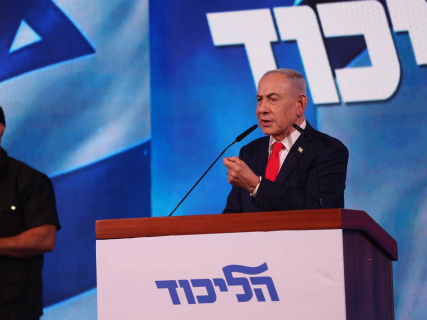

The Prime Minister of Israel, Benjamin Netanyahu, has launched this Wednesday a serious warning about the possibility that a future executive alternative to the one headed by his party, Likud, would depend on the support of Arab formations. This is his first public appearance after last week’s elections, in which Likud was the most-voted list, although his bloc has not reached the majority necessary to govern on its own.
In a message shared on his social media, Netanyahu has argued that a possible government of the opposition bloc to his leadership would be forced to rely on "Islamist parties that support terrorism," referring directly to Raam and the Joint List. These formations, which represent mainly the Palestinian population with Israeli citizenship —around 20% of the total—, have achieved an unprecedented result with 19 seats in the Knesset.
"Radical Islam is the challenge that is tearing Europe apart today. It is also the challenge that threatens us. It threatens us from the outside through Iran and its allies, and from within through the Islamist parties that support terrorism," the head of the Executive has said in the video, in which he also accuses these political forces of seeking to "erase Israel’s Jewish identity."
Netanyahu has insisted that a government of the opposition —currently headed by Gadi Eisenkot— that relies on the support of the Arab parties "will not only fail to combat our enemies, but, simply, will tear us apart from within." "This is a question of our own survival," the conservative leader has reiterated.
For this reason, he has called for the formation of a "broad-based national government," opening the door to the rest of the Zionist forces. "There is a government capable of facing this challenge: a broad national government led by Likud under my leadership, which includes all components of the national bloc and all Zionist parties that wish to join," he has stated.
The Israeli prime minister has also again cast doubt on the integrity of the electoral process. "There are serious suspicions that foreign countries have intervened, with huge sums of money, in an attempt to influence the election results in Israel," he has denounced, calling for it to be known "the whole truth, without cover-ups and without delays."
From Likud, the accusation is maintained that the elections were manipulated, although the election authorities have reiterated that the voting took place normally and that the results are fully valid. Even the State attorney general, Gali Baharav-Miara, has rejected opening an investigation against four leaders identified by Shin Bet, considering that there is insufficient evidence against them.
Eisenkot pushes an emergency government and strengthens the alliance with the U.S.
Meanwhile, Gadi Eisenkot has traveled to the United States, coinciding with the celebration of the midterm legislative elections, and has underlined that he is "working to fulfill the will of the Israeli people by forming a new Government as soon as possible: a national emergency Government."
"Our democracy remains strong and dynamic (...) My intention is to bring new leadership to Israel, a leadership that serves all Israelis. Together with my partners, we will build a stronger Israel: a Jewish and democratic Israel, committed to liberal values, equality for all and that trusts in its future," he has defended in an extensive message published on social media.
The Yashar leader has emphasized that the link between Israel and the United States "is more than an alliance between governments," since it is "an association between peoples, forged over generations, sustained by shared democratic values and strengthened by the conviction that our nations are safer and more prosperous when we remain united."
In a veiled reference to the shift in the balance of forces in the U.S. Congress—given that the Democratic Party has taken control of both chambers—Eisenkot has said that "we will renew and deepen that alliance, reinforce the bipartisan foundations that have supported it for so long, and collaborate with our allies to promote a Middle East that is not defined simply by the absence of conflicts, but by the presence of opportunities and cooperation."
"Israel will continue to be one of the most reliable and competent strategic partners of the United States in the Middle East, an alliance that is mutually beneficial for both peoples in all respects," he added, also expressing his willingness to "work in close collaboration and in a constructive way" with the President of the United States, Donald Trump, and his Administration.
Election results have granted victory to Likud, which would have obtained 27 seats, compared with the 21 achieved by Eisenkot's party. However, neither of the blocs reaches parliamentary majority on its own, set at 61 seats, so the alternatives now involve a pact with Arab formations or a right-wing coalition that leaves the ultra-Orthodox parties out.