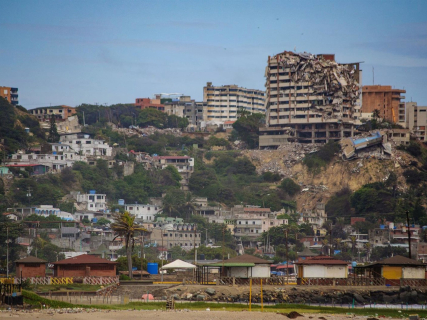

It has been a month since two consecutive earthquakes of magnitude 7.2 and 7.5 shook the north of Venezuela and transformed a festive day into one of the greatest natural disasters in the recent history of the country.
Thirty days later, the emergency is no longer measured solely by the collapsed buildings or the destroyed infrastructures, but also by the thousands of families who continue searching for their loved ones, by the displaced who are still living in temporary camps, and by the uncertainty about a reconstruction that, according to international organizations, will take years.
On June 24, coinciding with the celebration of the anniversary of the Battle of Carabobo and the feast of San Juan, a first earthquake of magnitude 7.2 shook the country. Just 39 seconds later, a second earthquake, even more powerful, of magnitude 7.5, finished collapsing buildings that had already been severely damaged. The epicenter was located in the state of Yaracuy, although the greatest impact was concentrated in La Guaira and Caracas, where thousands of people were enjoying the holiday bridge.
Since then, the country has recorded more than 1,400 aftershocks, keeping a population on alert that is still trying to regain a minimal normality.
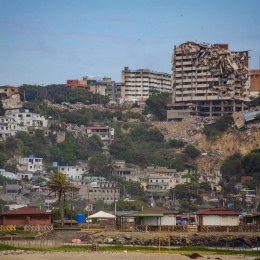
Close to 5,400 dead and thousands missing
Venezuelan authorities updated the official balance of the tragedy this Thursday. The president of the National Assembly, Jorge Rodríguez, reported that the number of deceased has risen to 5,398 people, while the injured reach 16,740.
According to official data, 17,907 people have been directly affected by the earthquakes and 6,462 have been rescued since emergency operations began. Additionally, 128,324 families have received some form of institutional aid and nearly 44,300 patients have required medical attention.
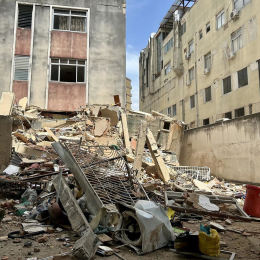
In material terms, the Government acknowledges that 190 buildings were completely destroyed and another 856 suffered varying degrees of damage. Currently, 107 temporary camps remain open, where around 23,300 people who lost their homes are living.
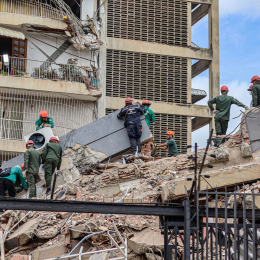
Rescue and assistance tasks continue supported by a large deployment formed by almost 31,000 national personnel, along with 2,278 international rescuers and more than 31,700 volunteers.
However, the number of victims continues to be a subject of controversy. Various citizen platforms dedicated to locating the disappeared maintain that contact has still not been made with tens of thousands of people. Some of these organizations raise that figure to close to 30,000 missing, while others handle even higher estimates, although for the moment none of them has been able to be officially verified.
The uncertainty remains especially painful for thousands of families who continue to wait for news of relatives whose trace was lost during the collapses.
Identifications of victims continue
One of the main challenges a month after the tragedy remains the identification of the deceased. The National Service of Medicine and Forensic Sciences (Senamecf) has requested in recent days that the direct relatives of missing persons come to undergo voluntary DNA tests to facilitate the identification of the remains recovered in the morgues set up in La Guaira and Caracas.
Meanwhile, numerous families still remain near the most affected areas waiting for search efforts to continue among the rubble.
Water, housing, and mental health: priorities after the emergency
Having surpassed the initial phase of rescue, the humanitarian crisis now enters a new stage.
Humanitarian organizations warn that the main needs are no longer solely immediate care for the injured, but ensuring access to drinking water, improving saniation conditions, preventing the emergence of infectious diseases, and ensuring the continuity of basic health care.
Particular concern is also generated by the protection of minors, elderly people, and citizens with disabilities, as well as the need to provide psychological support to thousands of affected individuals who have lost family members or homes.
Featured story
The seismic doublet of Venezuela could cost up to 11 billion dollars and take years to recover
3 minutes
Another of the major challenges will be to find stable housing solutions for those who continue to live in temporary shelters. International organizations remind that these camps were conceived as an emergency response and not as a permanent solution.
A reconstruction that could take more than a decade
The enormous economic cost of the disaster is also beginning to be quantified. The World Bank has estimated that the earthquakes caused 19.6 billion dollars in direct material damages, equivalent to about 17.225 billion euros.
According to the agency's assessment, 47% of the losses correspond to housing, 27% to infrastructure such as hospitals, schools, or roads, and the remaining 26% to non-residential buildings. Approximately half of all damages are concentrated between La Guaira and the Capital District.
The institution has prepared this first estimate using its international system GRADE (Global Rapid Post-Disaster Damage Estimation), used to assess the economic impact of major natural disasters and guide future recovery investments.
The report also issues a warning: if current levels of public and private investment are maintained, reconstruction will remain incomplete even in 2036.
According to the World Bank, a large part of the effort will need to be financed through the reallocation of already committed resources, which will inevitably slow down the recovery process and prolong the economic consequences of the disaster for years.
The Vice President of the World Bank for Latin America and the Caribbean, Susana Cordeiro, noted this Thursday that the earthquakes "have disrupted people's lives, damaged critical infrastructure, and created new challenges for Venezuela's recovery," while arguing that having a rigorous technical assessment is the first step to designing an effective reconstruction strategy.
The agency is currently working with the Venezuelan government, the Inter-American Development Bank (IDB), and the Development Bank of Latin America (CAF) to define the volume of financing and the necessary technical assistance.
The reconstruction plan progresses
The Executive is continuing the Venezuela Renace program, aimed at assessing and rehabilitating the affected infrastructures.
According to the latest data provided by the authorities, the plan is already working on 11,794 housing units distributed among La Guaira, Caracas, Miranda, Aragua, Yaracuy, Falcón, and Carabobo.
The technicians classify each property according to its level of impact using a color system that determines whether it can be repaired, needs deep rehabilitation, or must be demolished and rebuilt.
Furthermore, the Government has begun the relocation of some families to new housing while searching for land for future residential developments.
The tragedy reignites the political confrontation
The management of the disaster continues to fuel the confrontation between the Government and the opposition. During the presentation of the new balance, the Minister of the Interior, Diosdado Cabello, defended the actions of the Executive and harshly criticized the opposition leaders, stating that "no extremist opponent has gone to La Guaira to offer their help to the people" and accusing them of seeking only media prominence.
From the opposition, Edmundo González has disseminated a letter coinciding with the first month of the tragedy in which he argues that the reconstruction of the country also involves recovering institutions "at the service of its people." In his view, the disaster has highlighted the consequences of years of institutional deterioration and has left many victims without sufficient support from the State.
For her part, María Corina Machado published a message on social media in which she expressed her solidarity with the victims and assured that she accompanies "in a symbolic and spiritual plane" the affected families. The leader stated that the tragedy has struck the entire country and appealed to the solidarity of Venezuelan society to face the recovery.
We have each other. For already a month we have supported each other, encouraged each other, consoled each other. We left our souls and many, also their hands.
— María Corina Machado (@MariaCorinaYA) July 24, 2026
We have each other and we rise up. pic.twitter.com/m86oJe1J1z
A country trying to rise
Thirty days after the double earthquake, Venezuela remains immersed in an emergency that is far from over.
While the authorities continue the work of identifying victims, thousands of families are still waiting for news of their missing loved ones and tens of thousands of people are trying to rebuild their lives after losing their homes.
The rescue phase now gives way to a reconstruction process that will require significant national and international resources and that, according to forecasts from financial organizations, could extend for more than a decade. Meanwhile, the country continues to try to heal the wounds of a tragedy that already occupies a place among the most devastating in its recent history.