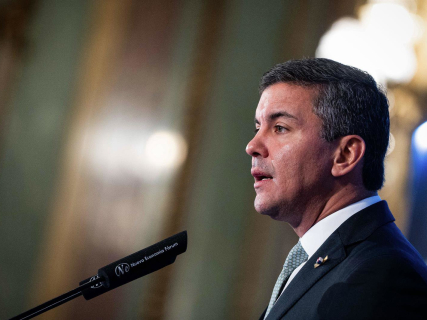

Paraguay is going through a political and financial crisis that has caused the resignation of its president, Santiago Peña, after the intervention of Ueno Bank left millions of clients without access to their savings. The collapse of the institution has triggered protests, judicial investigations, and a split within the ruling Partido Colorado, which has withdrawn its support from the president.
Peña has announced his resignation this Thursday, November 5, just two days after the Central Bank of Paraguay began the bank resolution procedure. He has done so as Congress was preparing to debate an impeachment proceeding against him, initially promoted by the opposition and later backed by his own party.
"I have made the decision to submit my resignation from the Presidency of the Republic. I do so with a view to the stability of our country, social peace, and the need to preserve our democratic institutions," he explained in a message shared on his social networks.
The crisis leaves several issues unresolved: the repayment of money to savers, responsibility for the bank’s operations, Peña’s judicial future, and the presidential succession. These are the main keys.
What has happened in Paraguay and why Santiago Peña resigned
Peña’s resignation comes after the Partido Colorado, which governs Paraguay and to which the president belongs, decided to support his being put on trial in an impeachment proceeding.
Former president Horacio Cartes, a leader of the party and Peña’s main political support, has announced that he would accompany the parliamentary procedure to demand accountability for the banking collapse.
The withdrawal of that support has left the head of state without a sufficient majority to guarantee his continued stay in office. Given that situation, Peña has chosen to submit his resignation and apologize to citizens.
The Chamber of Deputies, however, has continued with the accusation in order to put him through an impeachment proceeding. The 78 deputies present have voted in favor, so the case file has moved to the Senate, which must decide how to proceed after the resignation.
The future of the former president will depend both on that parliamentary decision and on the related judicial investigations into the financial institution.
What is Ueno Bank and why it went bankrupt
Ueno Bank is a Paraguayan financial institution that has grown rapidly in recent years thanks to its digital banking model.
The bank has approximately 2.9 million customers in a country of about 6.1 million inhabitants. That scale explains why its intervention has had immediate consequences for so many families and businesses.
The Central Bank of Paraguay began the resolution procedure after detecting that the entity had seriously failed to meet the solvency requirements required by law.
The investigation by supervisors found problems with the quality of its assets, deficiencies in the documentation of certain transactions and loans to companies linked to the bank’s owning group.
According to the regulator, the adjustments made in its financial statements showed that the solvency ratio had fallen to below half of the legal minimum.
The intervention seeks to determine the real net worth position of Ueno Bank, protect its assets, and organize the repayment of deposits in accordance with Paraguayan law.
The Central Bank insists that this is a specific problem of this entity and not a widespread crisis of the country’s banking system.
What connection Santiago Peña had with the bank
One of the central aspects of the crisis is the president’s prior ties to the business group that owns Ueno Bank.
Peña had a stake in Grupo Vázquez, linked to the financial institution, although he claims that he sold his shares in March 2025.
The opposition questions whether that relationship could have influenced decisions made during his term, especially due to the presence of significant public resources in the bank.
Among the entities that had deposited funds in Ueno is the Instituto de Previsión Social (IPS), responsible for managing the pensions of a large part of Paraguayan workers.
The investigations have also reached those responsible in the financial sector. Carlos Carvallo, president of the Central Bank and former executive of Ueno, has left his position following the intervention.
Peña’s business ties and public deposits have fueled accusations of possible conflicts of interest. However, the existence of those relationships alone does not by itself prove that the executive committed a crime. Determining any potential responsibilities corresponds to the Justice system.
What will happen with the money of savers
The most immediate concern for the affected Paraguayans is when they will be able to recover their savings.
The intervention has temporarily interrupted access to the accounts of Ueno Bank, which has harmed both individuals and companies that used its services to receive income, pay payrolls, or carry out everyday operations.
The Deposit Guarantee Fund of Paraguay protects up to 228.3 million guaraníes per depositor and entity, an amount equivalent to approximately 34,000 euros, depending on the exchange rate.
According to estimates disseminated by the authorities, that coverage would allow deposits to be returned in full to around 97% of customers.
The Central Bank has announced this Thursday the start of the guaranteed payments process, which will be carried out in stages.
The first group will be made up of customers who meet simultaneously three conditions:
-
Have deposits of up to 10 million guaraníes.
-
Not have debts with Ueno Bank.
-
Have an enabled account at another Paraguayan banking or financial entity.
Customers included in that group will be able to recover all of their deposits. For the others affected, the Central Bank will announce new payment phases.
The regulator has enabled official information about the procedure on its page for payments of the Deposit Guarantee Fund.
Legal coverage does not mean that all customers will receive their money immediately. The schedule will depend on the resolution procedure and on the checks carried out by the interveners.
Who will replace Santiago Peña as President of Paraguay
The Constitution of Paraguay establishes that, in the event of the president’s final departure, the vice president must assume the head of State.
In this case, the planned successor is Pedro Alliana, also a member of the Partido Colorado, who will have to complete the presidential term until August 15, 2028.
Alliana had also been included in a proposal for political impeachment over the banking crisis, but the Chamber of Deputies has rejected the accusation against him.
The vote resulted in 48 deputies opposed to the procedure and 30 in favor, which clears his path to the Presidency.
The continuity of the Partido Colorado in power contrasts with Peña’s departure, who had reached the Presidency in August 2023.
What could happen with the political impeachment and the judicial investigation
Peña’s resignation has not closed the parliamentary procedure opened against him.
The Chamber of Deputies has unanimously approved the accusation to subject him to impeachment proceedings, despite the fact that he had already submitted his resignation.
The Senate will now have to resolve the institutional situation of the former president, including the continuation of the procedure and the processing of his resignation.
The decision has consequences for Peña’s possible status as a lifetime senator, provided for in the Paraguayan Constitution for certain former presidents. A possible removal through impeachment could prevent him from accessing that status.
In parallel, the Prosecutor’s Office is investigating the operations linked to Ueno Bank and any possible responsibilities of executives and other persons related to the entity.
Judicial actions and parliamentary decisions are different procedures. The presidential resignation does not prevent criminal investigations from continuing.
What role has the Partido Colorado played in Peña’s downfall
The Partido Colorado is the main political force in Paraguay and has dominated much of the country’s recent history.
Peña came to power in 2023 with the backing of Horacio Cartes, a former president and one of the formation’s most influential figures.
The Ueno Bank crisis has caused a split between the two. Cartes has publicly backed the impeachment of the executive and has defended the need to hold accountable for the use of public and private resources.
The withdrawal of support from his own party has been decisive in precipitating Peña’s resignation.
At the same time, opposition to the impeachment of Alliana allows the Partido Colorado to preserve the Presidency through another one of its leaders.
How does the crisis affect companies and employment
The intervention of Ueno Bank has not only harmed savers. It has also affected companies that kept accounts with the entity and workers who relied on it to get their salaries paid.
Difficulties accessing deposits have caused liquidity problems and have increased pressure on the authorities to speed up refunds.
The Central Bank has said that its interveners are working to meet Ueno Bank’s labor obligations and expect to make the corresponding payments to employees in the coming days.
The crisis has also reached companies linked to the group that owns the entity, including media outlets that have suffered interruptions in activity.
The authorities must determine the economic scope of the intervention and the consequences for the affected workers and businesses.
Why Santiago Peña canceled his trip to Spain
The banking crisis has also had diplomatic consequences.
Peña was scheduled to participate in the Ibero-American Summit held in Madrid on November 4 and 5, but he canceled his attendance due to the deterioration of the situation in Paraguay.
The president was supposed to attend an appointment that brought together delegations from the 22 Ibero-American countries and that included institutional meetings with Spanish authorities.
His absence coincided with protests by savers, the progress of impeachment proceedings, and the break with the Partido Colorado.
With the resignation submitted, Paraguay will have to complete the presidential succession while the Ueno Bank resolution process continues. The immediate priority for millions of citizens remains regaining access to their money, while institutions investigate how the financial situation of one of the entities with the largest number of customers in the country could have deteriorated.