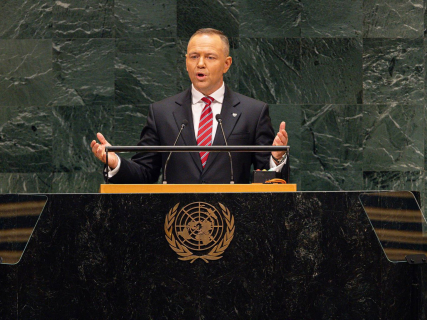

The president of Poland, Karol Nawrocki, issued a stern warning on Wednesday about the "imperialist arrogance" of Russia during his speech before the UN General Assembly, demanding that "the blind eye not be turned when (the rules are) violated."
"Russia is destabilizing Europe through open aggression, hybrid operations, subversive and sabotage acts, and ignoring several resolutions of this Assembly," he stated, emphasizing that "the imperialist arrogance of the past" was the trigger for the two world wars.
The head of state recalled Russia's "persistent" attempts to "conquer" a neighboring country and destabilize an entire region, noting that Moscow is now pursuing the same goal, "guided by a neocolonialist and imperialist vision of the world."
In this scenario, he called for effective accountability mechanisms, "because without them there will be no lasting peace and International Law will be nothing more than a declaration devoid of true power."
In this sense, he insisted that "disdain for International Law cannot become a rule" and on the need to call "aggression by its name," stressing that the purpose is to "condemn those who disturb the world order without turning a blind eye when they violate the rules."
"It is not too late to restore International Law and strengthen the foundations of a system in which principles matter and in which the international community acts in solidarity," he defended from the podium of the United Nations.
Nawrocki, who has claimed the primacy of Law over the use of force, emphasized that Poland, "aware" of the consequences of Russian imperialism, is determined to "fight against the threats posed by the Kremlin's aggressive policies against us."
"As a representative of a neighboring country to Russia, I want to say something very clearly, we do not seek confrontation, we are strengthening our alliances, developing our army, and modernizing our equipment, not to wage a war but to prevent it," he added, defending "deterrence" as one of the pillars of the United Nations Charter.
In this line, he reiterated his support for NATO as a "guarantor" of security on both sides of the Atlantic, as well as the agreement between the United States, Denmark, and Greenland to reinforce the protection of the island in the Arctic.
However, the president has warned that "modern threats to security are not limited to conventional military actions," and has cited the impact of Russian attacks on grain-laden ships on "global food security" as an example.
"At the same time, a large-scale hybrid war is being waged that includes sabotage, cyberattacks, and destabilization operations on an unprecedented scale, including an artificially induced migration crisis," he pointed out, describing actions that are "coordinated and carried out coherently" to "undermine the trust" of citizens in their states.
In his view, this is a "well-designed and sustained strategy," which is why he has called for a "firm, coherent, and united" reaction instead of "isolated and indecisive" responses.
At another point in his speech, the leader has claimed that Poland is currently the 20th largest economy in the world and has demanded that "the voice of Central Europe be heard at the G20," whose summit will be held in Miami on December 14 and 15, with the aim of addressing structural challenges such as the demographic crisis.
On this point, he has warned that "it is not just about statistics, but a challenge to civilization." "The aging of societies, the decline in birth rates, and the erosion of social ties are undermining the growth of our nations," he has alerted, calling for measures that go beyond the strictly economic realm.
In particular, Nawrocki has advocated for policies that allow "to strengthen the social importance of motherhood and fatherhood of families, mothers, fathers" and has also requested "that culture and the media promote having children and not aborting them."
"This is the first step to overcoming the demographic crisis. Without lasting communities and strong families, there will be no stable development or long-term security," he has maintained, before linking the demographic crisis to other challenges such as "illegal migration (which) causes misery, tension, and unrest."