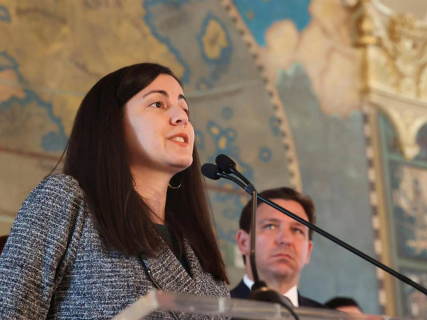

The Cuban opposition leader Rosa María Payá laid out this Tuesday in Madrid, coinciding with the 30th Ibero-American Summit, a structured plan in three stages to promote a political transition in Cuba and thus "restore to Cubans their right to decide about their future."
"The plan that we present today is not a statement of intent; it is a roadmap to organize a political change to address the humanitarian emergency, restore the rule of law, rebuild the economy, and hold free elections," she explained during the event held in the Spanish capital, which was attended by the Minister of Foreign Affairs of the Dominican Republic, Víctor Bisonó, the Polish MEP Arkadiusz Mularczyk, and the Secretary General of the Organization of American States (OEA), Albert Ramdin.
Payá broke down that the project is structured in three phases, which begin with "the unconditional release of all Cuban political prisoners, the removal from power of the Castro family and its generals, and includes an end to repression and guarantees for fundamental rights."
"We want to be very clear about something. There is no transition with repression. Liberation is only the beginning of the work. And that is why, immediately, stabilization and reconstruction begin to end with democratization," she said. She also clarified that a "transitional government" would have a limited mandate of between 18 and 36 months "not renewable," since "the final objective of this plan is not to manage the transition, it is to return to the people, to citizens, their right to decide their future."
The activist defended launching "a process in which Cubans will decide through a binding plebiscite the new constitutional framework and the calling of free, plural, and competitive elections." "The first free elections in more than 70 years for the Cuban people. We know that freedom cannot wait until reconstruction is over; people need solutions from day one. That is why, this plan includes an immediate humanitarian assistance program with concrete priorities for the first six months," she stressed.
During her appearance, several people interrupted the event with slogans against the blockade of the United States and tried to access the podium, although they were removed. Payá expressed her surprise at the incident, which she attributed to "delegates of the dictatorship". She recalled that "those responsible" for the socio-economic crisis that Cuba is going through "are in the Castro family and in the group of generals who have been clinging to power for 67 years" and that "even today they still dare to send us their representatives".
Even so, she insisted that her "proposal is for all Cuban people, including those who today are still stuck in the totalitarian institutions of that dictatorship because they also need liberation and because their families are also suffering".
Payá evoked the Liberation Agreement, signed on March 2 in Miami by different opposition organizations —headed by Asamblea de la Resistencia Cubana (ARC) and Pasos de Cambio— and later ratified in Madrid, under which "the main democratic forces of Cuban society committed to work to create the necessary capacities for the transition".
"That is what we did, and we invited Cubans, both inside and outside, to contribute to that process. And this invitation is open, and this process is open, because the future of Cuba belongs to all Cuban people", she emphasized.
The opposition figure also dedicated some words to her father, Oswaldo Payá, who died in July 2012 in a traffic accident when the vehicle was being driven by Ángel Carromero, then secretary general of Nuevas Generaciones of the Partido Popular in Madrid.
"He could have left Cuba many times, he could have chosen exile, tranquility, a life without persecution, but he decided to stay because he knew that every human being has dignity and that no government can grant it and no government can take it away either", she recalled.
"Freedom is not a concession of power, it is a right that belongs to us just by the fact of existing, by being children of God, my father would say. He dedicated his life to defending that principle and for that he was assassinated by the same dictators who still want to confuse us with their propaganda. The regime still today is afraid of his ideas and something became very clear. They couldn’t kill his legacy", she added.
Payá concluded by reiterating that "Cuba is closer to freedom than many people imagine. Not because the dictatorship is less cruel, but because after almost seven decades its failure is absolute".