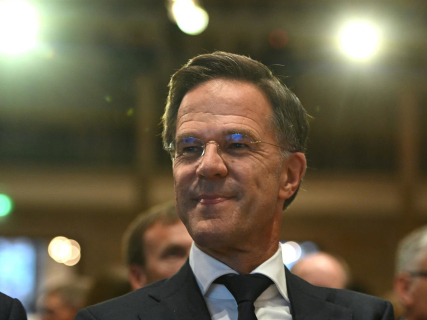

The NATO secretary general, Mark Rutte, defended this Thursday that he maintains "no criticism" toward Portugal or Spain, highlighting that both countries are increasing their military spending and reinforcing their industrial capacity in the field of defense. His remarks come after the discontent generated in Lisbon following previous statements in which he pointed out that these two nations perceive the Russian threat as "very far away".
"I have no criticism of Portugal or Spain, because they are doing exactly what we have to do: increase defense spending and boost industrial production," he said to the media in Dublin, before taking part in the summit of the European Political Community, which brings together nearly fifty heads of State and Government from across the continent.
The disagreement dates back to last week, when, in an interview with Dutch television, Rutte said that "Spain and Portugal say that (the war) 'is very far away, and what happens in Russia mainly affects Poland'" and added that "the most recent Russian missiles take five minutes longer to reach Lisbon than Warsaw".
Asked about the possibility of holding a meeting with the Portuguese prime minister, Luís Montenegro, to clarify the controversy —the head of Government, Pedro Sánchez, did not travel to the Dublin meeting—, Rutte was categorical in saying that he has "nothing to explain". "Absolutely nothing," he insisted.
Before closing the matter, the head of the Atlantic Alliance specified that his comments referred to "all of Europe, and not only the case of Portugal or Spain," suggesting that "the population, not politicians, but people" perceives the risk posed by Russia differently depending on how close it is to the eastern border.
"There is a difference between the countries on the eastern flank, such as Estonia, Poland and others, and the rest. The only thing I’m saying is that these new Russian missiles take five minutes longer to reach Dublin, Amsterdam, Madrid or Rome than it takes to reach Tallinn or Vilna," he stressed.
Portugal accuses Rutte of lack of connection with reality
Rutte’s clarifications have not satisfied the Portuguese prime minister, Luis Montenegro, who, upon arriving at the same summit in Dublin, accused the Dutch leader of being "disconnected from reality".
"These statements, like the first ones, are manifestly unfortunate, (made with) lightness and show a complete lack of understanding of the political and social reality in Portugal," the head of the Lusitanian Government has reproached, asserting the firm backing of Portuguese society and institutions for Ukraine in the face of Russian aggression.
Montenegro has underlined that support for Ukraine and rejection of Russia stand at 92% in Portugal, above the European average of 76% and "higher than that of the Netherlands, the country of origin of the Secretary General of the OTAN".
The prime minister has indicated that he has not kept in contact with Rutte since the controversy broke out last Tuesday, although he has stressed that he would have "no problem in telling him that on this occasion he was wrong, acted prematurely, and does not know a reality that he should know better".
"I think he is completely disconnected from reality in this case and, therefore, I can only regret it profoundly," Montenegro has concluded, asserting Portugal’s commitment to increasing defense investment and to solidarity with Ukraine.