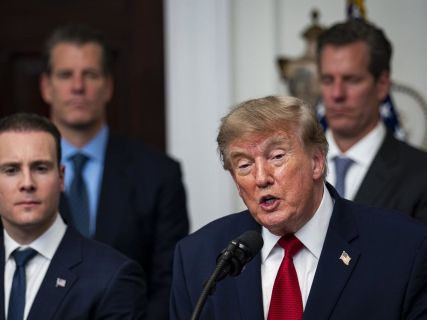

The South Korean Executive has questioned the data provided by the President of the United States, Donald Trump, regarding North Korea's nuclear potential and raises the estimate of Pyongyang's arsenal to a maximum of 120 atomic heads. This discrepancy occurs amid a cooling of relations with Washington following the White House's shift towards the North Korean regime, exemplified by the reduction of joint military exercises.
"We generally estimate that it ranges between 80 and 120, but it is quite difficult to specify the exact figure," said South Korean Defense Minister Ahn Kyu Baek during his speech before the National Assembly Defense Commission, when asked about the North's nuclear capability.
With these words, the minister has revised upward the estimate made public by Trump, who this Wednesday stated that Kim Jong Un's regime has 57 nuclear weapons. Despite this, the American president softened his rhetoric towards the North Korean leader, of whom he said he gets along well and with whom he hopes to hold a new meeting at the end of the year.
"The figure seems slightly different," Ahn noted when assessing the numbers released by the American president, emphasizing that Seoul's estimate is based on "assessments made by national research institutions." "At this moment, it is quite difficult to provide specific details on how our military authorities evaluate them," he added, according to the Yonhap agency.
The nuclear issue remains extremely delicate in South Korea, which does not officially recognize its neighbor as a nuclear power. Therefore, public references by the South Korean political elite to the capability or nuclear arsenal of Pyongyang are unusual and are handled with great caution.
In this context, the Defense Minister has insisted that Seoul's official line is not to develop its own nuclear weapons nor to accept the deployment of U.S. tactical nuclear weapons on its territory. "We maintain a constant policy to ensure that we are provided with the U.S. nuclear umbrella," he emphasized.
The recent statements by Trump about North Korea and his personal approach to Kim have strained the relationship with Seoul, Washington's strategic ally in Asia. One of the main points of friction is the joint military exercises between both countries, which have been reduced at the behest of Trump himself, who justifies the decision by his good rapport with the North Korean leader, the high cost of operations, and the South Korean government's refusal to get involved in a potential war against Iran.