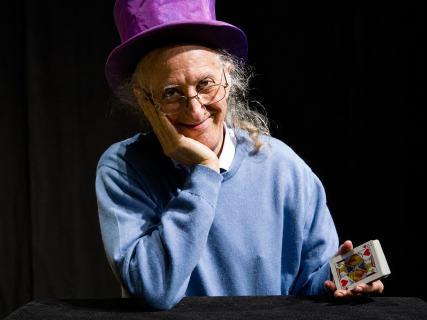
Juan Tamariz dies at 83, the magician who turned card magic into a popular phenomenon

His daughter Ana Tamariz has confirmed the death of the illusionist in Madrid. World champion of card magic, the artist marked several generations with his appearances on television and his work as a master of magicians.

4 minutes

ChatGPT Image 18 ago 2026, 19 52 00

ChatGPT Image 18 ago 2026, 19 52 00

Add DEMÓCRATA to Google

Ask FREN

Published

Last updated

4 minutes

Most read

Juan Tamariz, one of the most recognized figures of Spanish magic and an international reference of card magic, has died this Tuesday at the age of 83 at the Hospital Clínico San Carlos in Madrid, according to El País. His daughter, Ana Tamariz, has confirmed the death through social media.

"With immense sadness, today I say goodbye to my father Juan Tamariz, an incredible person, very loved and admired by all," she wrote, according to RTVE.

With his top hat, his mane, his imaginary violin, and the unmistakable "¡Chan, tatachán!", Tamariz turned illusionism into a recognizable show for millions of viewers. But behind that seemingly improvised character was also one of the great scholars of contemporary magic.

From a magic box to the world championship of card magic

Juan Manuel Tamariz-Martel Negrón was born in Madrid in 1942. His interest in illusionism began when he was only four years old, after attending a magician's performance. Shortly after, he asked for a magic game box and started practicing with family and friends.

At the age of twelve, he discovered the books of the illusionist Wenceslao Ciuró, which allowed him to delve into the technique and the psychological mechanisms involved in a show. As he explained in a interview published by the Madrid City Council, those readings were decisive in understanding that magic was not just about performing a trick.

His precocity opened the doors of the Spanish Society of Illusionism before he reached the minimum required age. He joined at 18, two years earlier than established, after convincing the institution's officials with his skills.

Tamariz studied Physical Sciences and was also interested in cinema, two fields that influenced his way of understanding the construction of a show. However, he ended up dedicating himself entirely to illusionism.

In 1972, he won the Grand Prize at the National Magic Congress. A year later came the recognition that definitively boosted his international career: the World Card Magic Prize, achieved during the World Magic Congress held in Paris.

The profile published by the Government of Spain highlights that, from then on, he presented his shows in cities such as Chicago, Tokyo, Paris, London, Bogotá, Cairo, New York, and Santiago de Chile.

The magician who entered every home

Although his professional prestige grew in international congresses, it was television that turned Juan Tamariz into a familiar character for several generations of Spaniards.

The RTVE archive preserves the pilot program of "Tiempo de magia", produced in 1975, in which he shared the screen with Julio Carabias. That participation anticipated a relationship with the small screen that would last for decades.

His appearance on "Un, dos, tres... responda otra vez" multiplied his popularity. Then came other shows like "Por arte de magia", "Magia Potagia", "Chantatachán" and the children's program "El recreo".

Against the traditional image of the solemn magician, Tamariz built a character that was approachable, overflowing, and apparently chaotic. His jokes, his constant conversation with the audience, and his way of celebrating each number ended up becoming an inseparable part of the show.

That staging, however, concealed a meticulous preparation and a deep understanding of the audience's attention. The ability to direct the gaze, anticipate the spectator's suspicions, and maintain the surprise explained much of the admiration he inspired among other professionals.

Books, teaching, and a school run by his daughter

Tamariz's contribution to magic went far beyond his television appearances. Throughout his career, he published books dedicated to the technique, theory, and presentation of illusionism.

Among his works are "La vía mágica", "Los cinco puntos mágicos", "Sonata" and "Sinfonía en mnemónica mayor", titles included in the bibliographic catalog of Todos Tus Libros.

His works addressed issues such as the relationship between the magician and the audience, the narrative construction of tricks, and the use of memory and psychology in card magic. This combination of reflection and spectacle helped to consolidate his prestige both inside and outside of Spain.

Part of his legacy continues in the Great School of Magic "Ana Tamariz", run by his daughter. Tamariz himself designed the training contents of the center, conceived to convey his way of understanding illusionism to new generations.

The school has included professionals such as Jorge Blass, Anthony Blake, Miguel Gómez, and Rafael Benatar. Its program combines the learning of tricks and techniques with subjects related to the history of magic, theory, and the psychology of the show.

Gold Medal of Fine Arts and recognition from Madrid

The recognition of Juan Tamariz's career also came from the institutions. In 2011, he received the Gold Medal for Merit in Fine Arts, awarded through a royal decree published in the Official State Bulletin.

Previously, in 2009, he had obtained the Honorary Award for Theory and Philosophy from the World Congress of Magic held in Beijing, a distinction linked to his work as a researcher and innovator of illusionism.

In 2019, his hometown also awarded him the Gold Medal of Madrid. The City Council of the capital then highlighted his contribution to the international dissemination of magic and his ability to combine creativity, humor, and research.

With his death, one of the most recognizable faces of Spanish television disappears, and an artist whose influence reached both the general public and several generations of illusionists.

More key points, information and questions with FREN

AI-GENERATED CONTENT

What requirements are currently necessary to join the Spanish Society of Illusionism?

No reliable and up-to-date information was found in the consulted sources about the specific requirements for joining the Spanish Society of Illusionism (SEI) (types of members, tests, endorsements, or procedures), nor about official uniform bases at the state level. This suggests that the practical details of access are mainly managed through the local circles or associations integrated into the SEI and internal regulations that are not indexed in the public databases used in the research.

That said, it is possible to explain how access to magician associations of this type in Spain usually works in practice and what reasonable steps you should take if you want to join the SEI today, making it clear that the following is an indicative outline and not a transcription of current official requirements:

1. General structure of the SEI and role of the circles
  • The SEI is a federation of local circles and groups of illusionists (for example, circles in large cities or provincial associations). Often, the real way in is to become a member of the SEI circle in your area, which in turn integrates you into the state structure.
  • This implies that there is not always a single centralized procedure: each circle may have internal regulations regarding tests, waiting times, or endorsements, although based on general common statutes of the SEI.
2. Usual requirements (indicative)

In illusionism associations similar to the SEI, a series of conditions are repeated that you will probably find, with nuances, when you contact the circle that corresponds to you:

  • Minimum age: it is common to require being of legal age to be a full member. In some circles, there may be a figure of youth member or “aspirant” for minors, with the consent of parents or guardians.
  • Commitment to the ethical code and professional secrecy: it is usually required to expressly accept statutes and a code of ethics (respect for the secrecy of tricks, respect for the audience, responsible use of magic, etc.). Without this adherence, registration is usually not processed.
  • Registration fee and periodic fees: registration normally includes:
    • An initial registration fee.
    • An annual or quarterly membership fee, which finances activities, bulletins, social venue, etc.
  • Endorsements or presentation by members: it is common to require that the aspirant be introduced by one or two active members, who vouch for their real interest in illusionism and responsible behavior. In some circles, if you do not know anyone, they may allow you to spend some time as a guest before applying for membership.
  • Level test or interview: many associations require:
    • A practical test (presenting some tricks before a commission), or
    • At least an interview with circle officials to check motivation, degree of commitment, and attitude regarding secrecy.
    The goal is not so much “professionalism” as to ensure that the person has a serious interest and is not joining just out of passing curiosity.
3. Types of members that usually exist

Although details may vary, it is common in entities of this type to find figures such as:

  • Full member: full member, with voting rights and participation in the life of the association.
  • Youth or aspirant member: for minors or people in a trial period, with some limited rights.
  • Honorary member: granted to great figures or people who have provided extraordinary services to the entity.
4. Practical steps you should take right now

Since we do not have the updated official requirements of the SEI, the safest path for you today is:

  • Locate the SEI circle in your city or province (searching “Spanish Society of Illusionism + your city name” on the web or social networks).
  • Request membership information by email or form: explicitly ask them to detail:
    • Available member types and their rights.
    • Age requirements, documentation, and endorsements.
    • If there is an entrance test or aspirant period.
    • Amount of the entry fee and periodic fees.
  • Request a copy of the statutes or internal regulations, to verify firsthand your obligations and rights once inside.

In summary: I cannot offer you, with documentary support, a closed list of “official and current” SEI requirements because that information does not appear in the accessible sources consulted. What I can give you is this general framework of how these types of associations are usually organized and, above all, the concrete actions so that you obtain the exact and updated requirements of the SEI circle that corresponds to you.

How can I prepare for a possible practical entrance test if I want to join an SEI circle? What advantages and obligations do members of the Spanish Society of Illusionism usually have once inside? Are there other magician associations in Spain besides the SEI, and how do they compare in requirements and activities?

What are the functions and competencies of the Madrid City Council in granting distinctions such as the Gold Medal of Madrid?

Within the framework of local government, the Madrid City Council has its own competence to regulate and grant honorary distinctions, including the Gold Medal of Madrid, as a form of institutional recognition to individuals or legal entities that have provided relevant services to the city. This competence is supported by the basic local government regulations and the Madrid regional legislation on local administration (for example, the Law 2/2003, on Local Administration of the Community of Madrid), which recognizes municipalities' regulatory and self-organization capacity to order their institutional life.

1. Normative competence and self-organization
  • The City Council, through its bodies, exercises a normative faculty to create and regulate municipal honorary distinctions. This is concretized in the approval of a regulation of honors and distinctions or equivalent norm, where the catalog of decorations (including the Gold Medal), their modalities, requirements, and effects are established.
  • This regulatory power derives from municipal autonomy and allows the City Council to define:
    • Who can be recipients of the Medal (individuals, entities, Spanish or foreign, etc.).
    • What merits or services are considered “relevant” or “extraordinary” for Madrid.
    • Whether distinctions can be awarded posthumously.
    • Regime of incompatibilities or accumulation with other municipal distinctions.
2. Competent bodies
  • In large municipalities, the central body in these matters is the City Council Plenary, which assumes the competence to agree on the granting of the highest-ranking distinctions (such as the Gold Medal), as these are decisions of high institutional content and representative of the entire corporation.
  • The Mayor's Office and, where appropriate, the Governing Board usually have functions of initiative and proposal:
    • Propose candidacies to the Plenary.
    • Order the initiation of the files.
    • Supervise the administrative processing.
  • There may also be a specific commission (permanent or ad hoc), formed by councilors and, where appropriate, technical staff, responsible for studying proposals and issuing reports or prior opinions to the plenary decision.
3. Functions in the granting procedure

The municipal competence unfolds throughout its own administrative procedure, which the City Council is empowered to design. Typical functions include:

  • Initiation of the file: the competent body (usually the Mayor's Office or a Government area) opens the granting file based on a motivated proposal, which may come from municipal groups, councilors, citizen entities, or the Mayor's Office itself.
  • Instruction: municipal administrative services carry out the necessary actions:
    • Gather background and merits of the proposed person or entity.
    • Request, if provided by the regulation, reports from commissions or consultative bodies.
    • Prepare a technical proposal or justificatory report.
  • Proposal of resolution: after instruction, a proposal (from the Mayor's Office, Governing Board, or commission) is submitted to the Plenary, which includes the specific reasons why the Gold Medal granting is considered deserved.
  • Granting agreement: the Plenary adopts the agreement, usually by vote. Given the symbolic and consensus nature of these distinctions, broad or unanimous support is often sought, although the regulation may establish specific majorities.
  • Publication and formalization: the City Council has the function to:
    • Publish the agreement in the corresponding official bulletin and/or on the municipal notice board and electronic headquarters.
    • Organize the solemn awarding ceremony (ceremony, protocol, use of the city’s coat of arms and symbols).
    • Issue the physical titles, diplomas, or insignias of the Gold Medal.
4. Scope and effects of the distinction
  • The Gold Medal of Madrid is a purely honorary distinction: it usually does not generate economic rights or special legal status, beyond public recognition of merits.
  • The City Council does have the competence to establish the symbolic effects:
    • Honorific treatment linked to the distinction (for example, mentions in official acts).
    • Registration of the awardee in honor books or municipal registers of distinctions.
    • Possible prominent participation in institutional city events.
  • Likewise, the municipal corporation retains the power of revocation of the distinction, through a motivated agreement and with procedural guarantees, if serious circumstances justify it and the regulation provides for it.

In short, the Madrid City Council exercises comprehensive competence over the Gold Medal of Madrid: it defines the distinction and its requirements, decides to whom it is granted, organizes its delivery, and determines its honorary effects, all through its own bodies and within the framework of local autonomy recognized by basic and regional legislation.

Can you explain, step by step, how a Gold Medal of Madrid granting file would work in practice? What differences are usually found between the Gold Medal of Madrid and other lower-ranking municipal honorary distinctions? How is the municipal regulation of distinctions coordinated with Law 2/2024 on Honorary Distinctions of the Community of Madrid?

Which other Spanish magicians have received the Gold Medal of Merit in Fine Arts?

In the sources I have consulted (press releases from the Ministry of Culture, Moncloa, and accessible press documentation through the Demócrata database) there is no specific list of Spanish magicians or illusionists awarded the Gold Medal of Merit in Fine Arts, nor clear references that allow reliably extracting a complete list of awardees in this particular discipline. That is: with the available information, I cannot rigorously confirm which other magicians, apart from the one you have in mind, have officially received this decoration.

Why it is difficult to provide a list of awarded “magicians”

The Gold Medal of Merit in Fine Arts is granted by the Government of Spain, at the proposal of the Ministry of Culture, and each year the list of awarded persons and entities is published in the Official State Gazette and official press releases (for example, those of 2022, 2023, and 2024 found at:

These lists detail the names of the awardees and, sometimes, their specialty (“painter,” “singer,” “film director,” “dancer,” “art historian,” etc.). However, in the explored documentation:

  • There are no profession filters that allow, with a single query, obtaining “all illusionists” or “all magicians” awarded.
  • The consulted press releases do not explicitly mention any awardee identified as “magician” or “illusionist.” They do mention filmmakers, musicians, visual artists, writers, circus entities, etc., but without clear references to magic artists.

What has been securely located

The searches have confirmed:

  • The general nature of the distinction: it is granted to persons and entities who have stood out extraordinarily in artistic and cultural creation, or in the protection and dissemination of Spanish cultural heritage.
  • Examples of other awardees from fields different from magic: musicians like Julio Iglesias, visual artists, writers, dance companies, filmmakers, or cultural institutions, cited in official notes and contextual articles, but not as illusionists.
  • Indirect references to the medal in other contexts (for example, when a biography mentions that someone was awarded the Gold Medal of Merit in Fine Arts, as happens with some visual artists or choreographers), again without magicians identified as such.

On the other hand, more specific searches such as “Juan Tamariz Gold Medal of Merit in Fine Arts,” “Mag Lari Gold Medal of Merit in Fine Arts,” or “Spanish illusionists Gold Medal of Merit in Fine Arts” have not returned relevant results in the examined database, nor in the Culture and Moncloa texts linked to it. This implies that, relying only on this evidence, I cannot documentarily prove a list of magicians recognized with this medal.

How you could reconstruct the list more precisely

If you need an exhaustive and verified answer, the safest procedure involves:

  1. Consulting the Official State Gazette (BOE) year by year from the creation of the medal (1978) to today, reviewing the ministerial orders granting the Gold Medals of Merit in Fine Arts. Each one lists all awardees of that year.
  2. Extracting names linked to circus, variety shows, or performing arts and, in case of doubt, cross-checking their professional career through search engines or biographies (to verify if their main activity is magic or illusionism).
  3. Verifying on the Ministry of Culture website (section “Awards and recognitions”) if there is any historical compilation of medals, sometimes offered in PDF format or downloadable databases.
  4. Cross-checking with sectoral sources of Spanish magicians and illusionists (magician associations, illusionism societies, etc.), which usually maintain lists of institutional awards obtained by their members and probably identify precisely which members have received this particular medal.

Conclusion

With the institutional and journalistic information accessible in this search, it is not possible to offer a reliable list of “other Spanish magicians” who have received the Gold Medal of Merit in Fine Arts, nor even to narrow down a small group of names with full documentary certainty. Any list I would give now based on memory or assumptions would be unrigorous.

If you want, in a next step I can help you design a working table or a small protocol to gradually compile, year by year, the data you find in the BOE and official websites, until you reconstruct that list yourself with guarantees.

Can you explain in more detail what exactly the Gold Medal of Merit in Fine Arts is and how it is granted? Can you help me prepare a list of concrete steps to review the BOE and locate the medal awardees year by year? Which Spanish magician and illusionist associations or entities could I consult to cross-check which members have received this distinction?

Play

Test your knowledge with FREN!

How much do you know about this topic? Answer the following 3 questions.

In which hospital did Juan Tamariz pass away?

Question 1 of 3

Which television program especially contributed to Juan Tamariz's popularity in Spain?

Question 2 of 3

Which award did Juan Tamariz receive in 2011?

Question 3 of 3

Hola, soy Fren. ¿Cómo te ayudo?