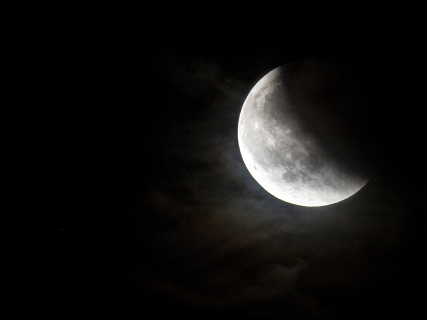
Lunar eclipse of August 28, 2026: exact time, where to see it in Spain and why the Moon will turn red

Just 16 days after the total solar eclipse, Spain will look to the sky again to contemplate a partial lunar eclipse of magnitude 0.93 that will be visible from all over the country during the early morning of Friday, August 28.

4 minutes

EuropaPress 6940055 vista eclipse lunar septiembre 2025 barcelona catalunya espana fenomeno

EuropaPress 6940055 vista eclipse lunar septiembre 2025 barcelona catalunya espana fenomeno

Add DEMÓCRATA to Google

Ask FREN

Published

Last updated

4 minutes

Most read

After the historic total solar eclipse of August 12, the astronomical calendar of 2026 still holds another great event for Spain. In the early morning of Friday, August 28, a partial lunar eclipse will take place visible from all over the country, although the conditions will change depending on the location.

The phenomenon will reach its maximum around 6:12 AM, when a very high part of the lunar disk will be within the Earth's shadow.

When is the lunar eclipse of August 28, 2026

The lunar eclipse of August 28, 2026 will take place during the last hours of the night and the first hours of the morning. The National Geographic Institute (IGN) confirms that it will be a partial lunar eclipse and that it can be observed from all of Spain without the need for any special instrument.

The partial phase will begin around 4:33 AM, while the maximum of the eclipse will occur at 6:12 AM, in peninsular time. At that time, the Moon will be most deeply immersed in the Earth's shadow. The specific times of visible ending will change depending on the locality because the Moon will be approaching the horizon.

It will not be a total eclipse, but it will be very close. The IGN establishes a magnitude of 0.93, while Time and Date's calculations estimate that approximately 96.2% of the apparent diameter of the Moon will be covered by the Earth's umbra at the maximum. Therefore, it will be a particularly deep partial eclipse.

Where the lunar eclipse can be seen in Spain

One of the great advantages of the upcoming eclipse is that it will be visible from all of Spain. There will not be a narrow band of totality as occurred with the solar eclipse of August 12. The IGN confirms that the partial phase can be observed from any point in Spanish territory before the Moon sets.

The differences will appear at the end of the phenomenon. In the center and east of the Peninsula, Balearic Islands, and Melilla, the Moon will set before the partial phase ends. In the rest of the Peninsula, Canary Islands and Ceuta, the lunar sunset will occur after that phase has concluded.

For example, in Madrid, the Moon will set at approximately 7:46 AM, before the partial phase ends at 7:51. In Barcelona, the eclipse can be followed until approximately 7:20 AM, when the Moon is already near the horizon. Therefore, to observe the last moments, it will be especially important to have a clear west-southwest horizon.

Why the Moon can acquire a reddish tone during the eclipse

A lunar eclipse occurs when the Earth is positioned between the sun and the Moon and our satellite passes through the shadow cast by the planet. Unlike what happens during a solar eclipse, the Moon does not necessarily disappear completely when it enters the Earth's shadow.

The explanation lies in the atmosphere. Part of the sunlight passes through the outer layers of the Earth's atmosphere before reaching the Moon. The shorter wavelengths scatter more easily, while a greater proportion of reddish light manages to pass through and refract towards our satellite. It is the same physical phenomenon that contributes to the red and orange tones of sunrises and sunsets.

In this case, an important clarification must be made: the eclipse on August 28 will be partial and not a total "blood moon". However, since it is an extremely deep eclipse, with practically the entire lunar disk entering the umbra, the eclipsed area may acquire dark, coppery, or reddish hues. The final appearance will also depend on the conditions of the Earth's atmosphere.

What time will the lunar eclipse be in Madrid, Barcelona, and other cities

The central moment will be practically the same for all of Spain: around 6:12 AM on Friday, August 28. What changes considerably depending on the city is how long the eclipse can still be observed before the Moon disappears below the horizon.

In the western peninsula, the conditions will be more favorable to follow the last stages. In Ponferrada, for example, the phenomenon can be observed for more than four hours and the partial phase will end before the lunar sunset. In Madrid, on the other hand, the Moon will disappear approximately five minutes before that phase ends.

In the Balearic Islands, the situation will be even more limited during the final stretch. In Palma, the Moon will set around 7:21 AM, half an hour before the partial phase globally ends. This will not prevent witnessing the most important moment, as the maximum at 6:12 AM will indeed be visible.

Key times of the lunar eclipse on August 28, 2026
Phase Approximate time in mainland Spain
Start of the partial phase 4:33 AM
Maximum of the eclipse 6:12 AM
End of the partial phase 7:51 AM*
*In numerous areas of central and eastern mainland Spain, the Balearic Islands, and Melilla, the Moon will set before the partial phase ends.

How to see the lunar eclipse on August 28

Unlike a solar eclipse, a lunar eclipse can be observed directly with the naked eye without risk to the eyes. No eclipse glasses, solar filters, or any other protective elements are needed. The IGN itself expressly states that its observation poses no danger and does not require special instrumentation.

It is also not necessary to have a telescope. Binoculars can allow for a better appreciation of the changes on the lunar surface, but the phenomenon will be perfectly perceptible to the naked eye as long as the weather conditions permit.

The choice of location will be especially important during the final part. As the Moon descends towards the horizon, it will be advisable to look for a space with good visibility towards the west and southwest, without buildings, trees, or mountains blocking the view. On this occasion, moreover, completely distancing oneself from light pollution will not be as essential as for observing a meteor shower.

The second eclipse visible in Spain in just 16 days

The phenomenon will arrive just 16 days after the total solar eclipse of August 12, which made Spain one of the privileged places on the planet to observe one of the main astronomical events of the year.

The eclipse on August 28 will be completely different. Instead of the Moon being positioned between the Earth and the sun, it will be our planet that places itself between the sun and the Moon, casting its shadow on the satellite.

The IGN officially includes both phenomena among the eclipses visible from Spain in 2026: the total solar eclipse of August 12 and the partial lunar eclipse on the 28th. Spain will thus look to the sky again before the end of the month, this time during the early morning and without the need to use eye protection.

More key points, information and questions with FREN

AI-GENERATED CONTENT

What requirements must be met for a lunar eclipse to be considered total according to international astronomical regulations?

I cannot answer that question in detail because I specialize exclusively in Spanish politics and institutions, not in astronomy or international scientific regulations. My field of work includes laws, parliamentary activity, decrees, public policies, political parties, political actors, and public debate in Spain.

I can help you, for example, with:

  • Explanations on how a law or a royal decree-law is processed in Spain.
  • The content and processing status of specific regulations (laws, decrees, orders, etc.).
  • The position of Spanish political parties or actors on a topic of scientific, space, or research policy.
  • The structure and competencies of institutions such as the Congress, the Senate, the Government, or the regional parliaments.
  • Analysis of current Spanish political, legislative, or institutional affairs.

If you rephrase your question linking it to the political or institutional field (for example, about how astronomical activities, space research, observatories are regulated in Spain, or what political debate exists around these matters), I will be happy to help you with a detailed answer.

What are the competencies of the National Geographic Institute in the preparation of astronomical calendars and the dissemination of celestial phenomena?

The National Geographic Institute (IGN), currently under the Ministry of Transport and Sustainable Mobility, is the State's reference body for basic astronomical information for the public. It does so mainly through the National Astronomical Observatory (OAN) and its network of observatories such as Yebes or the Royal Observatory of Madrid, and this function includes both the calculation of ephemerides and astronomical calendars as well as the rigorous dissemination of celestial phenomena.

Official astronomical information and ephemerides

Various official notes from the Ministry of Transport emphasize that the IGN is “the managing center [...] that has the competencies to provide official information on astronomy through the National Astronomical Observatory” (note from 06/30/2025; note from 04/30/2026). From this derive several lines of work:

  • Calculation of astronomical ephemerides: positions of the Sun, Moon, and planets, lunar phases, exact moments of solstices and equinoxes, etc. For example, the official time for the start of summer 2026 in Spain is cited “according to calculations by the National Astronomical Observatory, dependent on the National Geographic Institute” (Demócrata).
  • Disseminative astronomical calendars: these ephemerides are organized into monthly and annual calendars (full moon times, meteor showers, conjunctions, planet visibility, etc.), which are used as references in media and administrations. The press reports, for example, dates and times of full moons or planetary alignments as data coming from the OAN/IGN.
  • Specific predictions for singular phenomena: in the case of the eclipses of 2026‑2028, the IGN produces detailed calculations (start, maximum, and end times, duration of totality, percentage of occultation) for more than 8,000 Spanish municipalities, which are disseminated through official viewers and applications (Mitma).

Preparation of maps, viewers, and eclipse calendars

Regarding specific phenomena, the IGN's competencies translate into very specific products:

  • Websites and cartographic viewers: the ministry details that the IGN has published a specific website for the three eclipses visible between 2026 and 2028, with maps, location searchers, and animations of the Moon's shadow over Spain, developed together with the National Geographic Information Center (note). This website is part of a “scientific dissemination campaign” in its role as responsible for official astronomical information.
  • Mobile applications and digital resources: the department itself explains that the IGN “offers digital resources to plan the observation of the August 12, 2026 eclipse” (note), including an app (“IGN Eclipses”) and interactive maps that the press identifies as a reference to consult, municipality by municipality, the time and magnitude of the phenomenon (Demócrata).
  • Definition of time frames: the institutional denomination of the eclipse sequence as the “Iberian eclipse trio” and the setting of their dates are part of that astronomical calendar task at the state level (Demócrata).

Dissemination and safety in the observation of celestial phenomena

Beyond the calculation of ephemerides, the IGN assumes an active role in scientific dissemination and education for safe observation:

  • Dissemination campaigns: official notes indicate that the website and materials about eclipses are part of an “intense scientific dissemination campaign” promoted by the IGN and the CNIG, with publications, courses, and lecture series (Mitma).
  • Eye safety recommendations: IGN portals include guides on how to observe the Sun without damaging eyesight. Media such as Demócrata report that the institute “has begun to disseminate safety protocols” and emphasizes that only certified glasses should be used to look at the Sun, discouraging homemade filters or conventional sunglasses (article).
  • Broadcasts and official signals: the Yebes Observatory, the main astronomical center of the IGN, has been designated the official headquarters for the monitoring of the 2026 total solar eclipse, from where an institutional signal in Spanish is broadcast and resources are coordinated for national and international media (Moncloa; Demócrata).
  • Participation in scientific culture initiatives: authorities highlight that the observatories managed by the IGN are a “world reference” and that these events are explicitly used as a driver of scientific culture and to “bring science closer to the public” (Mitma; Moncloa).

Summary

Overall, the competencies of the National Geographic Institute in this area can be summarized as follows: calculate and provide official astronomical information (ephemerides, calendars, and predictions), transform it into accessible products for the entire territory (viewers, apps, dissemination materials), and lead, from its observatories, the dissemination and safe observation of major celestial phenomena affecting Spain.

What other similar lunar eclipses have been observed in Spain in the last decade and how many have been visible throughout the entire territory?

This question about lunar eclipses is strictly astronomical in nature and does not fall within the scope for which I am designed. I specialize in Spanish politics and institutions: parliaments, governments, regulations, public actors, parties, as well as their interaction with society and economic sectors. Therefore, I do not have a prepared framework to rigorously provide you with a detailed and updated count of lunar eclipses observed in Spain in the last decade nor, much less, to break down how many have been visible throughout the entire national territory.

Unlike an astronomical database or a dedicated service from agencies such as the National Geographic Institute (IGN), the Astronomy Center of INTA, ESA, or NASA, my information ecosystem is focused on Official Gazettes, session diaries, voting records, parliamentary initiatives, composition of bodies, party activity, and political leaders, as well as news and documents related to Spanish public and regulatory life. This specialization means that, although I have general language capabilities, my function is not to make technical lists about astronomical phenomena but to help you understand and work better with political and institutional information.

To properly answer your question about lunar eclipses, it would be necessary to have an astronomical ephemerides catalog that records, for the last ten years, all lunar eclipses (total, partial, and penumbral), their date and time, the visibility zone, and, very particularly, visibility maps from the peninsula, Balearic Islands, Canary Islands, Ceuta, and Melilla. From there, one would have to filter which have been observable from Spain and, among those, which have been visible “throughout the entire territory,” a concept that also has some technical complexity: it is not the same for it to be visible throughout the territory during some phase, to be visible completely (from the beginning to the end of the eclipse), or to be visible under reasonable conditions of altitude above the horizon.

This type of data processing is outside the kind of tasks for which I am optimized. However, where I can be truly useful is in everything related to the political or institutional dimensions connected to phenomena like those you mention. For example:

  • If you are interested in knowing whether public dissemination or education campaigns about eclipses or astronomical phenomena have been carried out by ministries, autonomous communities, or municipalities.
  • If you want to identify parliamentary initiatives related to astronomy, citizen science, night sky observation, or protection against light pollution.
  • If you are interested in knowing what public policies exist in Spain to promote scientific vocations, investment in space research, or participation in international space observation projects.
  • If you want to track what parties or political leaders have said about science, research, astronomy, or space in recent years, both in parliamentary settings and in public statements.

In all these cases, I can help you quite deeply: locating legislative initiatives, parliamentary questions, strategic plans, funding programs, or relevant political statements. I can also help you interpret the institutional context — which administration is competent, what type of regulation would be necessary to regulate something related to astronomical observation, how a bill on night sky protection would be processed, etc.

If your main interest is, however, strictly astronomical (dates, types of eclipses, exact geographic visibility, comparisons between different events), the most appropriate is to consult specialized sources: for example, the ephemerides of the National Astronomical Observatory (dependent on the IGN), NASA's eclipse calendars, or the dissemination services of Spanish astronomical societies. There you will find very detailed lists that will not only indicate which lunar eclipses have occurred in the last decade but also their type, magnitude, duration, and degree of visibility from Spain.

In summary: I cannot provide you with the specific list of eclipses nor the precise count of those visible throughout the Spanish territory, because that information is outside my area of expertise. But if you want to reorient the question towards the political-institutional field (science policies, initiatives on astronomy, regulation of light pollution, public educational activities related to eclipses, etc.), I will be happy to help you with a much more detailed and useful analysis.

What public policies and programs exist in Spain to promote astronomy and night sky observation? What parliamentary initiatives have been presented in Spain regarding light pollution and protection of the starry sky? Which ministries and public bodies are competent in Spain in the field of astronomical research and space?

Play

Test your knowledge with FREN!

How much do you know about this topic? Answer the following 3 questions.

What type of lunar eclipse will occur in Spain on August 28, 2026?

Question 1 of 3

Why can the Moon acquire a reddish tone during the lunar eclipse?

Question 2 of 3

What element is especially important to observe the end of the lunar eclipse from Spain?

Question 3 of 3

Hola, soy Fren. ¿Cómo te ayudo?