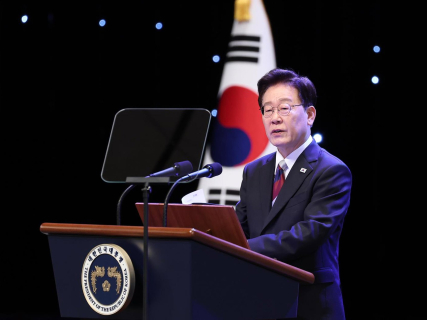

The president of South Korea, Lee Jae Myung, reiterated this Friday that the Armed Forces of the country will not carry out "any troop deployment that involves participating or intervening in a war," referring to the possibility of sending troops to the Strait of Hormuz, as requested by the United States to several of its partners due to the restrictions imposed by Iran on maritime traffic in this strategic enclave.
"We have maintained the principle of not deploying military assets under that modality, and that principle will not change in the future," the head of state pointed out in an appearance at the Blue House, insisting that "there will be no troop deployment that involves participating or intervening in a war," according to statements released by the South Korean news agency Yonhap.
However, Lee emphasized that it is "evident" that Seoul must "carry out, at a minimum, the necessary activities" to safeguard its merchant vessels and oil transport routes, in addition to "the life and safety of our citizens, just as other countries do."
The president also explained that the Government is "examining and deliberating on ways to further strengthen" the deployment of the Cheonghae unit, operational since May in order to "address threats to public safety, such as piracy." In light of the "concern over the idea that it is a deployment to participate or support a war or that combat troops are being sent," he stressed that "this is not a military deployment."
On another note, Lee wanted to "take responsibility" for the entry of South Korean oil tankers and cargo ships into the Red Sea despite the advance of Houthi rebel militias towards the southwestern coast of Yemen, justifying his decision because, when "they did not enter the Red Sea, there were significant disruptions in the supply of crude oil during the early phases of the conflict."
"Giving up crude oil transport due to a low level of risk would be too hard a blow to the economy, so I instructed that the entry into the Red Sea be evaluated. It is a matter for which I must take responsibility," he indicated.
Tehran had already warned South Korea last week of "serious consequences" if it ultimately decided to carry out a military deployment in the Middle East, warning that it would be interpreted as "a direct support to those responsible for the aggression," referring to the United States, after the pressures exerted by Washington on Seoul.
This diplomatic standoff takes place in parallel to the change in tone between Washington and North Korea, evidenced when the U.S. president, Donald Trump, ordered in August the Pentagon to "substantially reduce" military exercises with North Korea, appealing to the "very good relationship" with North Korean leader, Kim Jong Un, and to the priority that, in his opinion, the war in Iran represents, while criticizing Seoul for not supporting his campaign alongside Israel against the Islamic Republic.