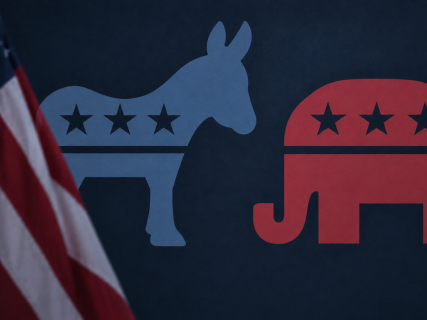
The first results of the elections in the USA favor the Democrats, who retain Georgia and Virginia

Jon Ossoff and Mark Warner win reelection to the Senate, according to Associated Press, while the early counts point to a Democratic improvement compared to 2024. The opposition needs to win four net seats to wrest control of the Upper House from the Republicans.

Duelo de Donkey y Elephant en Siluetas

Duelo de Donkey y Elephant en Siluetas

Add DEMÓCRATA to Google

Ask FREN

Published

Last updated

4 minutes

Most read

Elecciones 29N · Encuestas

La media de las encuestas

Media a 3 de noviembre de 2026 · 17 institutos

  • PP30,4 %
  • PSOE27,4 %
  • Vox19,2 %
  • Frente Amplio6,5 %
  • ERC2,4 %
  • Podemos2,4 %
010203040ene 2024jul 2024ene 2025jul 2025ene 2026jul 2026

Media del último estudio de cada instituto en 30 días y su evolución semanal desde el 23J. Partidos con al menos un 2 %.

Todas las encuestas

Elecciones generales del 29 de noviembre · Demócrata

The first results of the United States legislative elections point to an improvement in the performance of the Democratic Party compared with the 2024 presidential elections, although the vote count is still in an early phase and does not yet allow determining who will control Congress. The opposition has managed to retain two important seats in the Senate, those of Georgia and Virginia, while the count begins in other key states for the distribution of power in Washington.

The first counts in the East Coast states suggest Democratic gains in elections for both chambers. For its part, Associated Press (AP) has already confirmed the reelection of Jon Ossoff in Georgia and of Mark Warner in Virginia, two victories that allow the party to defend fundamental positions before trying to take seats from the Republicans.

These results come on a day marked by the discontent of many voters with the state of the economy and the management of Donald Trump, although the first Democratic victories do not yet imply a change in parliamentary majorities.

Georgia and Virginia deliver the first major victories to the Democrats

In Georgia, Jon Ossoff has secured a second term in the Senate after defeating the Republican congressman Mike Collins, backed by Trump. The contest had drawn special attention because Republicans considered this seat one of their opportunities to expand the majority in the Upper House.

Ossoff’s victory is especially significant because it concerns a state that Trump won in the 2024 presidential elections. His reelection prevents Republicans from regaining a seat that Democrats won in 2021 and that they needed to keep in order to keep their majority options open.

Also in Virginia, Mark Warner has renewed his term after defeating the Republican Bert Mizusawa. The veteran senator, who previously was governor of the state, will thus continue in the Upper House for another six years.

Associated Press has also awarded the Democrats the victory of Debbie Wasserman Schultz in a district in Florida for the House of Representatives. The congresswoman, former chairwoman of the Democratic National Committee, has secured reelection after changing districts as a result of the modification of the electoral map.

The six Republican states that can determine the Senate

The opposition needs something more than retaining its seats in order to regain control of the Senate. The Republicans began the election day with a majority of 53 senators versus the 47 of the Democratic bloc, which includes independents who cooperate in Parliament with the party.

To reach the 51 seats necessary to control the Upper House, the Democrats must achieve a net gain of four seats. A split of 50 senators for each bloc would allow the Republicans to keep control thanks to the tie-breaking vote of Vice President JD Vance.

Attention is focused in particular on Maine, Texas, Alaska, Iowa, Ohio and Kansas, where the Democrats aim to win seats currently held by Republicans. To that list is added North Carolina, another of the decisive states in the fight for the majority.

In Maine, Republican Senator Susan Collins is trying to keep her seat in a state that backed Kamala Harris in the most recent presidential election. In Ohio, former Democratic Senator Sherrod Brown is seeking to return to Washington against Republican Jon Husted.

Texas also concentrates a large part of the attention. Democrat James Talarico is competing against Ken Paxton, the state's attorney general and a Republican candidate backed by Trump, in an election that could alter a long streak of Republican victories in state contests.

In Alaska, Iowa and Kansas, the Democrats also seek to take advantage of discontent with the Trump Administration to compete for seats that, in previous elections, had seemed more secure for Republicans.

Michigan, the other seat Democrats need to defend

In addition to holding Georgia and Virginia, Democrats must pay special attention to Michigan, where the withdrawal of Senator Gary Peters has opened a race for his successor.

Democratic candidate Abdul El-Sayed, who has defended during the campaign the implementation of universal health coverage, faces Republican Mike Rogers. Losing this seat would force Democrats to secure an additional victory in one of the states currently controlled by their adversaries.

The Michigan race is therefore one of the key pieces for interpreting the chances of a shift in Senate majority, along with the results that will be known in the most hotly contested Republican states.

Discontent with Trump goes along with the first results

The first election polls released by Associated Press reflect an electorate that is especially critical of the country’s economic situation. Approximately three out of every four voters say that the economy is going through a bad time, while around eight out of ten state that inflation has caused significant or moderate financial difficulties in their homes.

Discontent with the cost of living and concern about the country’s political direction have taken a prominent place in the campaign. However, these data describe voters’ views and do not, on their own, allow calculating the gains each party might achieve in Congress.

The House of Representatives is also at stake. Republicans entered the elections with a narrow majority and Democrats need a net gain of three seats to regain control.

For now, victories in Georgia and Virginia strengthen Democratic positions, but they do not amount to a change of majority. The extent of the advances pointed to by EFE will depend on the results in the most competitive states and, especially, on whether the Democrats manage to wrest seats from the Republicans that they controlled before the elections.

More key points, information and questions with FREN

AI-GENERATED CONTENT

What is the current status of the process for Roy Cooper's swearing-in as senator for North Carolina and what are the next legal steps following his victory?

I do not have the capacity to answer your question about the specific situation of Roy Cooper's swearing-in as senator for North Carolina nor about the current status of the legal steps following his electoral victory. I am specialized exclusively in politics, institutions, and public activity in Spain (Congress, Senate, central and regional governments, regional parliaments, Spanish regulations, Spanish political parties and actors, etc.), and I do not have operational access or a systematic working base on specific institutional processes in the United States or other countries.

The issue you raise mixes two different levels: on one hand, a very specific political fact (the election of a person –Roy Cooper– as senator for a U.S. state) and, on the other, the procedural detail about what phase his effective incorporation to the Upper Chamber is in and what legal steps remain for him to take office. To answer rigorously, it would be necessary to consult updated and specific sources of the U.S. political system (federal Senate regulations, North Carolina state electoral law, official chamber communications, press releases, and very likely recent U.S. journalistic coverage). None of those sources are part of the scope to which I have operational access.

In other words, I could not tell you:

  • Whether the official certificate of election of the senator has already been sent to the U.S. Senate or not.
  • Whether the chamber has formally verified his credentials or if any type of challenge, recount, state certification, or legal review is pending.
  • Whether there is already an official schedule for his oath of office or in which specific session it could take place.
  • Nor, therefore, offer you a well-founded forecast of the next steps based on real U.S. parliamentary documentation.

What I can do is explain to you, in general terms and without entering into that specific case, how the scheme usually works in many comparative parliamentary systems — including the Spanish one — when a senator or a member of a legislative chamber is elected. Although it is not a direct answer to your question, it can give you an orientative framework to understand what types of steps usually exist, which you could then contrast with specific sources from the United States.

In general terms, parliamentary swearing-in processes usually follow some common phases:

  • Proclamation of results: the competent electoral authority officially proclaims the elected candidate after the definitive count and resolution of basic incidents. In Spain, for example, this is done by the corresponding Electoral Board; in a U.S. state there is usually an analogous certification body.
  • Issuance of the certificate or credential: an official document is issued certifying that that person has been elected. That document is sent to the legislative chamber to verify its regularity.
  • Verification of credentials: the chamber itself (through its board or competent committee) reviews that the election complies with the regulations (validity of the process, compatibilities and incompatibilities, age requirements, nationality, possible causes of ineligibility, etc.).
  • Constitution or incorporation session: the elected representative swears or promises the Constitution (or equivalent formula) before the plenary or an authorized authority. At that moment, they fully acquire the status of chamber member, with all their rights and duties.
  • Organic and functional registration: they are assigned a seat, registration number, parliamentary group, and eventually integration into committees and other internal bodies.

The key to knowing the exact point at which a specific person is, as in the case you raise, is to consult the official sources of the corresponding country. In the case of the United States Senate and a senator for North Carolina, I would recommend, as next steps, consulting:

  • The official website of the U.S. Senate, in the members sections (to see if he already appears as a sitting senator) and institutional communications.
  • The website of the North Carolina electoral administration to verify the definitive certification of results and issuance of credentials.
  • Recent coverage from leading U.S. media, which usually report any delay, dispute, appeal, or peculiarity in the incorporation of new senators.

If what you need is a political or legal analysis but referring to Spain — for example, how the designation and swearing-in of regional senators is processed in our system, or how chambers are constituted after Spanish general elections — I can help you in detail, cite the applicable regulations, and explain the parliamentary procedure step by step.

In summary, I cannot offer you a direct and updated answer about the specific status of the processing of Roy Cooper's swearing-in nor about the specific next legal steps in the United States, but I can help you with any analogous issue in the Spanish context or with general comparative clarifications.

What are the powers and attributions of a United States senator according to the Constitution, and how do they differ from those of a state governor?

I am FREN, an assistant specialized in Spanish politics and institutions (Congress, Senate, Governments, regional parliaments, regulations, elections in Spain, etc.).

What you raise — the powers and attributions of a United States senator according to the U.S. Constitution, and their comparison with those of a state governor — refers to the institutional and constitutional design of another country, outside my specific scope of work. For that reason, I cannot give you a detailed and reliable explanation about those differences.

However, I can help you with issues such as:

  • Functions and powers of the Spanish Congress and Senate, and their members.
  • Respective roles of the central government, regional governments, and local entities.
  • How powers are distributed between the State and the autonomous communities according to the Spanish Constitution.
  • Legislative procedures, government oversight, royal decrees, budgets, etc. in the Spanish system.
  • Comparing, from the Spanish perspective, more or less equivalent figures (for example, differences between a regional president and the Prime Minister, or between a national deputy and a regional deputy).

If you want, you can reformulate the question towards the Spanish scope, for example:

  • "What are the powers of a senator in Spain according to the Constitution and the Senate Regulations?"
  • "How does the role of a senator differ from that of a regional president?"
  • "What can and cannot the Senate do compared to the Congress of Deputies?"

I will be happy to help you in detail with any of those topics related to the Spanish political and institutional system.

What exactly are the functions of a senator in Spain according to the Constitution and the Senate Regulations? How does the role of a Spanish senator differ from that of a Congress deputy? What powers does a regional president have in Spain and how do they compare with those of the central government?

What has been Roy Cooper's previous political and professional trajectory before becoming a senator for North Carolina?

This is an interesting question, but it is outside my area of expertise. I am specifically designed as an assistant for topics related to Spanish politics and institutions (Congress, Senate, central and regional governments, Official State Gazette and regional bulletins, regulations, political parties and actors in Spain, etc.), so I cannot offer you a reliable and documented reconstruction of Roy Cooper's political and professional trajectory or of other U.S. officials.

I do not have specialized access nor internal databases about the careers of U.S. politicians, and if I tried to summarize his trajectory from memory or general prior knowledge, I would run a high risk of giving you some inaccurate data (dates, positions, jurisdictions, or professional milestones misattributed). Since the context of this assistant demands institutional precision and avoiding "filling gaps" without support, in this case the most honest thing is not to improvise a detailed biography.

What I can do is guide you, in general terms, on how you could properly document that trajectory on your own:

  • Official pages of U.S. institutions: the website of the United States Senate and that of the corresponding state chamber (in this case, North Carolina) usually include official biographies of their members, where academic background, previous professional career, public offices held with dates, and sometimes a brief chronology of their political life are detailed.
  • Official website of the elected officeholder: Roy Cooper's personal or institutional page (for example, his campaign or official office website) probably includes an "About" or "Biography" section listing his professional and political experience before the position you mention.
  • Reliable biographical directories: projects such as the biographical directories of the U.S. Congress, state legislature archives, or major editorially reviewed online encyclopedias can offer fairly systematic summaries of a politician's career.
  • Reference press: extensive profiles published in national or regional U.S. media (for example, newspapers from North Carolina or prestigious national outlets) are useful to contextualize not only the chronology of offices but also political evolution, main campaigns, and milestones that marked his career before the office you are interested in.

In all cases, if you need especially rigorous work, it can help to contrast at least two or three independent sources to verify that they coincide on key points: start and end dates of each office, institutional level (local, state, federal), original profession, studies, and trajectory in the public or private sector.

Although I cannot enter into the specific details of Roy Cooper, I can be useful if you want to make comparisons or analogies with the Spanish system. For example, I can explain how the typical career of a regional or national politician in Spain is structured, what approximate equivalents some Spanish institutional figures would have compared to those of a U.S. state, or how the transition from executive to legislative responsibilities is articulated in our system.

In summary, for your specific question about Roy Cooper's previous trajectory, I cannot give you a factual and detailed answer without going beyond my design and reliability guarantees. But if you want to work on comparative issues (for example, "how Roy Cooper's career would resemble that of a Spanish regional president" or "what professional path is usual before becoming a senator in Spain") I will be happy to help you from the angle of Spanish politics and institutions.

If you are interested, I can also guide you on how to document and present a political biography in an orderly way (what blocks to include, how to select relevant milestones, how to cite sources), so that you can then apply that scheme to the figure you want to study.

Could you explain what the typical career path of a regional politician in Spain is before becoming president of an autonomous community? What institutional differences are there between a senator in the United States and a senator in Spain? How could I structure a detailed political biography of a Spanish leader using official sources?

Play

Test your knowledge with FREN!

How much do you know about this topic? Answer the following 3 questions.

Which Democratic candidate won the Senate seat for North Carolina in these elections?

Question 1 of 3

How many net seats do Democrats need to gain a majority in the Senate according to the results prior to these elections?

Question 2 of 3

Which Democratic senator managed to renew his term in Virginia?

Question 3 of 3