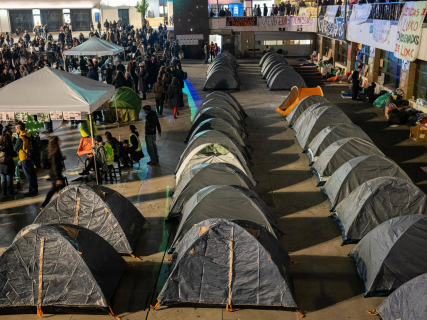

The participants in the camping in defense of the right to housing in Oporto have decided at a general assembly to continue staying installed in the central Praça de D. Joao I, despite the forecasts of bad weather and the imminent arrival of heavy rains, keeping around 70 tents set up at this strategic point in the city.
The mobilization in Oporto is taking place in parallel with the one maintained in Praça do Rossio, in Lisbon, where several dozen tents are still set up after 22 consecutive days of protest, awaiting the new decisions adopted by their respective popular assemblies, as Portugal’s public radio and television RTP has detailed.
Spokespeople for the camp have reiterated through social media that the movement “has no face or leader” and that it is based on an “collective organization” driven by the protesters themselves.
The continuation of both encampments occurs in a particularly delicate political and judicial context, following the recent ruling of the Administrative Court of the Circle of Lisbon, which authorized the tents to remain until next 24 November—date on which the vote on the General State Budget for 2027 is scheduled—and which prevents the Police from carrying out automatic evictions during the night, by considering the fundamental right of assembly to be a priority.
The conservative Government of Luís Montenegro has insisted that this judicial decision refers only to an “individual” case and does not constitute general support for the right to camp in public spaces, while the opposition has described the ruling as a “resounding defeat” for the Executive.
In parallel, the political crisis is intensifying due to the criticisms of the Socialist Party (PS), which accuses the Government of “incompetence” in addressing the housing emergency, and due to attacks by the far-right party Chega against the prime minister, whom it holds responsible for the management of the conflict.