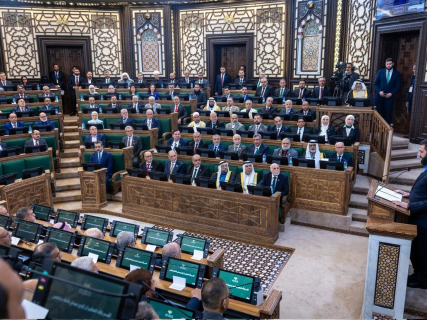

The People's Assembly of Syria, the country's Parliament, held its first meeting this Sunday since President Ahmed al Shara came to power. The Executive has presented the meeting as a democratic milestone after decades of rule by the Al Assad family, while various Syrian political forces have questioned the legitimacy of an institution in which around a third of its 210 seats have been directly appointed by the president himself, a former jihadist leader.
Al Shara himself presided over the opening of the session in Damascus, praising the role of the Chamber and its mission in this political stage. "There is no better way than to reconcile opinions to achieve the common good, and acceptance and satisfaction are crucial to dispel division, reject discord, foster consensus, and ensure sound judgment."
The start of parliamentary work, initially scheduled for the beginning of the week, was postponed due to delays in negotiations for the election of the Speaker of the Chamber and the official visit to the country by the French head of state, Emmanuel Macron. For Al Shara, this act marks "a phase of consolidation of the State and strengthening of its institutions."
The official Syrian agency SANA recalls that the People's Assembly continues to be, in any case, "a transitional constitutional mechanism" in the context of the "exceptional circumstances" the country is experiencing under Al Shara's leadership.
The president has decreed a five-year transition period during which general elections will not be called, at least until 2029. Within this framework, the central function of the current Parliament will be to advance a new constitution and an electoral law that will serve as the basis for future elections.
In this scenario, parties such as the Kurdish Future Party of Syria have expressed their distrust of the Chamber's configuration, which they consider to be far from international democratic standards. In addition to the third of deputies directly elected by Al Shara, the rest of the representatives, mostly Sunnis, were chosen by a college of 6,000 people appointed by the authorities.
"The designation of the third part of the popular deputies by the interim government leader, Ahmed al Shara, is an unusual procedure for the Syrian people. Many political parties considered this procedure to be contrary to the principles of democracy and the representation of the population," the party's communications official, Salé al Zuba, told the Hawar agency in this regard.