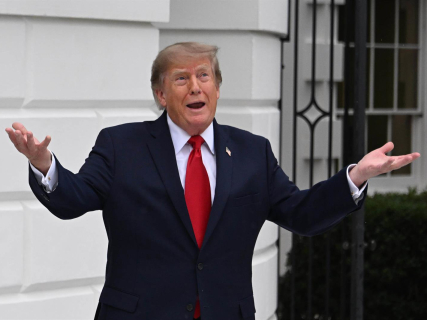

The president of the United States, Donald Trump, has pointed out this Sunday that he considers it “highly unlikely” to order further military actions against Iran as long as negotiations continue regarding the Iranian nuclear program and regarding the possible reopening of the Strait of Hormuz.
“It depends on whether they sign or not a very strong agreement,” Trump said in an interview with the American network CNN. “The answer is that it is highly unlikely that it will be necessary,” he pointed out, a position he repeated as many as five times throughout the conversation.
During the interview, Trump stressed that Iran “is a failed country.” “This year they have had 301% inflation. It is highly unlikely that it will be necessary. We would hit them again very hard if it were necessary. I have hit them very hard. You don’t know how hard I’ve hit them,” he reiterated. “They are devastated financially. We have hit them militarily. We could end them,” he defended.
Even so, he reiterated that the United States maintains in the region the military resources necessary to act if it decides to do so. “We are ready for that. I have three aircraft carriers there. The third one just arrived. We have three. They are fully prepared and loaded,” he emphasized.
Trump detailed that the Pentagon has selected possible infrastructure targets within Iranian territory, such as power plants and bridges. “We have 38 bridges that we could collapse in an hour, literally. They would all fall,” he explained.
Even so, he clarified that his preference is to avoid the destruction of these facilities. “I don’t want to do it because it would take ten years to rebuild them. I don’t like sinking bridges. A bridge is the most difficult thing to build. It takes years. I am a good builder,” he said.
He also stated that Iranian air defenses are practically exhausted. “It is unstoppable because they don’t have anti-aircraft guns. All their anti-aircraft guns are finished,” he assured. According to his data, Iran would retain only 10% of its missiles and 15% of its drones. “Many of their factories no longer exist,” he said. “The most likely thing is that it won’t be necessary. They are very eager to reach an agreement,” he reiterated.