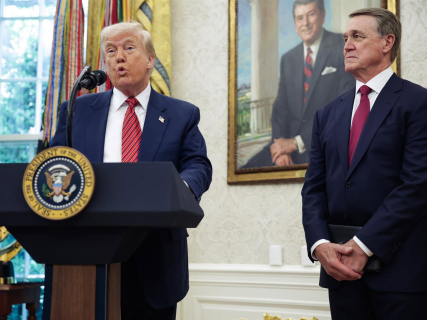

The president of the United States, Donald Trump, rejected this Monday having suggested to his Chinese counterpart, Xi Jinping, the option of selling him weapons, as the U.S. ambassador to China, David Perdue, stated the day before. The president pointed out that "he was probably talking about Taiwan," a territory that Beijing claims as its own and to which Washington supplies arms, although the Trump Administration has blocked since the beginning of the year a weapons package valued in billions.
"I had never heard of that, I will have to ask him," said the occupant of the White House when asked about Perdue's words, insisting that that offer never occurred during his conversations with the Chinese leader.
Trump added that "they (the Chinese authorities) would probably like to buy it," defending that the United States "makes better equipment than they do," so "maybe it's a good idea" for Beijing. "But we didn't discuss it," he reiterated, distancing himself from the version spread by his own ambassador.
In this line, the U.S. president maintained that, "probably," the diplomatic representative in Beijing "was talking about Taiwan," trying to narrow the scope of Perdue's statements.
On the previous day, David Perdue had assured: "President Trump keeps saying: 'Hey, we sell weapons to other people around the world'; in fact, at one point he asked President Xi if he would be interested in buying some." However, a State Department official indicated to Europa Press that "there is no offer or plan to sell weapons" to China and emphasized that "U.S. legislation prohibits the sale of weapons" to Beijing.
The exchanged words occur at a delicate moment in relations between China and the United States, after both powers have agreed to create a new framework for trade dialogue. This mechanism is aimed at analyzing possible mutual tariff restrictions on certain products for an amount close to 30 billion dollars (about 25.5 billion euros) for each country, according to the terms of reference of the newly constituted Bilateral Trade Board.
At the same time, the U.S. government —which has been legally required since 1979 to supply defensive weapons to Taiwan— is suspending a weapons sale operation to the island for 14 billion dollars (12.295 billion euros). Trump himself had already acknowledged in May that he was holding back these shipments because he considered them a "very good negotiating chip" in the diplomatic standoff with China.