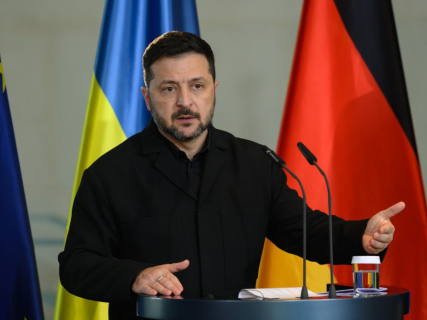










The president of Ukraine, Volodimir Zelenski, underlined this Tuesday that his meeting with the Hungarian prime minister, Péter Magyar, in the Transcarpathia region concluded with “positive results,” and he specified that understandings were reached on the political level, as well as in the fields of energy and infrastructure.
“A visit that will undoubtedly bring positive results,” Zelenski highlighted, who shared on his social media several photographs of the meeting and of the tribute that both leaders paid to the fallen Ukrainian soldiers in Úzhgorod, the capital of Transcarpathia, a territory where a large community of Hungarian origin resides.
“Our ability to live in a free country, and the security of our neighbors and of all Europe, has an enormous price—one that Ukraine pays every day. It is our duty to remember everyone who gave their life in this struggle,” the Ukrainian leader praised.
It is the first time since 2015 that a Hungarian head of government has traveled to this historic area of Ukraine, something that has been highlighted on social media by Magyar himself, who had already been in the region in 2024 when he was still serving as leader of the opposition.
The prime minister has said that, in addition to the meeting with Zelenski, he will maintain contacts with local representatives and with Hungarian institutions established in Transcarpathia. “I carry a message of solidarity and support from our side to the neighboring country, which has been under attack for almost five years,” Magyar recalled.
Before the bilateral meeting, Zelenski spoke at a congress of local and regional authorities held in Úzhgorod, where he pointed to the weight of this visit in channeling and normalizing ties with Hungary with a view to Ukraine’s accession aspirations to the European Union.
“We are doing everything necessary to open paths in the negotiations on Ukraine’s accession to the European Union (...) We often do more than other countries that joined the EU. And we are also doing everything necessary to draw closer to and strengthen relations with our neighbors,” the president said.
Tensions between Kiev and Budapest continue to focus on the situation of the Hungarian minority in Transcarpathia, estimated at around 150,000 people, and on their linguistic and educational rights. The more restrictive Ukrainian regulations led, for years, the then prime minister Viktor Orbán to halt Ukraine’s steps toward European rapprochement.
The arrival of Magyar to power has opened a new phase after the prolonged struggle with Orbán, aggravated by his closeness to Russian President Vladimir Putin. Nevertheless, the current prime minister has made any progress conditional on the full respect of the rights of the Hungarian community and the restoration of those rights that were limited by the laws of 2017 and 2019.
In October of this year, the Ukrainian Parliament gave the green light to a reform that grants a special status to educational centers where more than half of the student body studies in an official EU language, such as Hungarian. This legislative change allowed Budapest to lift the veto it had maintained over the opening of formal negotiations for Kiev’s accession to the community bloc.