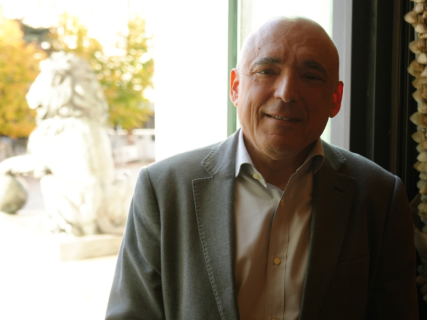

Just a few days before the rendezvous with the ballot boxes this 29N, Rafael Simancas, Secretary of State for Relations with the Cortes and Constitutional Affairs, a deputy for Madrid and number 7 on the lists of the PSOE to the capital, goes to his own in full form and with possibilities of making a comeback. In an interview with DEMÓCRATA, he questions the polls and believes in the ability to weave again a parliamentary majority in order to reissue a Government.
In addition, he goes after the strategy of delegitimizing the institutions of PP and Vox, even lamenting that they want to "destroy" the Prime Minister, Pedro Sánchez; and he warns against the "dangers" of retreating on rights: "I cannot normalize that Feijóo opens the possibility for the far right to be back in the government of this country".
QUESTION: 29N is approaching in an inexorable manner and the polls are smiling at the right, although until the count, one never knows. Precisely for that reason I want to ask you: What has to happen for the PSOE to turn around what the polls indicate? What horizon does it expect and how could they reissue an Executive? How do they intend to mobilize?
RESPONSE: Let's talk about polls. On November 29, no elections are held; in reality they are 52 elections in 52 constituencies. A large part of the polls that are being published have between 1,000 and 2,000 interviews, so we would be talking about between 20 and 40 interviews per constituency. In the big constituencies they do more interviews, which means that in some they do none. Estimating results in the Congress seat by seat with those backgrounds is more of a bet than a poll.
Poll is the CIS, which says what I think is going to happen: a victory for the PSOE and a left-wing Government.
How are we mobilizing? With joy. Because ours is about moving forward, about building. Our adversaries' thing is about destroying, about repealing. What is Feijóo telling in this campaign? That they want to repeal everything: the Euthanasia Law, the Memory Law, labor reform, the Trans Law… Even the Rules of Congress that allow the use of co-official languages. We move forward, Feijóo repeals. We only have to tell the truth in order to mobilize our electorate.
P: I want to read you some measures they carry in their electoral program: universal benefit for a child, reinforcement of the time-recording register, luxury tax, voting at 16… These are just some of their electoral promises, but so far, they have blocked them despite Sumar’s push. What guarantees does the PSOE give that they will be fulfilled if they reissue a Government?
R: The guarantee of what we have done over the last three and a half years. In this time, 89 rules with the rank of law have been approved in this House. It may be a lot or a little. How many laws on average have regional parliaments with an absolute majority pushed through? Half. With the three decrees that we will ratify this week, we will be above 90, and they are not minor laws: the Amnesty Law, the one that guarantees parity, the Law on care for ELA patients, the one that regulates the work of firefighters and forest agents, the Law on Sustainable Mobility, the one on Efficiency in the public service of Justice… Of course there are laws that we still have not pushed through; it’s just that you have to manage the timelines.
You speak to me about some initiatives that we have in the program and that we will push through during the next legislature. For that, we are asking for a broad and sufficient majority. With this complex, difficult majority, which only the PSOE is capable of bringing together because the PP only knows how to agree with Vox, we have pushed many initiatives through. And we are convinced that the next legislature, with a broader majority—which is what our president [Pedro Sánchez] is asking for—we will do it with even better prospects.
P: From the right and the far right, it has been stirring up a story for some time that this Government has not governed fairly due to a lack of majorities.
R: In this country, the right has institutional power and extraordinary media power. They try to condition the narratives, but we trust the intelligence of the ordinary citizens, the intelligence of the electorate, because they are aware of the progress that has been made in this term of office. The data are there: the SMI has been increased and not a little, by 75%, pensions have been updated in line with the CPI, work contracts have been stabilized… In short, initiatives have been carried out with reach and depth, and they have to be assessed by the citizens.
P: You have mentioned the “next term of office” several times. If the PSOE again arranges a parliamentary majority to govern, do you think something should be changed in the way of negotiating with the partners? You have been there, haven’t you felt that everything has sometimes been very last-minute?
R: It is not easy to build majorities that involve more than 20 political forces across eight or nine parliamentary groups, but it is worth it. The results are there and, I insist, only the PSOE is historically capable of those cross-cutting alliances, from the most combative left to the most moderate, passing through nationalisms and absolute secessionisms.
And I don’t want to focus only on the fact of the sum of support, but on what for. I am talking about what we have called shared prosperity, that is, growing while sharing, which is what this Government has achieved. With one of Europe’s most advanced social programs, we have managed to lead growth in GDP. They say, “that’s just macroeconomics, it doesn’t count”… I can imagine what some headlines would say if macroeconomics were bad.
A second vector is the modernization of the country through three elements: the ecological transition, the digital transition, and equality between women and men. And I also speak of progress in rights and freedoms; combating hatred, protecting groups that have historically been discriminated against, to improve transparency and the functioning of democratic institutions.
P: This scenario, if the PSOE manages to keep the Moncloa. If not, I’m interested in knowing how the opposition would take it, how they would behave in Congress and the Senate. Would they negotiate and fight over amendments, or would they prefer not to enter into negotiations with the PP?
R: The democratic game has rules, and they are breaking them. That’s why we say this is not a normal campaign or standard elections. It’s not just that we contrast certain candidates and programs; we’re talking about models of democracy, of society, of coexistence, of life in common.
Previously, in campaigns, what the Government had done was valued and whether there was a better alternative; now the Government is branded as illegitimate, as criminal, as mafioso. Previously, you would discuss with the unions whether wages should be raised; now it’s said they are cowed and they are gluttons, and that they have to be outlawed. Previously, filmmakers and comedians or critics had their proposals accepted better or worse; now they are censored and told, 'good luck, because you’re going to need it'.
This is not a standard situation. We are deciding whether to move forward in terms of democratic quality, of citizenship rights, or whether to go back—going back a long time, 50 years back. That’s why I trust in extraordinary participation in these elections, and everything indicates that it will be so.
P: You’ve opened an interesting subject: how the credibility of institutions is eroded little by little. You have accused the Partido Popular of a partisan use of the Senate and regret that, together with Vox, they raise the ghost of doubts about the electoral process. What is the cost of all this for public institutions—can it be restored?
R: There has been an undeniable harm to the prestige and credibility of democratic institutions. The spurious use that has been made of the Senate, or all the control sessions in this house [Congreso], in which they have talked about sanchismo or antisanchismo. Listen, this isn’t what interests people.
The strategy of PP and Vox has been more focused on socially destroying, even delegitimizing—on a personal level—Pedro Sánchez, than on criticizing his policies specifically. They have no alternative, and they try to conceal it with a strategy of destroying the political adversary. It is harmful to democracy. Criticize what Sánchez does, propose an alternative, but don’t destroy the institution.
Why do I think they are trying to destroy Pedro Sánchez and they won’t manage it? Because he is demonstrating a series of realities that they can’t stand: that taxes can be raised on the most powerful and the economy can be made to grow; that wages can be increased and a great deal of stable employment can be created; that renewable energy can be backed and the electricity bill can be brought down. And this destroys the “motosierra” narrative.
You don’t need a “motosierra” to create jobs or to grow GDP and reduce debt and the deficit. The “motosierra” doesn’t work, it’s no use, and Sánchez is proving it with facts; that’s why they’re trying to destroy him.
P: Speaking of the chainsaw. In DEMÓCRATA we published an interview with the candidate of Democracia21, Miriam González, in which she said that we had to cut 90% of the political advisers. PP and Vox talk a lot too about wasteful spending, although then when they get to government they don’t reduce it and even increase the number of advisers. Do you think it should be standardized somehow, or is there a need to educate people about this?
R: It’s simple demagoguery. In a debate on Justice at the Bar Association of Madrid not long ago, Vox proposed that subsidies to political parties should be abolished and that this money be used to speed up the administration of Justice. I told them: Are you going to give up the subsidy for the current election campaign? No?
This is demagoguery for supporters of the minimum government and the minimum state, which is a legitimate ideological option. A small state in which each person looks out for themselves. I believe in a fair, equitable society that addresses needs and guarantees a dignified life for the most vulnerable families.
I believe in a supportive society, but I understand that there are those who prefer that each person is worth what they can pay, and the ones who can’t, to the ditch. Pensions? The ones each person looks for in private funds. Wages? Have them negotiate with their employer, or in Health and Education, which bet on what you can pay for or what you’ve inherited. That isn’t my model. Our model is a supportive society that collects taxes from those who can pay them—those who earn more and have more—and with that we build a fairer society.
P: You have mentioned before the reform of the Standing Orders of Congress. Do you think it should be reviewed to avoid extensions of time sine die, limiting intrusive amendments, etc.?
R: There is also a lot of demagoguery regarding the time limits for amendments and what they call intrusive amendments. The Bureau has held the competence forever, also under the governments of the Partido Popular, to plan and manage the pace of the legislative work of Congress. You cannot load all the committees with all the laws at once. The drafting of a law, especially with parliamentary fragmentation as complex as this, requires dedication; and the Bureau manages the schedules so that each committee drafts laws according to its capacities. This is what has been done in this legislature and always, also when the PP was in government.
As for intrusive amendments, that is another fallacy. It has always happened that in a law about a particular matter, suddenly, it seems reasonable to incorporate an additional provision that modifies another law on a topic more or less closely related that results in general interest. What is the guarantee that the general interest is taken into account? That it has majority support among the representatives of the citizens. If the amendment is so intrusive that it is inconvenient, the representatives of the citizens are not going to vote for it. That is the best guarantee.
Yes, I have to reproach that a reform of the Standing Orders that was very advanced has been left us with the task pending, and that PP, Vox and Junts blocked: the so-called lobbies.
Citizens have the right to know who calls whom, who proposes what, who says yes or who says no. In a rise in taxes for energy companies, in the stabilization of labor contracts: who says no? Who talks to whom? Who sends the proposal and who applies pressure? Transparency must be provided. Interest groups have interesting functions; they are permissible and legitimate insofar as they are transparent. That everyone knows that such-and-such a company has spoken with such-and-such a parliamentary group and has proposed such-and-such, exercising its democratic and independent powers. We want people to know the legislative footprint, to know how the laws were made, who has influenced and who has said yes or no. PP, Vox and Junts blocked the reform, but we are going to keep fighting for it.
P: Because of how the PP talks, it seems far away to me that they will sit down to negotiate anything, but, do you think that on the horizon we will be able to see the popular and the socialists again making pacts or are the blocs irreconcilable?
R: It’s that the PP has adopted a drift that makes understanding impossible. I can’t normalize it opening the possibility that the far right could be back in the government of this country. The last time, in Spain, death sentences were signed and people were jailed based on what they thought; and women needed their husbands’ authorization to open a bank account. These people are a danger and I don’t want to dramatize, it’s not talking about fear, it’s telling the truth. It’s that Figaredo has said he wants a mixed pensions system, which is what has been applied in Paraguay and whose model Vox wants and has broken, leaving millions of Paraguayan retirees without a pension.
They are a danger because they don’t believe in climate change, which is causing droughts, flooding, mega fires… It’s that they don’t believe that gender violence exists, so how are you going to protect women? I repeat, they are a danger, which is why it is very difficult to come to terms with this PP.
P: To wrap up this conversation, you run for Madrid, a key constituency because it distributes 38 seats, the most. What must the PSOE do to regain ground in the region? And I ask you also with an eye on the May 2027 regional elections.
R: Polls show a certain balance in Madrid and I’m convinced that, on this occasion, the PSOE will lead the result of the general elections, which will be a decisive and very important step to recover the Government of the Community. We talked earlier about the government of minimums, and that is Ayuso in the Community of Madrid: that whoever can pay, it goes ahead, that Sanity be provided for whoever can afford it, whoever wants a residence for their parents or mothers and that they are not abandoned in a pandemic, that it gets paid. That, if you have 7 million euros for a penthouse in Chamberí, fine, and if not, to suffer because her housing policy is nothing.
The vast majority of people in Madrid are already realizing the duplicitous strategy of Mrs. Ayuso, which is to say outrageous things every day so that people won’t talk about what’s important. It worked for a while, but the game is already over. They are going to lose the elections on 29N and they are going to lose them in May.