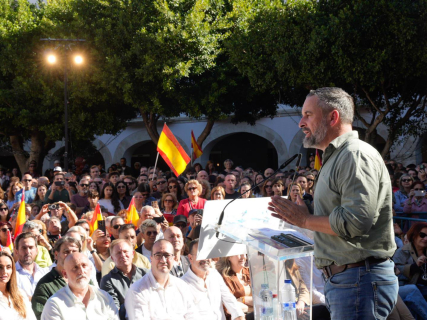

The president of Vox and candidate for the presidency of the Government, Santiago Abascal, has warned that, ahead of the general elections on 29 November next, his party does not have “a greater enemy than the polls at this moment”, which in his view generate dangerous confidence despite opening up the possibility of political change. For this reason, he has called for a “gigantic mobilization” to oust from power “the mafia of Sánchez”.
“There is no worse enemy than confidence. There is no worse enemy than sloth. There is no worse enemy than the idea of taking for granted that Sánchez has no options, when Sánchez is willing to do anything to stay in power,” he said in Almería, at his first campaign rally in Andalusia ahead of the general elections.
Before a packed Plaza de la Constitución, Abascal emphasized the exceptional importance of the appointment on 29 November, insisting that it is not “just another election”. “We are risking everything and we can say without any fear of exaggerating that it is now or never,” he stressed, asking citizens not to be carried away by self-satisfaction despite favorable polling.
Vox leader has attributed the decided election snap to a strictly personal calculation, linked to the ongoing judicial investigations. “They know what is coming for them,” he said, referring to investigations into the alleged illegal financing of the PSOE, the increase in “opaque” accounts within the party, and the recent police and judicial actions that affect the Ministry of Equality and the Court of Auditors.
Criticism of the “corrupt and treacherous mafia”
Abascal described the central Government as “a lying mafia that has lied to its own members, to its own voters and to all Spaniards” in relation to its agreements with Bildu, the nationalists and the communists, as well as regarding the amnesty law and the pardons. He added that it is “a corrupt mafia all the way to the chauffeur”, citing the cases of Ábalos, Koldo and Cerdán.
In the same way, he has branded the Executive as a “traitor” for “selling national sovereignty to the highest bidder” in order to retain power and for having “handed over the national interest to Morocco.” Along these lines, he has argued that “Pedro Sánchez Castejón is Morocco’s candidate in the general elections,” and he has reproached the absence of a firm defense of the borders of Ceuta and Melilla, criticizing that the Government chose to open a diplomatic conflict with Italy rather than with the Alaouite kingdom.
The Vox leader has also accused the Executive of “destroying everything public” during the legislature, citing the deterioration of the rail network, the roads, the education system, and public healthcare. As he has denounced it, the latter suffers collapses and long waiting lists while “patients are imported” and “doctors and nurses are exported” trained in Spain, all of this in a context of “unbearable fiscal suffocation” for the middle classes and workers.
“National urgency” program
As a response, Abascal has presented a “national urgency” plan based on three pillars: national priority, economic deregulation, and remigration. He has defended that Spaniards must enjoy “priority in accessing social benefits, rent aid, and nursery places.”
He has assured that “national priority today is to recover Ceuta first so that national dignity can be restored” and has reproached the PP leader, Alberto Núñez Feijóo, for rejecting this proposal because he considers it illegal. “We present ourselves in the elections to make legal what today they tell us is illegal,” he stressed.
In the area of deregulation, he has proposed suppressing the “ideological” rules which, according to him, suffocate the countryside, industry, and commerce, and which he attributes to “green fanaticisms,” the Agenda 2030, and gender ideologies “promoted jointly in Brussels by the PSOE and the PP.” He has criticized that the difficulty many families have in making ends meet is ignored while concepts such as the “deconstruction of masculinity” are disseminated.
“I think that masculinity is positive, just as femininity is,” he said, relating that he refused to address this issue in a television interview and that he suggested to the presenter that, if he wanted, he “deconstruct” his own masculinity.
As for “remigration,” Abascal has explained that it involves that “those who don’t have to be here have to leave, collecting social welfare without working, criminals and illegal immigrants,” but it also considers facilitating the return of young Spanish people who were forced to leave abroad due to lack of opportunities.
Distance from the PP and call for the vote
During his speech, Abascal marked differences with the PP, which he accused of backing policies of “tax abuse” and “migratory invasion” together with the socialists in the European sphere. Likewise, he denounced the “unfair competition” that the Almería countryside is enduring due to the entry of foreign products which, he said, do not meet the same phytosanitary and labor requirements that are imposed on local farmers.
For this reason, he called for a direct vote for Vox from those who share his proposals of common sense, national priority, and remigration, and he suggested with irony that those who prefer to keep high levels of tax pressure or reject these measures should opt for the PP. “If you want to vote for common sense, national priority, remigration and deregulation, vote for Vox,” he concluded.
In the final stretch of his address, Abascal appealed to “concord” among all Spaniards, regardless of their previous ideology. He closed his speech by calling on his supporters to carry out a “giant mobilization” until November 29 to convince the undecided and to overcome any attempt at “trickery, violence or intimidation.”
Other interventions at Vox’s event
Before Abascal, the second deputy vice president of Vox in the Junta de Andalucía, Manuel Gavira, and the candidate for Congress Rocío de Meer took the floor, who agreed on the need to apply “national priority” to curb the “degradation” of working-class neighborhoods, reinforce security against crime and illegal immigration, and “recover common sense” in the Government of Spain.
Gavira emphasized that Vox’s goal is not to accumulate regional posts, but “to reach the Government of Spain, end red socialism, end blue socialism and, of course, always put Spaniards first.” In his view, on November 29, citizens are deciding whether they will have “the president we deserve,” pointing to Santiago Abascal over the popular candidate, Alberto Núñez Feijóo.
For Gavira, restoring common sense and national dignity requires “recovering Ceuta, defending our borders,” also citing Melilla, El Hierro and the Canary Islands, as well as “protecting our women” and shielding the province of Almería against drug trafficking.
For her part, the national deputy Rocío de Meer focused much of her speech on denouncing the loss of security and the transformation of the humble neighborhoods of the province, recounting the case of an elderly neighbor named Antonia, a resident of the neighborhood of 'Las 200' and, as she explained, is “the last Spaniard in her block.”
“We want our neighborhoods back, our families back, the tranquility, the prosperity, the peace of our elders and housing back; but, above all, we want Spain back,” De Meer proclaimed to the attendees.